



Key Takeaways
- BitMEX co-founder Arthur Hayes forecasts Bitcoin reaching $126,000 in 2025
- The prediction ties BTC’s upward trajectory to artificial intelligence infrastructure investment, military conflict with Iran, and worldwide monetary expansion
- According to Hayes, Bitcoin established its bottom at $60,000 earlier in 2025 and has already surpassed gold in performance
- The $90,000 threshold represents a critical point where Hayes anticipates rapid price acceleration
- Maelstrom fund is adopting a “maximum risk” strategy with positions in HYPE, ZEC, and NEAR tokens
Arthur Hayes, who co-founded BitMEX and currently serves as chief investment officer at cryptocurrency investment firm Maelstrom, released a detailed analysis on May 12 declaring that Bitcoin’s bullish cycle has officially commenced.
In his essay titled “The Butterfly Touch,” Hayes presented a thesis centered on three converging macroeconomic dynamics — government expenditure on AI infrastructure, the United States-Iran military engagement, and international movement away from dollar-denominated holdings — which collectively compel governments toward expansionary monetary frameworks and increased currency creation.
“The bullish cycle kicked off in full force when the United States launched attacks against Iran on February 28th,” Hayes stated in his analysis.
Bitcoin has fluctuated within a range of $79,467 to $82,496 throughout the last week, based on CoinGecko data. The cryptocurrency was valued near $81,000 on Wednesday, representing an increase exceeding 31% from its February 6 floor of $62,822.
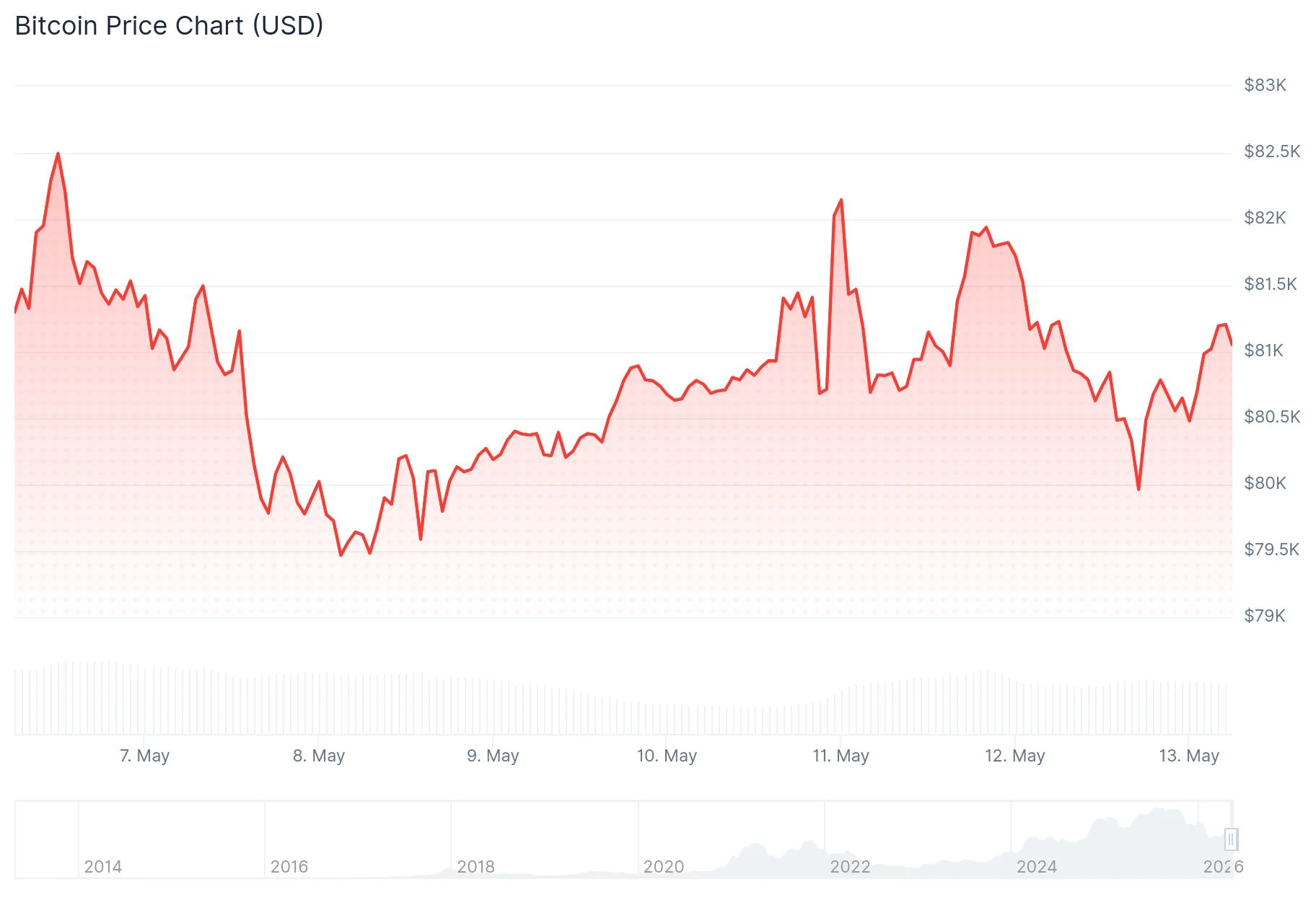
Hayes contends this recent superior performance relative to gold — which appreciated approximately 2% during the identical timeframe — demonstrates Bitcoin’s heightened responsiveness to evolving political dynamics surrounding monetary creation.

Artificial Intelligence Competition Viewed as Driver of Currency Expansion
Hayes positioned AI as a critical national security imperative for both the United States and China. Given this strategic importance, he contends that neither nation can implement restrictive monetary policies while its rival pursues aggressive AI investment strategies in infrastructure development.
He observed that AI capital allocation is penetrating the credit system, compelling financial institutions and central banks to facilitate financing for data centers, electrical grids, and computational resources. Hayes referenced the Jevons Paradox alongside the “Red Queen Effect” to support his argument that AI expenditure creates a self-perpetuating cycle — reduced costs for intelligence generate increased demand, necessitating additional capital investment.
“The quantity of fiat currency units tomorrow will vastly exceed today’s supply, with the rate of expansion accelerating due to rapidly escalating annual AI and electrification capital expenditure commitments,” Hayes explained.
$90,000 Identified as Critical Resistance Point
Hayes maintains Bitcoin established its cyclical low at $60,000 earlier this year and designated $126,000 as his price objective, characterizing it as an inevitable outcome.
He highlighted $90,000 as a significant threshold where options market dynamics could trigger forced buying from call option sellers, potentially catalyzing rapid upward momentum.
“I anticipate the rally will gain intensity and skeptics will retreat as Bitcoin’s price movement becomes explosive following a decisive break above $90,000,” Hayes projected.
He confirmed that Maelstrom would adopt a “maximum risk” portfolio allocation unless fundamental conditions shift substantially.
Hayes additionally suggested that nations previously holding US Treasury securities may reallocate resources toward defense capabilities, energy systems, and tangible infrastructure projects — providing US authorities with justification to maintain accommodative financial conditions. He referenced potential dollar swap facilities and relaxed banking capital requirements as prospective policy instruments.
Hayes concluded his analysis by disclosing Hyperliquid’s HYPE token and Zcash’s ZEC as substantial current holdings, while identifying NEAR as his subsequent preferred investment opportunity.
