


Key Highlights
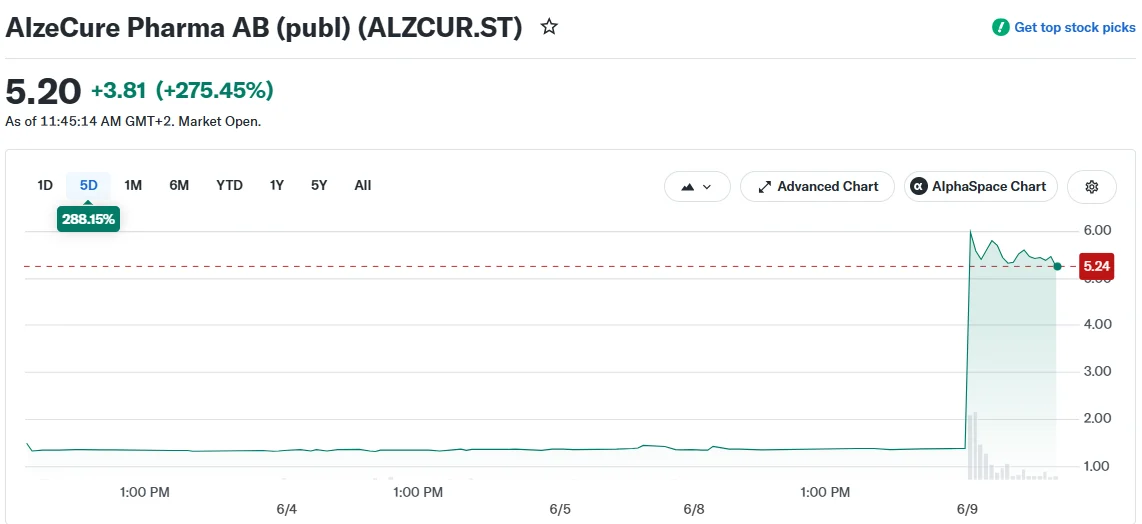
- AlzeCure Pharma stock skyrocketed more than 301% following the announcement of a licensing partnership with Eli Lilly for Alzheimer’s candidate Alzstatin ACD680
- The agreement’s total potential value surpasses $1 billion, not including royalty arrangements
- AlzeCure secures $10 million initial payment alongside developmental and sales-based milestone opportunities
- Eli Lilly obtains worldwide rights to ACD680, a gamma-secretase modulator designed to reduce toxic amyloid-beta accumulation
- The agreement awaits clearance from Swedish regulatory bodies under foreign investment oversight laws
Shares of AlzeCure Pharma exploded more than 301% during Tuesday’s trading session following the Swedish biotechnology firm’s disclosure of a significant licensing partnership with Eli Lilly centered on its Alzheimer’s disease treatment candidate, Alzstatin ACD680.
The partnership transfers worldwide development and commercialization rights for ACD680 to Eli Lilly, with the compound currently undergoing preclinical evaluation. The total transaction value, excluding royalty streams, could surpass $1 billion.
AlzeCure stands to collect a $10 million initial payment immediately. Beyond this upfront compensation, the Swedish company will be eligible for additional payments linked to developmental progress and commercial achievements, alongside tiered mid-single digit percentage royalties on eventual product revenues.
Alzstatin ACD680 functions as a gamma-secretase modulator. Put simply, the therapeutic candidate aims to decrease the generation of amyloid-beta 42, a destructive protein that accumulates as plaques within the brains of individuals suffering from Alzheimer’s disease.

The drug candidate simultaneously aims to increase the generation of shorter, non-toxic amyloid proteins — specifically Aβ37 and Aβ38 — which potentially counteract the accumulation of the harmful variant.
CEO Martin Jönsson described the partnership as “an important milestone for AlzeCure and Alzstatin.” He suggested that these compounds might eventually contribute to preventing Alzheimer’s disease entirely.
Distinguishing Features of ACD680
Chief Scientific Officer Johan Sandin emphasized that the Alzstatin platform generates small-molecule therapeutics. This distinction carries significance because small molecules generally offer simpler manufacturing processes and more convenient administration routes compared to larger biologic medications.
Sandin additionally highlighted the mechanism’s robust genetic connection to Alzheimer’s pathology, which provides the scientific approach with stronger validation.
While the gamma-secretase modulator strategy has experienced challenges throughout pharmaceutical development history, the genetic evidence supporting Alzstatin’s structural design differentiates it from previous unsuccessful programs.
Eli Lilly’s Strategic Position
Eli Lilly maintains a prominent position among companies pursuing Alzheimer’s treatments. The pharmaceutical giant’s currently marketed treatment Kisunla also addresses amyloid plaques, making the acquisition of a preclinical small-molecule option a logical extension of its portfolio approach.
For AlzeCure, this partnership represents recognition of extensive research efforts on a scientific platform that has maintained relatively low visibility beyond Swedish borders.
The transaction remains subject to regulatory review. Swedish government agencies must grant authorization under foreign investment oversight protocols before finalization can occur.
AlzeCure maintains its listing on Nasdaq First North Premier Growth Market. Eli Lilly stock climbed approximately 1.57% following the announcement.
The $10 million upfront compensation provides AlzeCure with immediate financial resources. Development and commercial milestone payments could substantially increase total proceeds if ACD680 successfully progresses through human clinical testing phases.
