



Key Takeaways
- Iran has implemented a $1-per-barrel Bitcoin fee for vessels transiting the Strait of Hormuz
- Matt Hougan, Bitwise’s CIO, believes this development could propel Bitcoin toward $1 million per token
- Since airstrikes by the US and Israel on Iran commenced February 28, Bitcoin has surged 12%
- Market observers argue Iran’s decision validates Bitcoin for global trade applications
- Bitcoin’s potential market opportunity may now surpass gold’s $33.7 trillion valuation
Iran has declared that vessels navigating through the Strait of Hormuz must pay a $1-per-barrel fee — exclusively in Bitcoin.
This groundbreaking policy, initially disclosed by the Financial Times, represents the inaugural instance of a sovereign state formally embracing Bitcoin for international transaction settlements.
The Strait of Hormuz represents a critical artery for global energy transport. Prior to escalating tensions, approximately 20% of the world’s liquid petroleum products traversed this waterway.
Following Washington’s recent blockade of the strait designed to economically isolate Iran, Tehran’s Bitcoin toll emerges as a strategic countermeasure to circumvent traditional financial pressure.

Bitcoin is presently valued near $74,500, commanding a market capitalization approaching $1.4 trillion, per CoinGecko data. Meanwhile, gold trades at $4,854 per ounce with a total market cap exceeding $33.7 trillion.
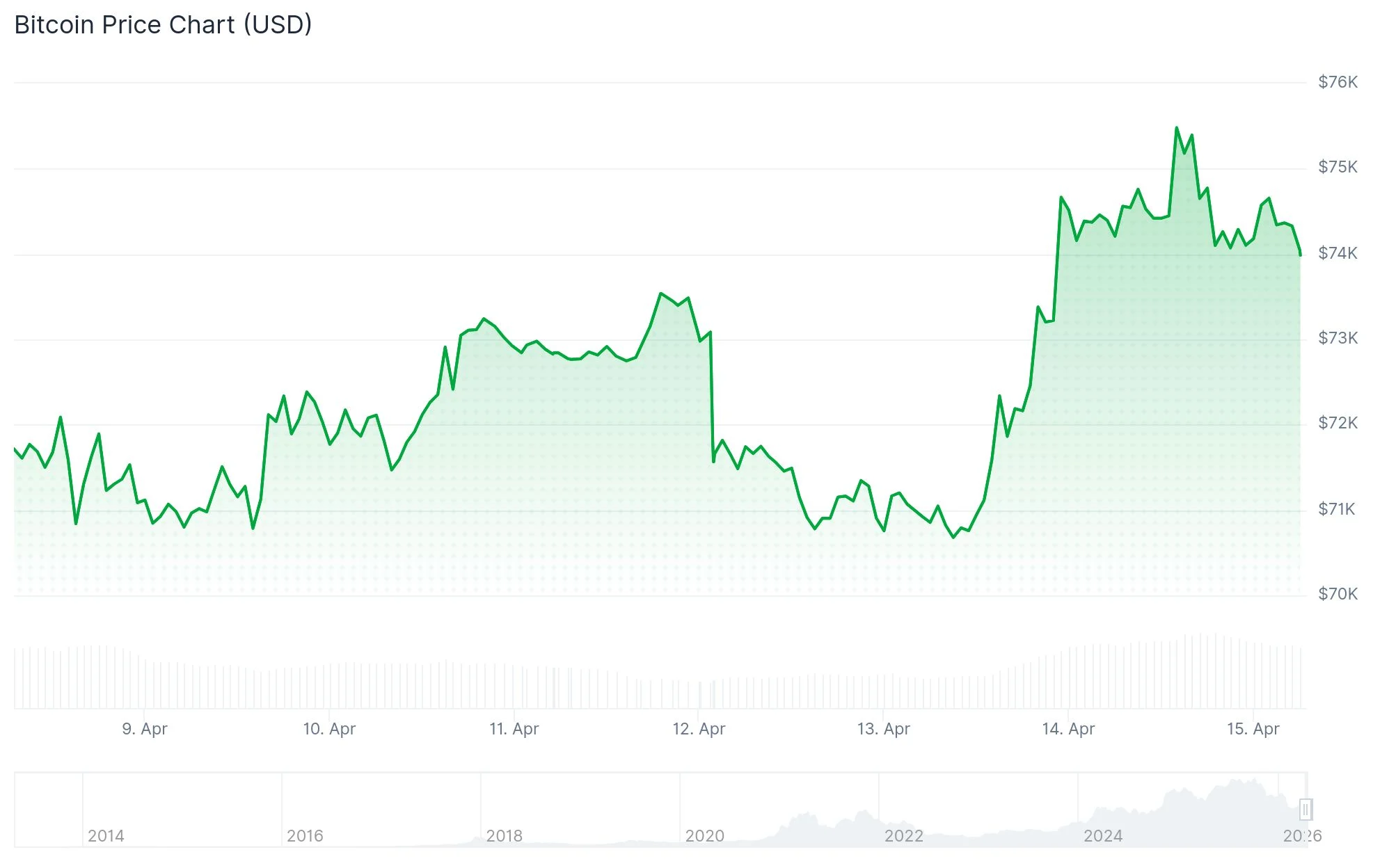
Bitcoin has climbed 12% since military strikes against Iran by US and Israeli forces launched on February 28. During the identical timeframe, the S&P 500 declined 1% while gold tumbled 10%.
Bitcoin’s Emerging Dual Functionality as Money and Asset
Matt Hougan, who serves as Bitwise’s chief investment officer, contends that Iran’s unprecedented action fundamentally alters the framework for assessing Bitcoin’s total addressable market.
Historically, Bitcoin has primarily been evaluated against gold as a wealth preservation vehicle. Hougan’s earlier projections suggested that Bitcoin capturing merely 17% of the $38 trillion store-of-value sector could drive prices to $1 million per coin.
However, Iran’s toll policy demonstrates Bitcoin’s viability as a medium of exchange for international commerce. This dual-purpose functionality could expand its addressable market dramatically beyond gold’s territory.
“Should Bitcoin begin fulfilling a combined role as both a value preservation mechanism, similar to gold, and a functional currency, comparable to the dollar, we may need to substantially revise our price projections upward,” Hougan stated.
The London Crypto Club characterized this development as a significant expansion of the “Overton Window” — the spectrum of politically acceptable concepts. Market analysts drew comparisons to Russia’s 2022 SWIFT expulsion, which catalyzed widespread central bank gold accumulation globally.
Bitcoin Adoption Accelerating Across Multiple Fronts
Bitcoin uptake has been accelerating beyond geopolitical applications. Populations in Argentina, Turkey, and Venezuela have increasingly adopted Bitcoin as protection against hyperinflation and domestic currency devaluation.
Coinbase research from January revealed that 87% of Argentine respondents believe cryptocurrency could strengthen their financial autonomy.
Regarding institutional adoption, BitBo data shows that public and private enterprises collectively possess over 1.5 million Bitcoin, representing more than $116 billion in aggregate value.
Approximately 11,000 businesses globally now process Bitcoin payments, according to research published by Springer Nature utilizing BTC Map statistics.
Iran’s toll policy continues to remain operational this week, with no signals suggesting reversal or renegotiation of the terms.
