



Key Highlights
- Brent crude climbed toward $110 per barrel while WTI reached $96 amid escalating Middle East tensions.
- President Trump pushed back the deadline for potential strikes on Iranian energy sites to April 6, citing diplomatic progress.
- Tehran officially rejected claims of ongoing negotiations with Washington.
- Approximately 8 million barrels daily remain unavailable due to the Strait of Hormuz blockade.
- Macquarie forecasts potential crude prices of $200 per barrel if the crisis extends beyond June.
Global crude markets are experiencing significant upward pressure as geopolitical turmoil involving the United States, Israel, and Iran disrupts worldwide energy distribution networks. Brent crude advanced nearly 2% to settle at $109.92 per barrel during Friday trading sessions. Meanwhile, U.S. West Texas Intermediate climbed to $96.08.
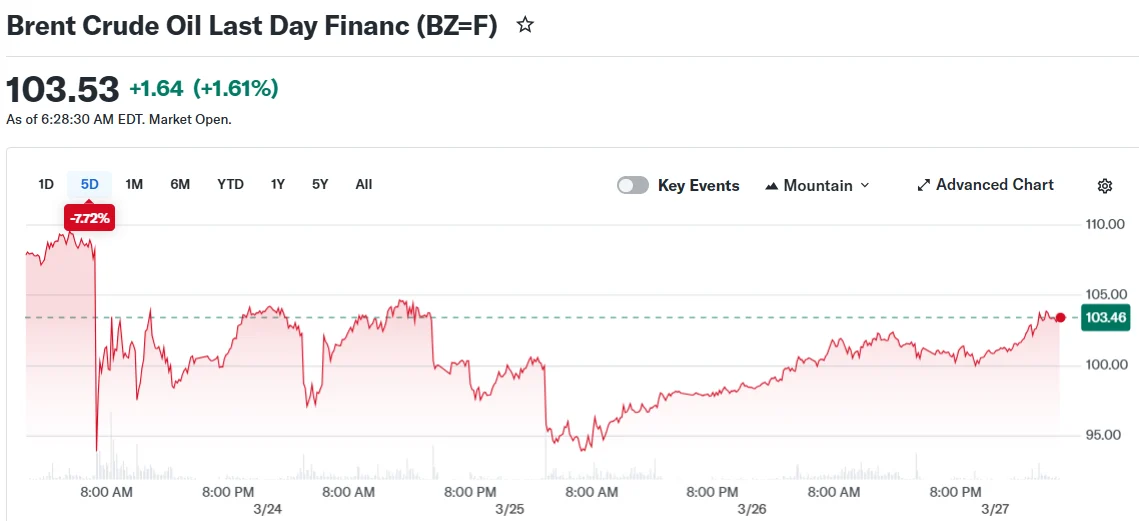
Brent is tracking toward an unprecedented monthly increase for March. The benchmark has jumped approximately 52% during this period, representing one of the most dramatic monthly rallies in decades.
The crisis erupted in late February and has resulted in the virtual shutdown of the Strait of Hormuz. This critical shipping channel typically handles approximately 20% of worldwide petroleum transit.
Following the strait’s effective closure, roughly 8 million barrels daily have been removed from circulation. Ole Hansen, Saxo Bank’s commodities strategy chief, noted that supply constraints are intensifying rapidly as vessels that departed the Persian Gulf before the closure have completed deliveries and inventories are depleting.

President Trump postponed the White House’s ultimatum for Iran to reopen maritime passage or face American military action against its energy infrastructure. The revised deadline stands at April 6. Trump indicated the delay followed Iranian requests and characterized diplomatic exchanges as productive.
Tehran contradicted this narrative through official channels. Iranian authorities maintained that no diplomatic dialogue with the United States is currently active.
Ongoing Military Operations and Troop Deployments
Military engagements have persisted despite diplomatic claims. Israeli forces reported striking Iran’s primary missile and naval mine manufacturing complex located in Yazd. Kuwait documented drone assaults targeting two of its port facilities. Saudi Arabia successfully intercepted unmanned aerial vehicles approaching its eastern territories.
The Pentagon is allegedly evaluating the deployment of as many as 10,000 supplementary ground forces to the theater, potentially including elements from the 82nd Airborne Division and Marine Expeditionary Units.
The Trump administration is simultaneously attempting to orchestrate discussions in Pakistan scheduled for this weekend, featuring Vice President JD Vance and additional high-ranking officials to investigate pathways toward conflict resolution.
Iran announced it rebuffed a comprehensive 15-point American peace framework and presented alternative conditions. These demands encompass acknowledgment of Tehran’s authority over the Strait of Hormuz.
Economic Implications and Financial Market Reactions
The oil spike is amplifying wider economic anxieties. Government bond yields have advanced as market participants anticipate that elevated energy costs might compel central banking institutions to implement interest rate increases.
The benchmark U.S. 10-year Treasury yield advanced to levels not witnessed since July. Similar yield increases occurred across German and French sovereign debt markets.
Numerous nations have implemented measures to cushion consumers from price shocks. India reduced taxation on diesel and gasoline products. Vietnam suspended fuel levies through mid-April. New Zealand documented evidence of consumer fuel stockpiling.
Macquarie’s research team estimates a 40% probability that hostilities will persist through June. Under that scenario, they project crude could escalate to $200 per barrel.
Two container vessels associated with China’s Cosco Shipping made attempts to transit the Strait of Hormuz on Friday before reversing course in proximity to Iranian waters.
