


TLDR
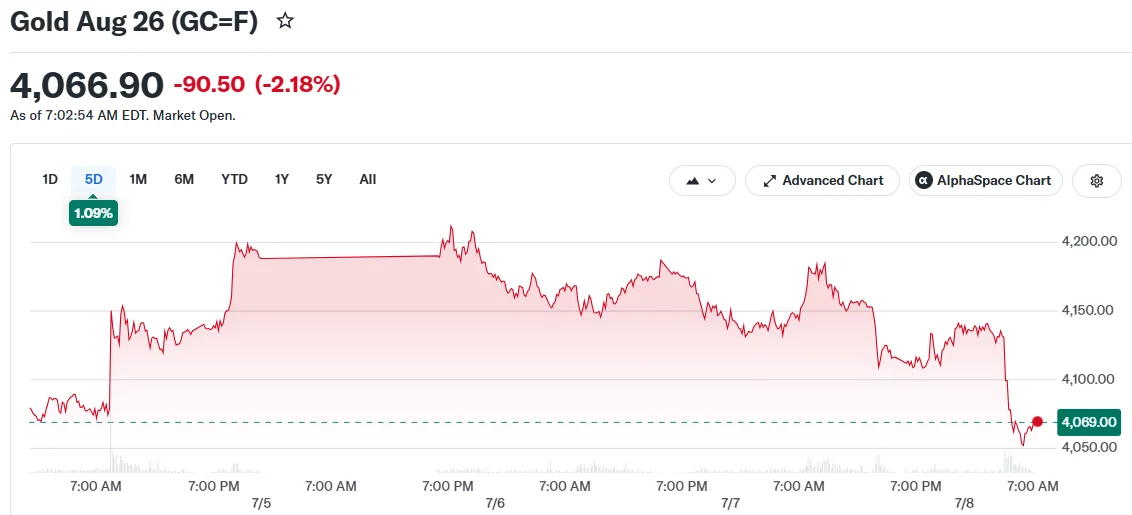
- Gold slid more than 1.3% to approximately $4,052 per ounce on Wednesday
- Trump announced the U.S.-Iran temporary peace agreement was “over” during a NATO summit in Turkey
- Iran reported launching strikes against 85 American military installations in Kuwait and Bahrain
- Crude oil prices climbed following the escalation, sparking renewed inflation concerns
- Silver declined 2.6%, platinum tumbled 3.5%, and palladium dropped 3.2%
Precious metals experienced significant declines on Wednesday following President Donald Trump’s declaration that the temporary peace agreement with Iran had collapsed, amid fresh military confrontations between the two nations.
During early trading hours in New York, spot gold declined 1.2% to reach $4,057.09 per ounce. The downturn was more pronounced in gold futures, which plummeted 2.2% to settle at $4,066.56 per ounce.
During remarks at a NATO summit held in Turkey, Trump criticized Iran for publicly contradicting agreements that had allegedly been reached in private negotiations.
“We make a deal, and everyone’s agreed. No nuclear weapons. We make a deal. They go outside, talk to the press, they say we never even talked about it. There’s something wrong with them. They’re cuckoo. As far as I’m concerned, it’s over,” Trump stated.
Iran Reports Attacks on American Military Facilities
According to Iran’s Islamic Revolutionary Guards Corps, the nation conducted strikes on 85 American military installations located in Kuwait and Bahrain, and successfully downed a U.S. MQ-9 drone.

The Pentagon characterized its military operations as retaliation for Iranian assaults on commercial vessels navigating the Strait of Hormuz, a critical artery for international oil transportation. U.S. Central Command reported engaging more than 80 targets within Iranian territory and eliminating over 60 Iranian small watercraft in and surrounding the strait.
Tehran has not accepted responsibility for Tuesday’s attacks on vessels near the Omani coast, which targeted a Saudi petroleum tanker and a Qatari ship transporting liquefied natural gas.
Crude Prices Surge, Stoking Inflation Worries
Oil prices climbed as the conflict intensified, clawing back some of the declines seen after the initial peace framework was established on June 17.
The surge in crude oil prices is reigniting concerns about a fresh inflationary cycle across global economies.
Market participants are now questioning whether the Federal Reserve will respond with interest rate increases. Speculation about a Fed rate hike had diminished following disappointing employment figures last week, but analysts at Britannia Global Markets indicate those expectations are intensifying once more in light of the renewed military action.
Elevated interest rates typically diminish gold’s appeal to investors because the precious metal generates no income. Additionally, a strengthening U.S. dollar can increase gold’s cost for international purchasers.
Lukman Otunuga, Head of Market Research at FXTM, characterized gold as being at a “critical crossroads,” where geopolitical instability and inflation anxieties are counterbalanced by weaker U.S. economic indicators that may constrain the Fed’s ability to implement aggressive policy measures.
Investors are now awaiting the release of the Fed’s June meeting minutes, scheduled for later Wednesday. The Federal Reserve maintained rates at 3.5% to 3.75% during that session, although certain members projected potential rate increases in 2026.
The broader precious metals sector also suffered losses. Silver plunged 2.61% to $58.39 per ounce, platinum declined 3.47% to $1,589.17, and palladium retreated 3.19% to $1,212.94.
Trump’s additional remarks regarding Greenland and Spain at the NATO summit contributed to heightened concerns about international stability, applying additional downward pressure on metals markets.
