


Key Highlights
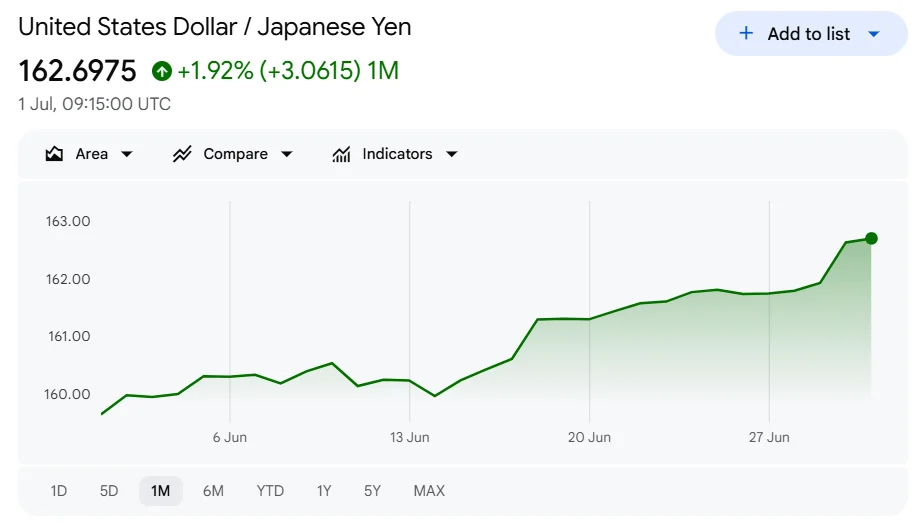
- The US dollar surged to a four-decade peak versus the yen, touching 162.84 during Wednesday’s trading session.
- Climbing US Treasury yields fueled greenback gains against major global currencies.
- Fed rate hike probability for September has surged to 67%, a dramatic increase from 20.5% recorded just one month prior.
- Japanese financial authorities are closely monitoring currency movements and may intervene to stabilize the yen.
- Geopolitical tensions involving Iran are bolstering dollar demand, though analysts caution about potential reversals.
The greenback ascended to its most powerful position against Japan’s currency in four decades on Wednesday, July 1, 2026, propelled by escalating Treasury yields and mounting expectations of Federal Reserve monetary tightening.
The dollar peaked at 162.84 yen during the session, reaching a threshold that historically triggered Japanese currency market intervention. Trading concluded near 162.71 yen, representing a 0.1% daily gain.
Surging Treasury Yields Power Dollar Rally
US Treasury yields experienced a substantial spike on Tuesday, with the benchmark 10-year note jumping as much as 9 basis points before moderating. Wednesday saw yields advance another 4 basis points to reach 4.465%, significantly outperforming European bond market movements.
Market observers noted the Treasury selloff lacked a singular catalyst. End-of-month portfolio adjustments likely contributed to the volatility.

This yield movement amplified the dollar’s existing momentum. The euro declined 0.14% to $1.1404, while the British pound retreated 0.2% to $1.3240. The dollar index remained stable at 101.31.
According to CME FedWatch tool data, market participants now assign a 67% probability to a September Fed rate increase. This marks a substantial shift from the mere 20.5% odds priced in just thirty days earlier.
Overnight economic data revealed US job openings climbed to a two-year peak in May. Despite this, tepid hiring activity negatively impacted worker sentiment regarding labor market conditions. The critical non-farm payrolls report is scheduled for Thursday release.
Japanese Officials Monitor Intervention Opportunity
The yen’s weakness is intensifying pressure on Japan’s Ministry of Finance to take action. Japanese authorities last intervened approximately two months ago, with the nation’s chief currency official stating the operation proved effective and received support from certain US policymakers.
According to Wells Fargo’s Chidu Narayanan, markets are approaching “potential action” territory. He emphasized that the ministry may need to intervene to maintain credibility, even though no predetermined threshold automatically triggers intervention.
Market participants view Friday’s US public holiday as a strategic opportunity for Japan to purchase yen, since reduced market liquidity could magnify intervention impact.
HSBC’s Joey Chew suggested Japanese authorities might be awaiting Thursday’s US employment data, hoping for weak results that could naturally pressure the dollar lower. She additionally noted officials may be allowing short positions to accumulate, which could enhance the effectiveness of future intervention efforts.
Concurrently, geopolitical uncertainty continues supporting dollar strength. Commerzbank analysts indicated the greenback will likely maintain firmness throughout the ongoing Iran conflict. However, the bank cautioned that once geopolitical tensions subside, rate hike expectations may weaken, potentially triggering a dollar correction.
Fed Chair Kevin Warsh is scheduled to address the ECB Forum on Central Banking in Portugal later Wednesday. Analysts anticipate limited forward guidance based on his June communication style.
The dollar’s robust performance reflects both elevated US yields and global market uncertainty, with Japanese authorities carefully evaluating the optimal timing for potential market intervention.
