



Key Takeaways
- BTC declined more than 1% Tuesday, slipping beneath the $60,000 threshold and its 200-week moving average marker.
- Japan’s yen tumbled to 162.40 against the dollar, marking its weakest position in forty years and boosting the Dollar Index.
- Strategy announced a $1 billion share repurchase initiative alongside a $1.25 billion capital raise program involving Bitcoin sales.
- June witnessed $4.4 billion in outflows from U.S. spot Bitcoin ETFs, representing 2024’s heaviest monthly exodus.
- Market watchers identify $58,800 as critical support, warning a breach could accelerate declines toward $55,000-$56,000 territory.
Bitcoin slipped beneath the $60,000 mark during Tuesday’s trading session, registering losses exceeding 1% as foreign exchange markets absorbed dramatic movements in the Japanese yen. Japan’s currency weakened to 162.40 against the greenback, representing its most vulnerable position since October 1986. This currency deterioration elevated the U.S. Dollar Index to 101.32, climbing from just below 101 during the previous session.
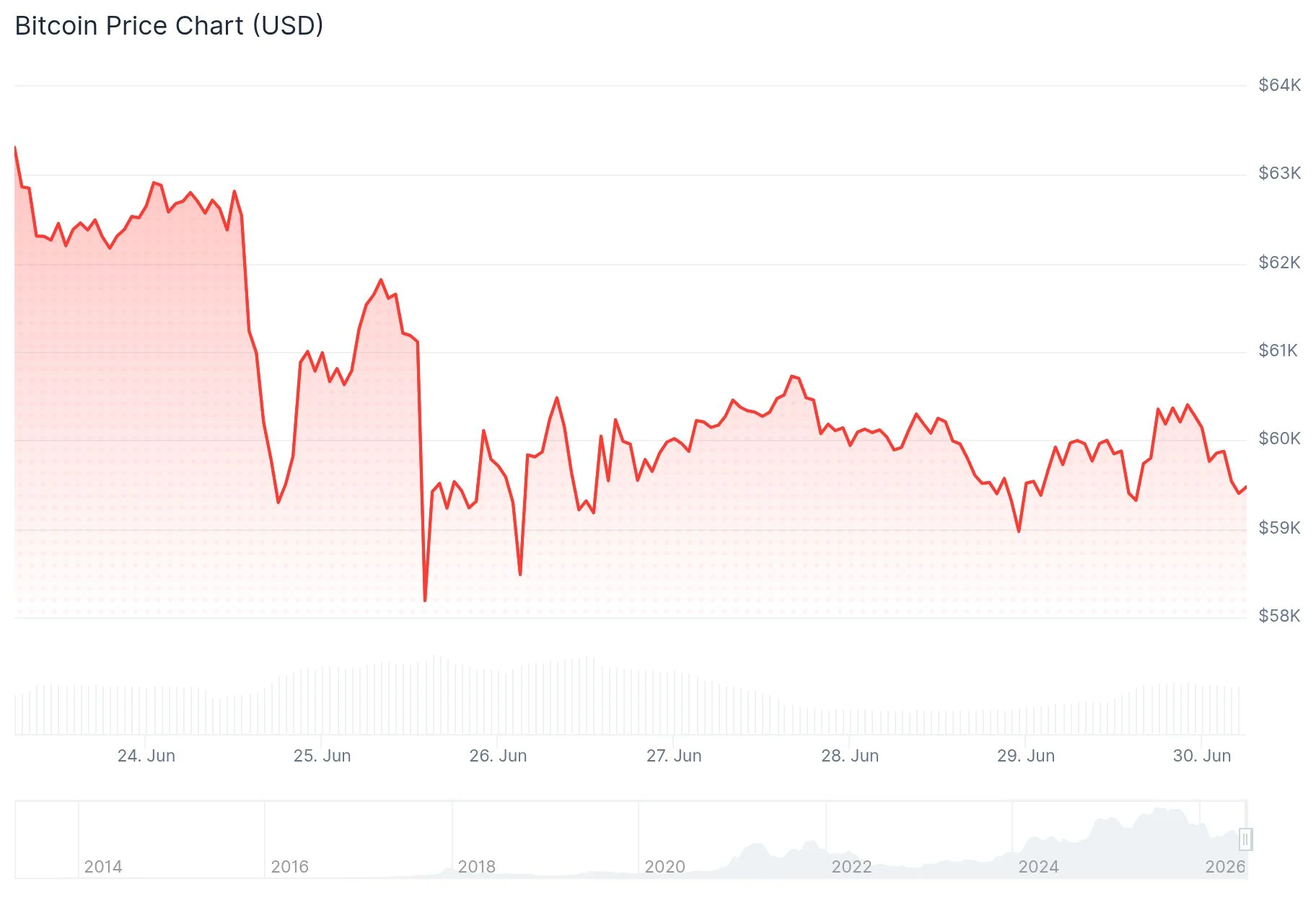
Throughout the trading day, Bitcoin continued hovering beneath its 200-week simple moving average. Market participants frequently monitor this technical indicator as a barometer for sustained bullish or bearish momentum.
The yen’s weakness represents an extension of a multi-year pattern. Japan’s currency has surrendered approximately 57% of its value relative to the dollar since 2021. This divergence stems from contrasting monetary policy trajectories. The Federal Reserve elevated U.S. interest rates beyond 5% at their peak, while Japanese authorities maintained rates anchored near zero for an extended period. The Bank of Japan has only recently adjusted its rate to approximately 1%, remaining substantially below America’s current 3.5% benchmark.
Strategy Announces Capital Restructuring
Strategy, which holds the distinction of being the largest publicly-traded Bitcoin accumulator, greenlit plans Monday to repurchase as much as $1 billion worth of both its preferred shares and Class A common stock. Simultaneously, the firm initiated a $1.25 billion capital-raising initiative that encompasses liquidating portions of its Bitcoin treasury.

This strategic pivot represents a departure from founder Michael Saylor’s historically unwavering commitment to never divesting Bitcoin holdings. Jeff Dorman, serving as Chief Investment Officer at Arca, offered analysis on the development through a social media post. He characterized the company’s actions as temporarily postponing fundamental challenges rather than addressing them conclusively.
Dorman articulated that “the can has been kicked down the road for a year or two.” He suggested that Strategy’s underlying capital structure complications will inevitably resurface unless Bitcoin experiences substantial price appreciation. He referenced a recent move to retire $1.5 billion in outstanding debt, which he argued eliminated $40 billion in enterprise valuation.
Strategy’s preferred equity instrument, STRC, has experienced notable depreciation in recent trading periods. This decline has undermined one of the corporation’s primary mechanisms for securing capital to expand its Bitcoin position.
Divergence Between Retail and Institutional Participants
Bitcoin currently trades around $60,300, a price zone where retail market participants and institutional players demonstrate contrasting sentiment. The Crypto Fear and Greed Index registers 36 on its 100-point scale, reflecting prevailing anxiety among market participants.
June brought $4.4 billion in net redemptions from American spot Bitcoin exchange-traded funds. This withdrawal volume establishes a new record for the heaviest monthly outflow year-to-date. Despite broader market hesitation, Strategy maintained its accumulation strategy during June, acquiring 3,600 BTC for $236 million, although its purchasing velocity has moderated.
Aggregate open interest across Bitcoin futures contracts stands at $19.92 billion, representing a modest decline from $20.1 billion recorded two weeks prior. Financing rates for leveraged long positions contracted from 0.25% to 0.12%, suggesting diminished pressure from forced liquidations.
Market analysts are closely monitoring $58,800 as a pivotal support threshold. Penetration below this level could catalyze approximately $500 million in liquidations, potentially accelerating downward momentum toward the $56,000 range. Conversely, a sustainable recovery would require Bitcoin to reclaim territory above $62,000.
Trading activity remains subdued, while open interest figures show minimal fluctuation. These conditions suggest a marketplace where selling pressure may have exhausted itself, yet substantial buying conviction has yet to materialize among larger market participants.
The current technical setup presents Bitcoin at a crossroads, with the cryptocurrency’s next directional move likely dependent on whether support levels hold or give way under continued macroeconomic pressures stemming from currency market volatility and shifting institutional positioning.
