



Key Takeaways
- Ethereum trades around $2,130, representing a ~12% decline from its recent peak of $2,420
- Potential US-Iran diplomatic breakthrough could influence ETH through oil market dynamics
- Ethereum spot ETFs witnessed $33M in net redemptions on May 21
- More than $1.7B worth of leveraged long positions risk liquidation if ETH breaches $2,044
- Critical support level established at $2,080 — failure could accelerate decline toward $1,800
Ethereum maintains a precarious position slightly above the $2,100 threshold while market participants monitor multiple risk factors threatening to accelerate downward price movement.
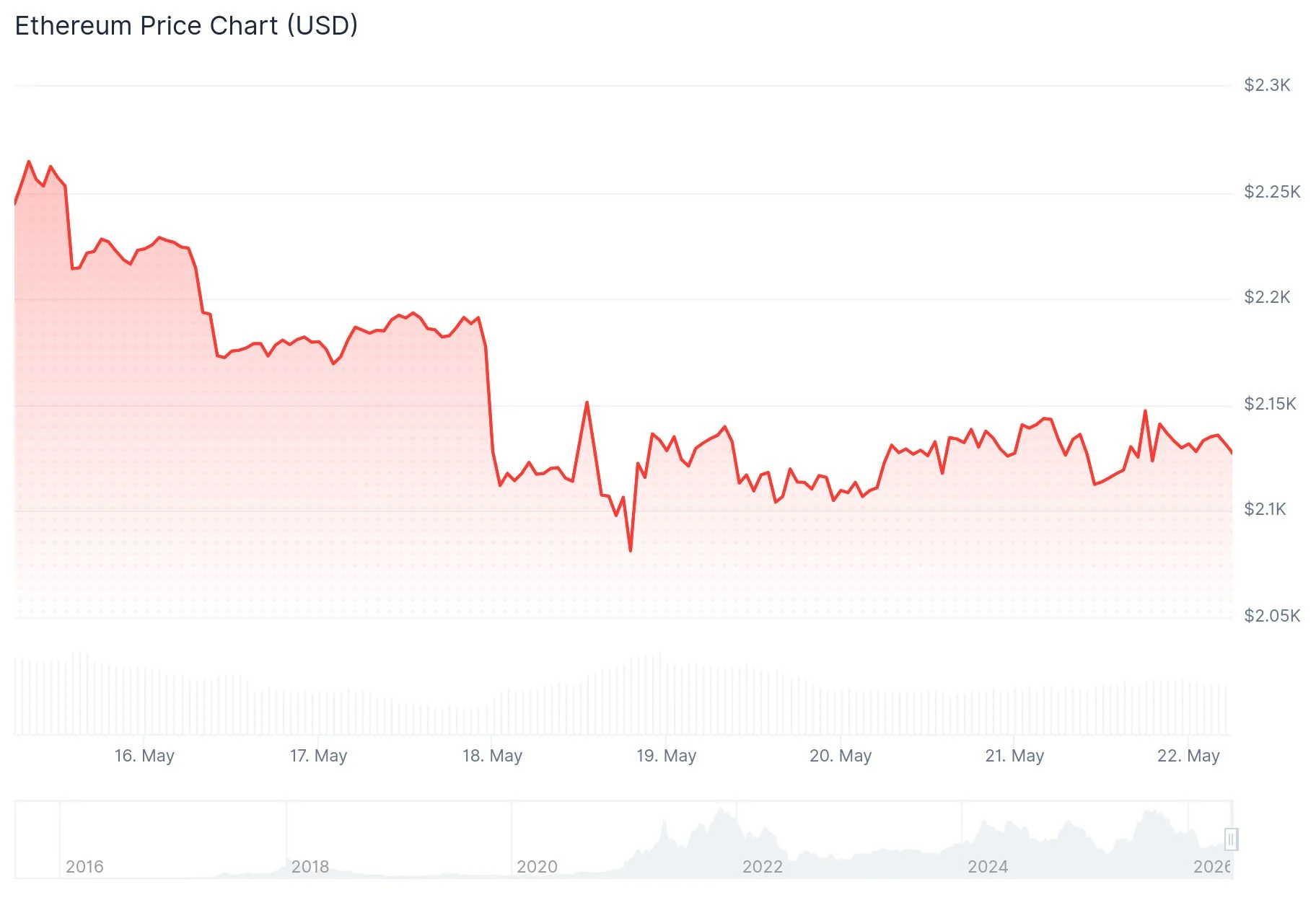
The second-largest cryptocurrency by market capitalization was changing hands near $2,129 on Wednesday, marking approximately a 12% retreat from its recent high point around $2,420. This decline coincided with US Treasury yields surging to 4.58%, reaching multi-month peaks after inflation figures exceeded forecasts. Elevated yields typically redirect investor capital toward lower-risk assets and away from cryptocurrency markets.
Spot Ethereum exchange-traded funds contributed additional downward pressure. May 21 data revealed $33M in net redemptions from ETH ETFs, extending a pattern of consecutive withdrawal days. Bitcoin ETFs similarly experienced $101M in outflows during the same period, while Solana ETFs stood as the sole exception with $4M in net inflows.
[[TWEET_0]]

BitMEX co-founder Arthur Hayes identified an underlying structural challenge. “Ethereum ETFs continue to lack the structural yield benefit that many institutional players anticipated,” Hayes noted. “Without staking integration into these investment vehicles, capital allocation will continue favoring Bitcoin.”
Geopolitical Developments and Petroleum Market Implications
Thursday brought reports indicating the United States and Iran are approaching a ceasefire agreement, with Pakistan serving as mediator. The proposed deal reportedly incorporates a collaborative monitoring framework for the Strait of Hormuz. In response to this development, US crude oil prices declined from above $100 toward $96.
BitMine Immersion Chairman Thomas Lee commented on X that resolving this geopolitical tension could “decisively” affect petroleum markets — with downstream consequences for Ethereum. “Elevated oil prices increase the likelihood of Federal Reserve rate hikes,” Lee explained. “Since ETH and cryptocurrency valuations correlate with monetary liquidity, crypto assets will demonstrate inverse correlation to oil.”
Lee’s company, BitMine, maintains the largest corporate Ethereum holdings, with approximately 5.278 million ETH in its treasury.
Analyst Ted Pillows expressed a more cautious outlook, stating on X: “The technical setup doesn’t appear favorable for $ETH. Ethereum must maintain support above $2,100, otherwise we could witness significant deterioration.” His assessment echoes widespread trader sentiment that the $2,100 zone represents a crucial threshold.
[[TWEET_1]]
Technical Analysis Reveals Growing Weakness
Examining the daily timeframe, Ethereum has broken beneath an ascending channel pattern and currently trades below its 20-, 50-, and 100-day exponential moving averages, which cluster between $2,225 and $2,326. The MACD indicator has crossed into negative territory, validating bearish momentum.
Blockchain analytics compound these concerns. Wallet addresses containing more than 10,000 ETH have decreased to their lowest count in nearly 10 months. Meanwhile, net Ethereum deposits to cryptocurrency exchanges have reached their highest levels since early 2025 — suggesting increased selling pressure from current holders.
CoinGlass tracking reveals over $1.7B in leveraged long positions concentrated in the $2,044 to $2,000 range. A breakdown through this zone could initiate a chain reaction of forced liquidations. The past 24 hours alone saw $47.9M in total ETH liquidations across exchanges.
Immediate support levels to monitor include $2,080, with secondary support zones at $1,909 and $1,800.
