


Key Highlights
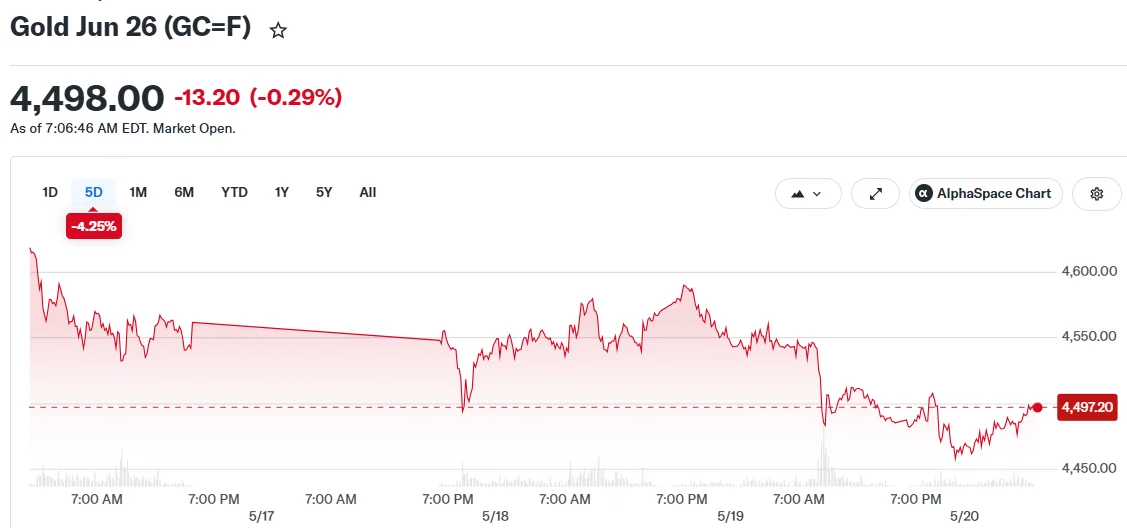
- Precious metal stabilizes near $4,500 per ounce following Tuesday’s nearly 2% decline
- U.S. 30-year Treasury rates reached 17-year peak, creating headwinds for gold valuations
- Trump administration sends mixed messages on Iran, threatening renewed attacks while suggesting rapid diplomatic resolution
- Silver recovers with 2.5% gain after Monday’s steep 5% selloff; platinum and palladium also advance
- Precious metal has declined approximately 15% since U.S.-Israeli military action against Iran commenced in late February
Precious metal valuations found stability on Wednesday following several volatile trading sessions, with spot pricing hovering just beneath the $4,500 per ounce threshold. The commodity experienced a near 2% retreat on Tuesday before finding support as market participants attempted to navigate contradictory developments from both the Middle East conflict and fixed-income markets.
The primary downward force on gold valuations has originated from ascending bond rates. U.S. 30-year Treasury yields advanced to their most elevated position since 2007, immediately preceding the international financial meltdown. Elevated yields generally diminish the appeal of non-interest-bearing holdings such as gold for portfolio managers.
Market strategists at Phillip Capital noted increasing concerns that an Iran-related oil price surge might catalyze worldwide inflationary pressures, potentially prompting monetary authorities to implement rate increases. The Federal Reserve is scheduled to publish its April policy meeting minutes later Wednesday, potentially offering additional insight into future rate trajectory.
The U.S. currency has also maintained positions close to a six-week peak. A stronger dollar typically increases gold’s cost for international purchasers outside American borders.

Middle East Conflict Creates Continued Market Volatility
Developments surrounding Iran continue to serve as the primary catalyst for market fluctuations. President Trump informed congressional members Tuesday night that hostilities might conclude “very quickly.” He revealed postponing additional military operations against Iran following appeals from three Persian Gulf nations.
Nevertheless, Trump simultaneously warned of resuming offensive actions within coming days as leverage to compel a diplomatic settlement. Vice President JD Vance indicated Tehran’s willingness to pursue an agreement.
Iran has maintained its fundamental requirements, and market observers suggest the route toward a settlement remains ambiguous. Neil Welsh from Britannia Global Markets stated negotiation prospects “remained uncertain.”
The Strait of Hormuz, a critical petroleum shipping channel along Iran’s southern coastline, has remained essentially inaccessible to tanker operations since military action initiated in late February. On Wednesday, two Chinese-registered supertankers reportedly departed the strait, accompanied by a South Korean vessel. Petroleum prices declined on optimism that supply channels might normalize shortly, although Brent crude maintains substantial elevation above pre-conflict benchmarks.
Precious Metal Declines 15% Since Conflict Initiation
Gold has maintained a constrained trading band following its sharp depreciation during the conflict’s opening phase. The commodity has depreciated roughly 15% since warfare commenced in late February.
Ole Hansen from Saxo Bank identified an emerging divergence between near-term speculators concentrating on rate projections and extended-horizon investors viewing gold as protection against elevated inflation and sluggish economic expansion. He observed insufficient new capital flowing into gold exchange-traded products and suggested the marketplace appears to await more definitive directional signals.
Silver similarly experienced challenging conditions this week but recovered Wednesday, advancing as much as 2.5% after Monday’s 5% retreat. Silver had climbed to approximately $90 per ounce last Wednesday but has subsequently declined around 16%. Platinum and palladium also registered upward movement on Wednesday.
Spot gold remained relatively unchanged at approximately $4,475 during late morning European trading hours.
