


Key Takeaways
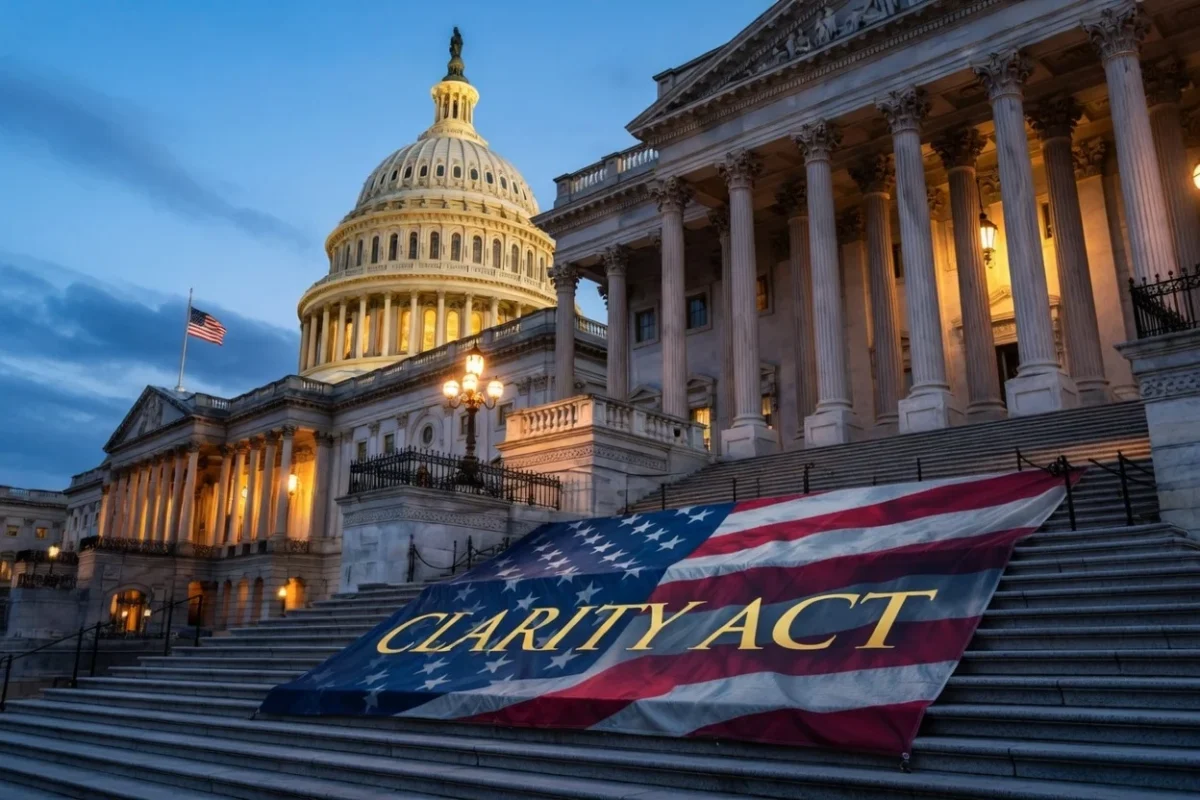
- Senate Banking Committee published the complete Clarity Act text on Monday evening, just before the May 14 committee markup.
- The legislation features limitations on stablecoin interest payments and safeguards for decentralized finance developers.
- Traditional banking institutions are advocating to eliminate what they describe as a stablecoin “loophole,” claiming it threatens conventional bank deposits.
- An ethics clause designed to prevent government officials from profiting on crypto remains absent from the current draft — Democrats insist on its inclusion.
- Prediction markets on Polymarket show 64% probability that President Trump will sign the Clarity Act into law in 2025.
The Senate Banking Committee unveiled the comprehensive Clarity Act text on Monday evening, mere hours before the May 14 markup session. This legislation represents one of the most ambitious efforts to establish a comprehensive regulatory framework for the cryptocurrency sector in the United States.
Banking Committee Chair Tim Scott stated the legislation “puts consumers first, combats illicit finance, cracks down on criminals and foreign adversaries and keeps the future of finance here in the United States.”
The 309-page legislation had been circulating unofficially among industry participants, so major revelations were unlikely. Crypto advocacy organizations worked through the evening to analyze the final language and verify their key objectives were incorporated.
The legislation addresses three primary domains: regulations governing stablecoin yields, legal protections for DeFi developers, and enhanced enforcement mechanisms for prosecutors handling cryptocurrency money laundering cases.
Banks and Crypto Companies Clash Over Stablecoin Yield Provisions
Among the most contentious elements involves stablecoin compensation structures. The present language prohibits cryptocurrency platforms from offering interest on dormant stablecoin holdings. Only performance-based incentives are authorized.
Coinbase Chief Executive Brian Armstrong stated Monday that “not everyone got everything they wanted, but they got the must-haves.” He revealed Coinbase is collaborating with at least five significant international banks to incorporate cryptocurrency offerings.
However, the traditional banking sector remains dissatisfied. American Bankers Association Chief Executive Rob Nichols distributed correspondence to banking leaders encouraging them to contact their senators prior to the vote.

Nichols cautioned that the existing provisions would “unnecessarily incentivize the flight of bank deposits into payment stablecoins, putting both economic growth and financial stability at risk.”
Banking industry associations also submitted additional correspondence to Senate Banking Committee members requesting stricter limitations on stablecoin reward programs.
Analysis from Galaxy countered these objections, maintaining that the majority of stablecoin expansion will originate from international capital entering U.S. banking systems, rather than from domestic deposit transfers.
Ethics Language Continues to Create Division
The current bill lacks a conflicts-of-interest section that would restrict government personnel from generating cryptocurrency profits. This provision exists beyond the banking committee’s authority and requires subsequent incorporation.
Democratic lawmakers have established the ethics language as a prerequisite for their backing. Senator Elizabeth Warren declared the bill “turbocharges Donald Trump’s crypto corruption,” citing over $1.4 billion in cryptocurrency profits accumulated by the president and his relatives since assuming office.
White House cryptocurrency advisor Patrick Witt indicated the administration endorses regulations applicable to all government employees, but opposes provisions targeting any particular official.
Senate Republicans anticipate moving the legislation forward through partisan votes during the May 14 markup. Subsequently, it must be reconciled with legislation approved by the Senate Agriculture Committee before reaching the full Senate.
Sixty votes are necessary for Senate floor passage, requiring Democratic cooperation. The White House has established a July 4 target date. Senator Kirsten Gillibrand forecasted passage by early August.
Polymarket currently assigns a 64% probability that Trump will enact the Clarity Act into law this year.
