



TLDR
- Artificial intelligence equities contribute over 80% of the S&P 500’s 2026 performance; without them, the benchmark shows only 2% growth
- Jefferies analysts argue the surge stems from fundamental earnings expansion rather than excessive multiples, labeling AI “the cheapest sector to own” using PEG ratios
- Forward earnings projections for the AI sector have climbed more than 30% since mid-2025, with anticipated EPS compound growth of 38.5% through 2027
- Samsung Electronics achieved $1 trillion market capitalization, entering an elite group with Nvidia, TSMC, and Broadcom in AI infrastructure
- A record 86% of S&P 500 firms exceeded Q1 2026 earnings forecasts — the highest since COVID — driven by AI and commodity sectors
Artificial intelligence companies are shouldering the bulk of U.S. equity market performance in 2026. Data from Jefferies reveals these stocks represent more than 80% of all S&P 500 appreciation year-to-date. Strip away the AI component, and the broader index shows a modest 2% advance.
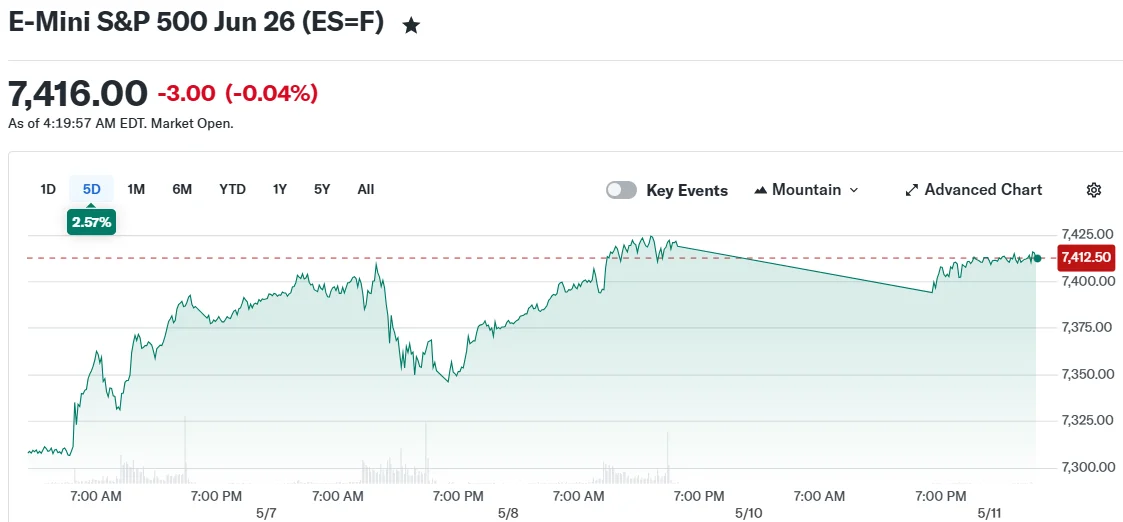
Such heavy concentration typically raises red flags among market participants. However, Jefferies contends there’s substantial justification for this performance gap.
The financial institution’s quantitative research division analyzed the underlying forces propelling these returns. Their conclusion: fundamental earnings expansion, not multiple inflation, powers the advance. This differentiation carries significant weight for investors assessing bubble risk.
The AI basket’s forward earnings projections for 2026 have jumped over 30% since the middle of 2025. Wall Street forecasts compound annual profit growth of 38.5% for artificial intelligence companies spanning 2026-2027. By contrast, non-AI segments project only 11.9% growth.

Despite this robust expansion, the AI group trades around 25 times forward earnings. That sits beneath its one standard deviation historical range. Its price-to-earnings-growth multiple registers at merely 0.6 times.
“AI is the cheapest sector to own in the U.S.,” Jefferies strategists stated in their research.
Performance Varies Widely Across AI Subsectors
Results within the artificial intelligence universe show significant dispersion. AI server manufacturers, optical networking components, and memory chip producers have delivered the strongest returns this year. Cloud hyperscalers and semiconductor designers have underperformed.
From a valuation perspective, memory and compute hardware stocks appear most compelling on a PEG basis. Semiconductor fabrication equipment and chip architecture firms trade at richer multiples comparatively.
First quarter 2026 results provided additional insight. Approximately 86% of S&P 500 constituents surpassed earnings projections — the strongest performance since the pandemic, rising from 75% the prior quarter. Revenue beats reached 82%.
The caveat: these positive surprises largely failed to generate stock outperformance. Shares typically didn’t rally after exceeding estimates, with exceptions in AI and select other sectors. Shortfalls triggered sharp declines, suggesting elevated investor expectations market-wide.
Jefferies examined roughly 330 corporate earnings presentations using AlphaSense analytics. Management commentary registered 95% optimistic. Analyst sentiment also strengthened, with 58% of discussions reflecting positive assessments, compared to 48% in Q4 2025.
One recurring concern emerged from conference calls: the U.S.-Iran military situation. Nearly 44% of corporations identified it as a headwind, citing supply chain complications and diminished consumer confidence.
Samsung Enters the Trillion-Dollar Valuation Tier
The artificial intelligence boom extends beyond software platforms and chip architects. Hardware manufacturers are experiencing substantial appreciation. Samsung Electronics recently surpassed $1 trillion in market value, becoming the latest AI-connected enterprise to reach this milestone.
Samsung now stands alongside Nvidia, TSMC, and Broadcom — corporations producing the processors, memory modules, and infrastructure enabling AI deployment. Samsung’s inclusion reflects demand for its high-bandwidth memory, essential for AI computing systems.
The trillion-dollar club previously centered on consumer technology. Apple, Amazon, Microsoft, Alphabet, Meta, and Tesla achieved this threshold through smartphones, cloud computing, e-commerce, and software platforms.
The current wave shows stronger hardware concentration. Nvidia crossed $1 trillion in May 2023. TSMC followed throughout 2024. Broadcom joined subsequently. Samsung now adds memory production to this category.
Berkshire Hathaway and Walmart have also entered the elite group, alongside Eli Lilly driven by pharmaceutical demand and energy majors Saudi Aramco and PetroChina. Yet the most dynamic segment currently remains AI infrastructure.
Earnings estimate revisions across the S&P 500 have increased 6% over the past three months. Removing AI and commodity stocks from the calculation reduces that figure to merely 0.3%.
