



Key Highlights
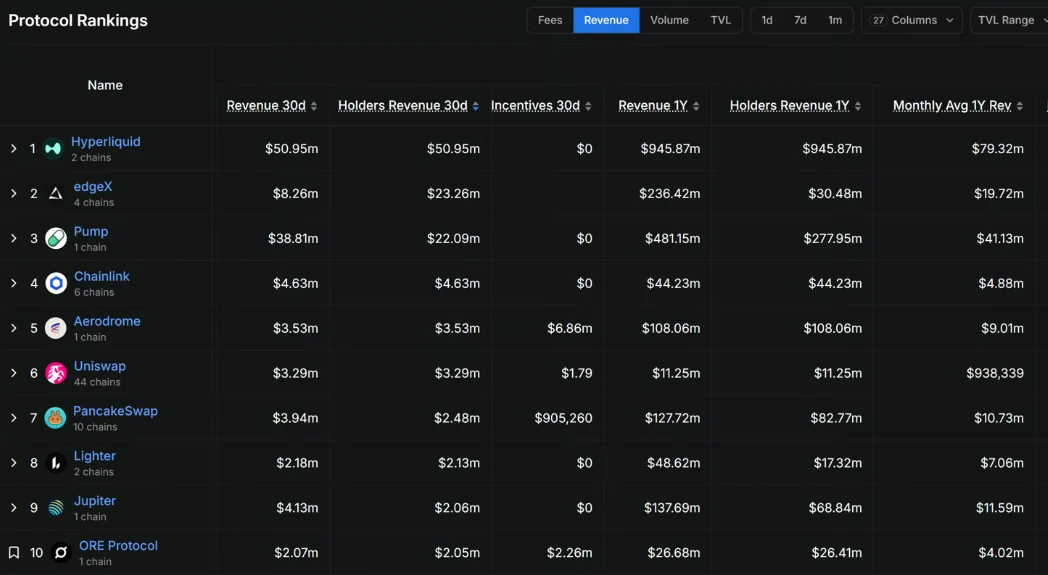
- Three DeFi platforms—Hyperliquid, Pump.fun, and EdgeX—collectively distributed $96.3 million to their token holders within a 30-day window
- Hyperliquid dominated distributions with $50.95 million, sourced exclusively from trading fees without any incentive spending
- Pump.fun distributed $22.09 million from its $38.81 million revenue stream following its transition to a balanced 50/50 distribution model implemented on April 28, 2026
- EdgeX distributed $23.26 million while generating merely $8.26 million in protocol income, indicating reliance on capital reserves
- The decentralized finance ecosystem is pivoting from volume-based metrics to sustainable, revenue-driven performance indicators
According to DefiLlama analytics, three decentralized finance platforms have collectively distributed $96.3 million to their token holders within a single 30-day timeframe. These platforms include Hyperliquid, Pump.fun, and EdgeX.
What makes this distribution particularly noteworthy is that each platform employed distinctly different mechanisms to achieve these numbers, with not all distributions stemming from sustainable revenue streams.
Hyperliquid produced $50.95 million in protocol income during this period, with the entire sum directed to token holders. The platform allocated zero funds toward user incentive programs. Through its Assistance Fund—established in January 2025—the protocol captures 97% of all trading fees and deploys them for open market token buybacks.
In December 2025, validators proposed permanently burning approximately $920 million worth of tokens held by the fund. Approval of this measure would create structural supply reduction for the token.

Pump.fun secured second position, distributing $22.09 million to holders from its total revenue of $38.81 million. After maintaining a complete buyback strategy for nine months, the platform transitioned to an even split model on April 28, 2026. Currently, 50% of net fee income powers an automated buy-and-burn mechanism.
CoinGecko research revealed that 73.3% of Pump.fun participants recorded realized profits in April 2026, a significant increase from the 30.1% low point in June 2025. Active wallet addresses rebounded to 3.14 million from December 2025’s bottom of 1.8 million. However, most gains remained modest, with 65.1% of profitable addresses earning between $1 and $500.
EdgeX’s Unusual Distribution Economics
EdgeX represents an anomaly within this trio. The protocol delivered $23.26 million to token holders despite producing only $8.26 million in actual protocol revenue. This discrepancy indicates the team is tapping into reserve funds or pre-allocated incentive treasuries.
With its token launching on March 31, 2026, EdgeX remains in the initial stages of implementing its tokenomics framework. The critical question facing investors is whether the platform can scale its fee generation rapidly enough to sustain distributions without depleting reserves.
The Evolution Toward Sustainable Revenue Models
These distributions reflect a broader transformation within DeFi, shifting from inflationary token emission rewards toward distributing genuine earnings. Andre Cronje, the architect behind Yearn.Finance, observed that 2026’s DeFi ecosystem resembles traditional financial infrastructure more than speculative markets.
He highlighted stablecoins achieving a $320 billion market capitalization, decentralized trading platforms processing upwards of $160 billion in monthly spot trading volume, and lending protocols maintaining $28 billion in outstanding loans.
Additional platforms also returned capital to holders during this timeframe. Chainlink distributed $4.63 million, Aerodrome returned $3.53 million, and Uniswap paid out $3.29 million.
Among the three primary protocols examined, only Hyperliquid financed its complete distribution through organic fee generation. Pump.fun’s revised model continues undergoing market validation after its recent structural change, while EdgeX has yet to demonstrate sustainable economics independent of subsidization.
