



Key Takeaways
- Citigroup has elevated its near-term Brent crude projection to $120 per barrel from $95
- Goldman Sachs increased its fourth-quarter Brent outlook to $90/barrel, representing a nearly $30 jump from pre-crisis levels
- The shutdown of the Strait of Hormuz has effectively halted Persian Gulf oil shipments
- Approximately 500 million barrels of oil supply have been eliminated since hostilities commenced
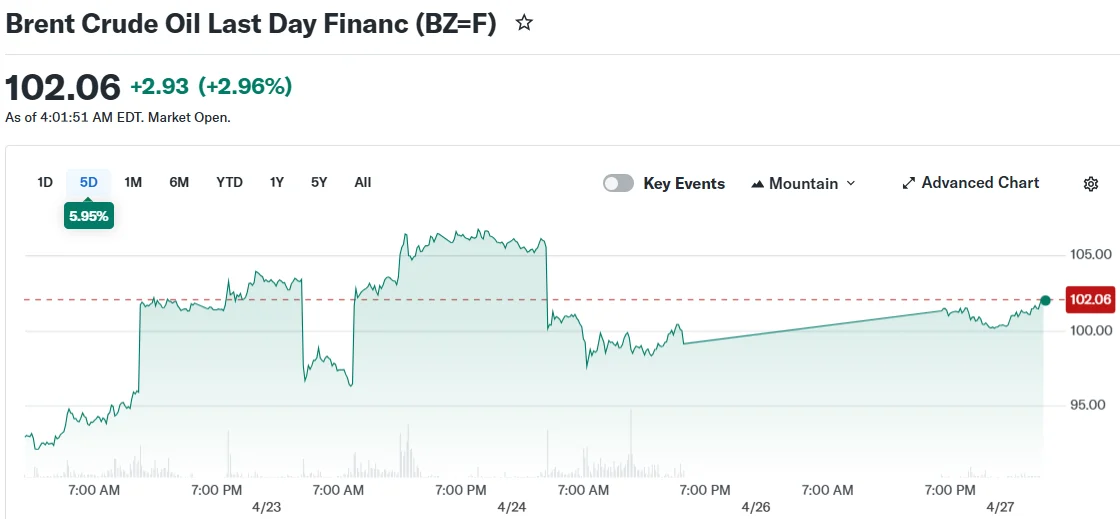
- Brent prices have climbed roughly 50% since late February when the conflict erupted
Leading financial institutions Citigroup and Goldman Sachs have revised their oil price projections upward following the persistent closure of the Strait of Hormuz. On Monday, Brent crude was hovering around $108.50 per barrel, marking a roughly 3% increase for the session and maintaining its momentum for a sixth consecutive day of gains.
Citigroup’s updated forecast positions Brent at $120 per barrel within a zero to three-month timeframe. The investment bank has adjusted its quarterly average predictions to $110, $95, and $80 for the second, third, and fourth quarters of 2026, respectively. These revised numbers represent significant increases from the firm’s previous projections of $95, $80, and $75.
The financial institution assigns a 50% likelihood to its baseline projection. This central scenario anticipates the Strait beginning to reopen by late May, representing a one-month delay compared to Citi’s earlier timeline.
Citi’s research team indicated that Iran’s government possesses both economic and geopolitical incentives to maintain the current blockade of the Strait. The analysts contend this strategy would constrict worldwide petroleum availability, accelerate the depletion of stored reserves, and drive market prices upward.

According to Citi’s calculations, approximately 500 million barrels of cumulative oil supply have vanished from markets since the beginning of the crisis. Should the waterway remain impassable throughout May, the institution forecasts aggregate losses could escalate to 1.3 billion barrels.
Goldman Sachs Elevates Price Outlook
Goldman Sachs similarly adjusted its oil price predictions on April 27. The bank’s revised forecast projects Brent averaging $90 per barrel during the fourth quarter of 2026, up from an earlier estimate of $80. Goldman’s analysts note this represents approximately a $30 premium compared to pre-crisis expectations for what they’ve termed the “Hormuz shock.”
Goldman’s assessment indicates that 14.5 million barrels daily of Persian Gulf crude production disruptions are causing global petroleum reserves to decline at an unprecedented rate of 11 to 12 million barrels per day throughout April. The institution anticipates a shortfall of 9.6 million barrels daily for the current quarter. Goldman’s current outlook places Brent at $100 for this quarter and $93 during the third quarter.
Morgan Stanley Maintains Current Position
Morgan Stanley has opted to maintain its existing forecasts without modification. The institution anticipates Brent will average $110 during the present quarter, $100 in the third quarter, and $90 in the fourth quarter. Morgan Stanley calculates that Gulf region oil shipments have declined by 14.2 million barrels daily resulting from the waterway closure.
The bank noted that worldwide petroleum stockpiles have decreased by an estimated 4.8 million barrels per day, with diminished consumption patterns explaining some of the differential.
Citi’s optimistic scenario, carrying a 30% probability assessment, envisions Brent climbing to $150 per barrel should disruptions continue through June’s conclusion. An extreme scenario involving significant infrastructure damage could propel prices to a sustained range of $160–$180 per barrel.
Under Citi’s baseline forecast, global petroleum inventories are projected to decline to their lowest points in more than ten years by the end of July.
