



TLDR
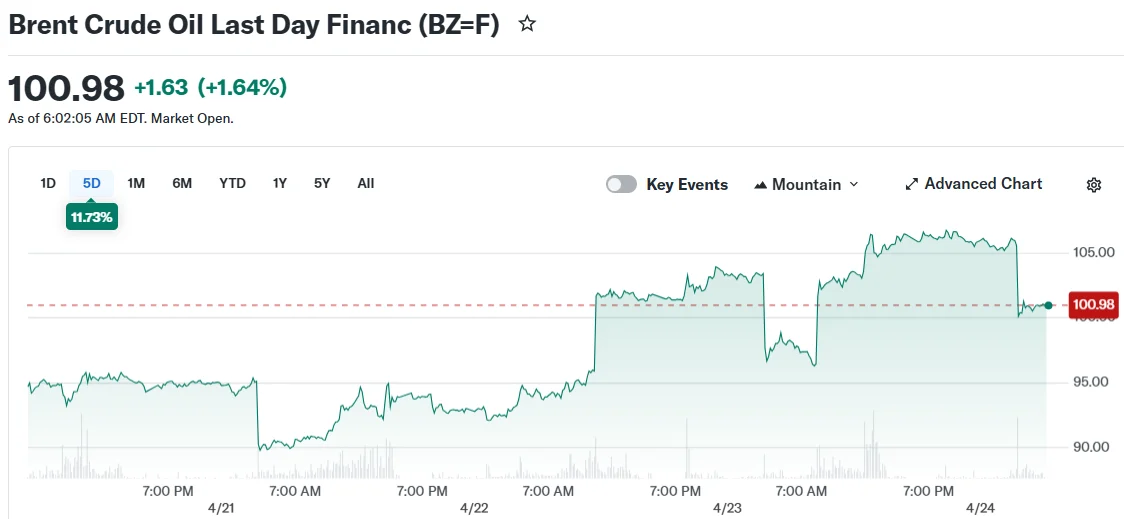
- Brent crude increased 1.7% to reach $106.88 per barrel; WTI advanced 1.4% to $97.21 per barrel
- Weekly gains for both benchmarks tracking toward the strongest performance since March’s opening weeks
- Critical Strait of Hormuz shipping channel continues near-total closure, eliminating approximately 20% of worldwide oil transit
- President Trump indicated no urgency for finalizing a comprehensive agreement with Iran, prolonging market volatility
- Goldman Sachs calculates Persian Gulf production has dropped approximately 14.5 million barrels daily, representing over half of April’s regional output
Energy markets saw significant upward movement Friday following President Donald Trump’s comments indicating no immediate timeline for resolving the escalating U.S.-Iran confrontation, injecting additional volatility into already disrupted commodity markets.
Brent crude futures advanced 1.7% to settle at $106.88 per barrel. U.S. West Texas Intermediate climbed 1.4% to close at $97.21 per barrel. Both oil benchmarks are tracking toward their most substantial weekly advances since the beginning of March.
The price acceleration follows sustained disruption at the Strait of Hormuz — a critical chokepoint along Iran’s southern coastline — which continues to experience virtually no tanker movement. Approximately one-fifth of the world’s petroleum supply normally transits through this strategic passage.
The waterway has experienced effective shutdown conditions for several weeks. Leading Gulf petroleum exporters such as Saudi Arabia and Qatar have been investigating alternate maritime routes, though none have successfully compensated for the closure.

Iranian forces captured vessels attempting strait passage earlier this week. American military units simultaneously intercepted a supertanker transporting Iranian crude in Indian Ocean waters as naval enforcement of Iranian port restrictions intensified.
Thursday saw Trump declare via Truth Social platform that he had authorized the U.S. Navy to employ lethal force against any Iranian craft discovered deploying mines within the strait. Tehran responded by broadcasting footage of its special forces boarding a commercial vessel while emphasizing its speed-boat assault capabilities.
Peace Talks at a Standstill
Diplomatic initiatives aimed at restarting dialogue remain frozen. Two government officials with knowledge of the situation informed Bloomberg that Trump’s online statements and the continuing naval embargo have hindered mediation attempts led by nations including Pakistan.
Trump addressed media Thursday stating his reluctance to accelerate toward a lasting agreement, noting that U.S. actions had severely degraded Iran’s military infrastructure and left the nation in chaos.
An indefinite extension of the U.S.-Iran ceasefire was announced earlier this week, though petroleum markets demonstrated minimal confidence in the development. The Lebanon-Israel cessation of hostilities also received a three-week extension following diplomatic discussions in Washington.
A sanctioned supertanker laden with Iranian petroleum was observed Friday apparently making an attempt to navigate the Strait of Hormuz, while overall vessel movement through the passage remains virtually nonexistent.
Goldman Sees Months of Supply Disruption
Goldman Sachs researchers, led by Daan Struyven, stated in their April 23 analysis that Persian Gulf petroleum production could require “a few months” to substantially normalize — contingent upon complete Hormuz reopening and no additional military strikes.
The financial institution projects that Gulf region output has been reduced by approximately 14.5 million barrels each day, comprising more than half of the area’s April production volume.
“Oil is rising more because of the physical supply shock rather than a geopolitical risk premium alone,” said Charu Chanana, chief investment strategist at Saxo Markets. “The war risk may be fading at the margin, but the flow risk has not gone away.”
Mona Yacoubian of the Center for Strategic and International Studies noted the disruption is proving hard to ignore. “The longer this continues, the more it becomes clear that the disruptive effects of this conflict are going to reverberate for months, if not longer,” she said.
Brent crude was positioned for approximately 17% weekly appreciation as of Friday’s morning trading session.
