


Key Takeaways
- XRP currently sits near $1.38, representing a 61% decline from its July 2025 peak of $3.66.
- Large holders accumulated 110 million XRP tokens ($152M) throughout March, while exchange holdings reached their lowest point in five years.
- February brought five significant institutional partnerships, including Deutsche Bank and Société Générale, yet price remained stagnant.
- Critical resistance zone exists between $1.43–$1.48; clearing $1.55 could trigger moves toward $1.60–$1.85.
- ASIC in Australia approved regulated status for AUDD stablecoin operations on the XRP Ledger.
As of March 11, 2026, XRP maintains a price position of $1.38 with a total market capitalization standing at $84 billion. The digital asset has experienced a significant 61% correction from its peak value of $3.66 recorded in July 2025.
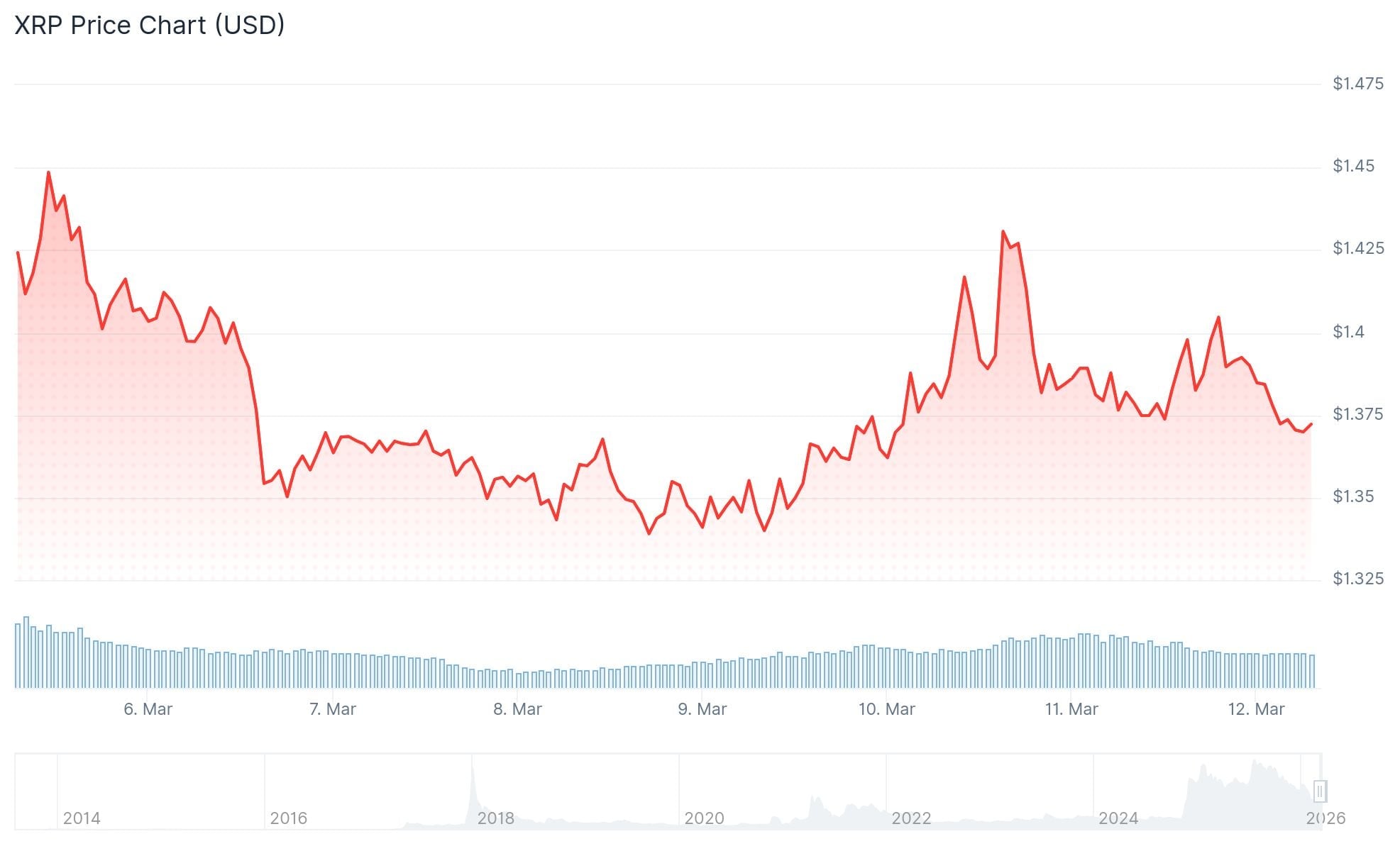
Volume metrics continue declining as price action consolidates within a narrow band of $1.34 to $1.48 across recent weeks. Market participants show no clear directional bias.
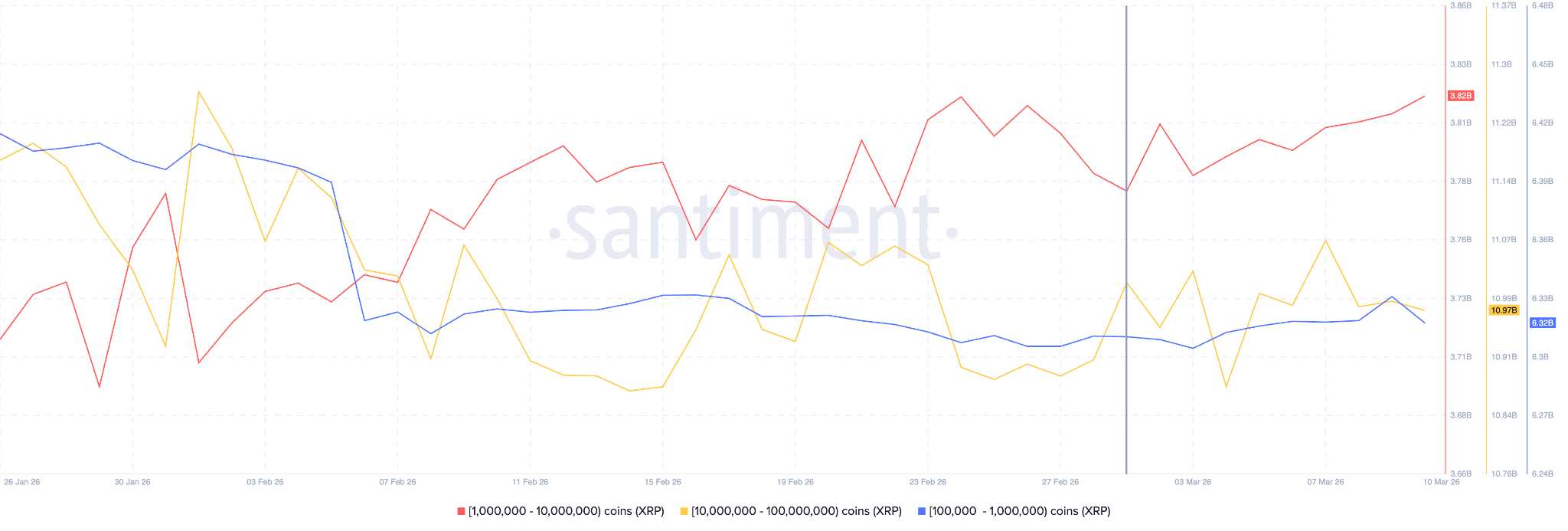
Yet beneath the surface, significant whale addresses — those controlling between 100,000 and 100 million tokens — accumulated an additional 110 million XRP throughout March. This translates to approximately $152 million based on prevailing market rates.
XRP holdings on centralized exchanges have contracted to 12.9 billion tokens — marking the lowest concentration recorded since May 2021. Binance alone processed more than 14,000 XRP withdrawal transactions on March 6.

When tokens migrate from exchanges into self-custody solutions, this pattern generally indicates accumulation behavior rather than distribution pressure.
Major Partnership Announcements Didn’t Catalyze Price Movement
Ripple recorded unprecedented partnership activity throughout February 2026. Deutsche Bank, Aviva Investors, Zand, Figment, and Société Générale’s SG-FORGE all formalized integrations within a 30-day window.
Yet XRP declined consistently throughout this period.
The explanation centers on implementation specifics: these institutional arrangements primarily utilize Ripple’s enterprise infrastructure layer rather than directly transacting on the XRP Ledger. Deutsche Bank processes payment messaging, not XRP-denominated settlements. Transaction costs remain minimal at 0.00001 XRP per operation — even 100 million transactions would only require 1,000 XRP total.
Goldman Sachs now holds the largest position among U.S.-registered spot XRP ETF providers. Institutional fund outflows have moderated following public disclosure of this holding.
AUDD Regulatory Approval Expands Payment Infrastructure
Australia’s securities regulator ASIC granted licensing approval to AUDC Pty Ltd, authorizing the AUDD Australian dollar stablecoin to function as a regulated payment mechanism on the XRP Ledger.
AUDD has facilitated over $1.4 billion in transaction flow on Stellar network since inception, subsequently expanding to XRPL in June 2023. Every issued token maintains 1:1 backing through Australian dollars held in segregated custodial accounts.
This development carries significance because it strengthens the multi-currency framework that Ripple’s On-Demand Liquidity (ODL) solution requires for operation. ODL functionality actually employs XRP as an intermediary bridge — converting source fiat into XRP, transmitting value, then converting to destination currency. Additional regulated stablecoins create new corridors where ODL can deploy.
Bitso, representing Latin America’s dominant crypto exchange, currently operates ODL utilizing both XRP and RLUSD for active cross-border settlement flows between United States and Latin American markets.
Technical indicators on the 3-day timeframe show MACD generating a bullish crossover signal. RSI readings have strengthened during March alongside the whale accumulation pattern.
Bitrue Research projects XRP’s base scenario for 2026 between $1.40–$3.00, with their primary expectation spanning $2.50–$4.00.
Tokenized real-world asset value on the XRP Ledger reached $461 million as of March 11, 2026.
