


Quick Summary
- The XRP token declined 2.4% within a 24-hour period, settling around $1.36 with trading activity between $1.34 and $1.40
- Market-wide selling pressure emerged from escalating Middle Eastern geopolitical tensions affecting oil markets
- Ripple announced the integration of stablecoin capabilities, including RLUSD, into its payment infrastructure
- Technical analysis shows critical support at $1.3320 with overhead resistance at $1.3880
- Market observers question whether RLUSD could challenge XRP’s position as Ripple’s primary bridge currency
The XRP token experienced a 2.4% decline throughout Tuesday, March 3, 2026, settling near $1.36 based on CoinGecko market data. Trading activity for the digital asset remained within a $1.34 to $1.40 corridor during this timeframe.
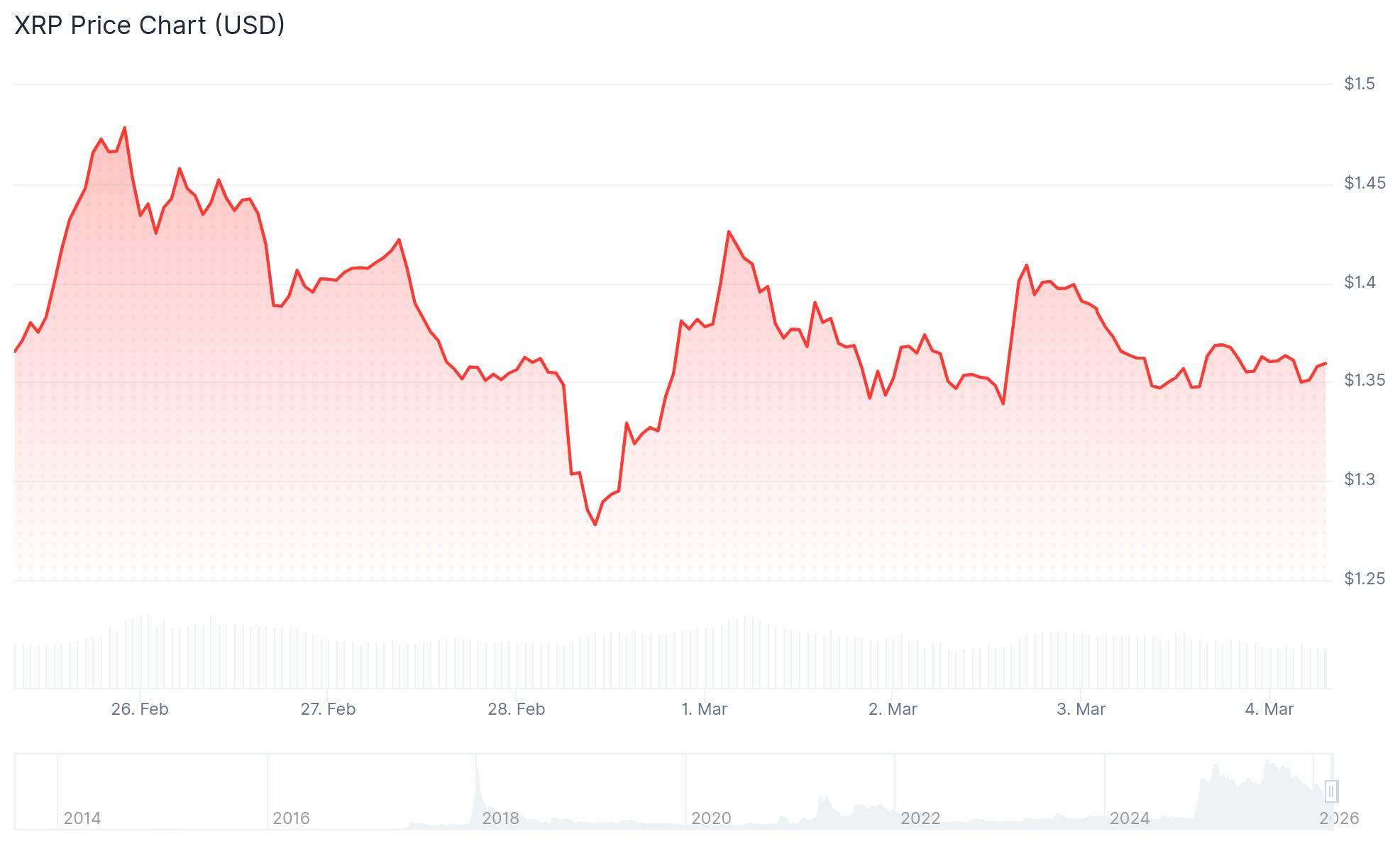
XRP maintained a market capitalization hovering around $83 billion. Trading volume reached approximately $3 billion during the 24-hour measurement period.
The decline reflected a wider retreat across risk-sensitive investments. Market participants attributed the selling pressure to intensifying military operations involving the United States, Israel, and Iran.
“The market is concerned that the US is getting pulled deeper into this conflict,” said Tim Ghriskey, senior portfolio strategist at Ingalls & Snyder.
Bitcoin similarly retreated, posting a 1.35% loss to reach $68,496 during the corresponding timeframe. Blockchain analytics revealed significant cryptocurrency withdrawals from Iranian exchanges, totaling $10.3 million between Saturday and Monday, according to Chainalysis data.

Ripple Announces Platform Enhancement
Ripple revealed plans Tuesday to expand its Ripple Payments infrastructure, incorporating support for both conventional currencies and stablecoin assets. The company is elevating its dollar-backed RLUSD stablecoin to function alongside XRP as fundamental components of the platform.
“Success in this space requires enterprise-grade infrastructure, extensive licensing, and deep liquidity,” said Monica Long, Ripple’s president.
Ripple has strategically pivoted toward stablecoin infrastructure throughout the previous year. The company acquired Rail, a stablecoin payment processor, for $200 million and introduced RLUSD after the Genius Act provided enhanced regulatory frameworks for stablecoin operations.
Implications for XRP’s Market Position
XRP has historically functioned as the intermediary asset within Ripple’s international payment network. RLUSD now presents an alternative solution operating within the identical infrastructure.
Certain market analysts suggest this development presents complications for XRP’s value proposition. Financial institutions utilizing XRP for transaction settlement typically execute conversions instantaneously, generating minimal sustained buying pressure.
RLUSD introduces a price-stable, regulatory-compliant alternative that may resonate more effectively with banking institutions and financial service providers.
From a technical analysis perspective, XRP is currently positioned beneath its 100-hour Simple Moving Average. A downward trend line has developed with resistance established near $1.3880 on hourly charts.
Should the price break above $1.3880, subsequent resistance targets emerge at $1.40 followed by $1.4320. On the downside, immediate support appears at $1.3320, with additional support at $1.3085.
XRP reached peak levels approaching $3.50 during late 2025 before entering a correction phase. The token has remained below $1.50 throughout the subsequent pullback period.
As of Tuesday’s close, XRP traded at approximately $1.36.
