



Key Highlights
- Three commercial vessels sustained damage from projectiles in the Strait of Hormuz and surrounding Persian Gulf waters
- Crude oil markets rebounded more than 3% following Tuesday’s historic 12% plunge triggered by a retracted Navy statement
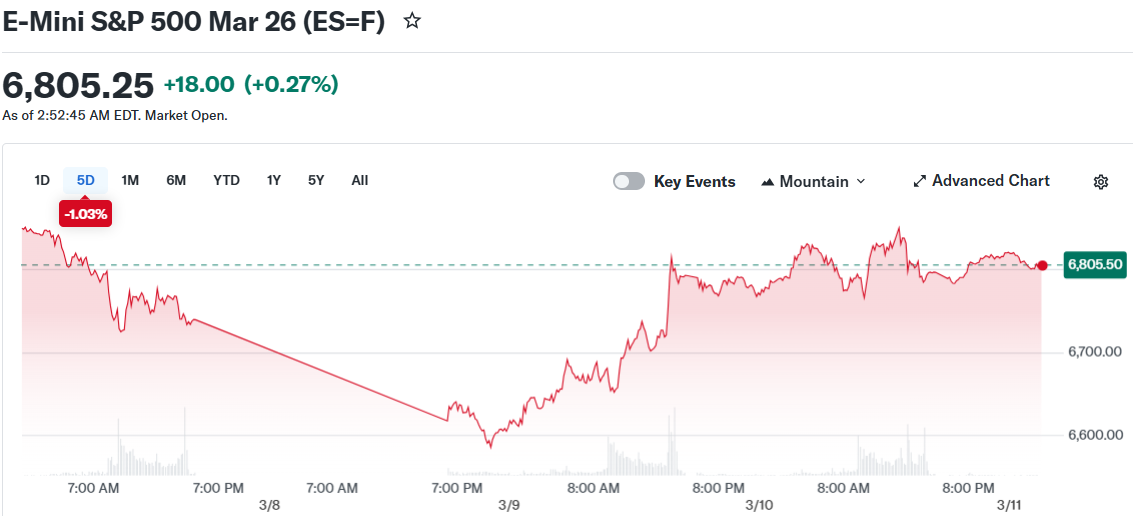
- U.S. equity index futures showed modest declines across major benchmarks in premarket trading
- International Energy Agency announces unprecedented strategic petroleum reserve deployment
- Market participants await February CPI inflation figures scheduled for 8:30 a.m. Eastern Time
U.S. equity markets opened lower on Wednesday as traders monitored escalating Middle East tensions and prepared for critical inflation metrics.
Premarket activity showed S&P 500 and Nasdaq 100 futures declining between 0.1% and 0.2%. Dow Jones Industrial Average futures similarly retreated following Tuesday’s essentially unchanged closing session.
Oil prices experienced renewed upward momentum Wednesday following extreme volatility during the prior session. West Texas Intermediate advanced 3.4% to $86.43 per barrel, while Brent crude climbed 2.7% to reach $90.25 per barrel.
The rebound follows extraordinary market turbulence Tuesday. After nearly touching $120 per barrel Monday, crude oil plummeted 12% Tuesday—marking the sharpest one-day decline in four years.

Tuesday’s collapse occurred after Energy Secretary Chris Wright posted on social media that naval forces were providing convoy protection through the Strait of Hormuz. The statement was subsequently removed, and U.S. military representatives clarified that commercial vessel escorts are not currently operational in the strategic waterway.
British naval authorities reported Wednesday that three ships sustained hits from suspected projectile weapons in the region. Affected vessels included a cargo ship near Oman in the Strait of Hormuz, a container ship west of Ras Al-Khaimah, and a bulk carrier positioned northwest of Dubai.
The cargo vessel’s onboard fire was successfully controlled without environmental contamination. A minimal crew remained aboard following the incident.
Global Oil Supply Chain Adjustments Underway
Saudi Arabia’s state oil company announced a strategic shift in export routing, redirecting crude shipments to its Red Sea terminal at Yanbu through the East-West pipeline system, completely avoiding the Strait of Hormuz.
The International Energy Agency revealed plans for a strategic petroleum reserve release exceeding the 182 million barrels deployed during 2022’s Russia-Ukraine crisis. This would represent the agency’s largest coordinated release since its establishment.
Deutsche Bank’s Jim Reid commented that market dynamics remain heavily influenced by Iranian conflict developments and petroleum supply chain concerns. While describing sentiment as “cautiously more optimistic,” he acknowledged no immediate resolution appears forthcoming.
Critical Inflation Metrics May Influence Federal Reserve Policy
Beyond petroleum market volatility, financial markets are focused on February’s Consumer Price Index report, releasing at 8:30 a.m. Eastern Wednesday. Economic forecasters anticipate headline inflation matching January’s 2.4% annual rate, with core inflation projected near 2.5%.
January’s Personal Consumption Expenditures data follows Friday.
These indicators will likely influence Federal Reserve monetary policy expectations, particularly as recent employment sector data suggests moderating growth.
In corporate news, Oracle shares surged following impressive quarterly results and optimistic forward guidance. Adobe and Dollar General earnings reports are scheduled for Thursday.
The benchmark 10-year Treasury yield registered 4.156% Wednesday morning, marginally below Tuesday’s level.
