


Key Highlights
- TD Cowen slashed LUV’s price target from $56 down to $46 but kept its Buy recommendation intact
- The most pessimistic view comes from Goldman Sachs with a Sell rating and $30 target
- Fuel costs for airlines have jumped approximately 70% following the start of the U.S.-Israel conflict with Iran
- Southwest ranked among Thursday’s biggest S&P 500 losers, declining 1.6%
- Wall Street consensus stands at Hold with a mean target price of $43.72
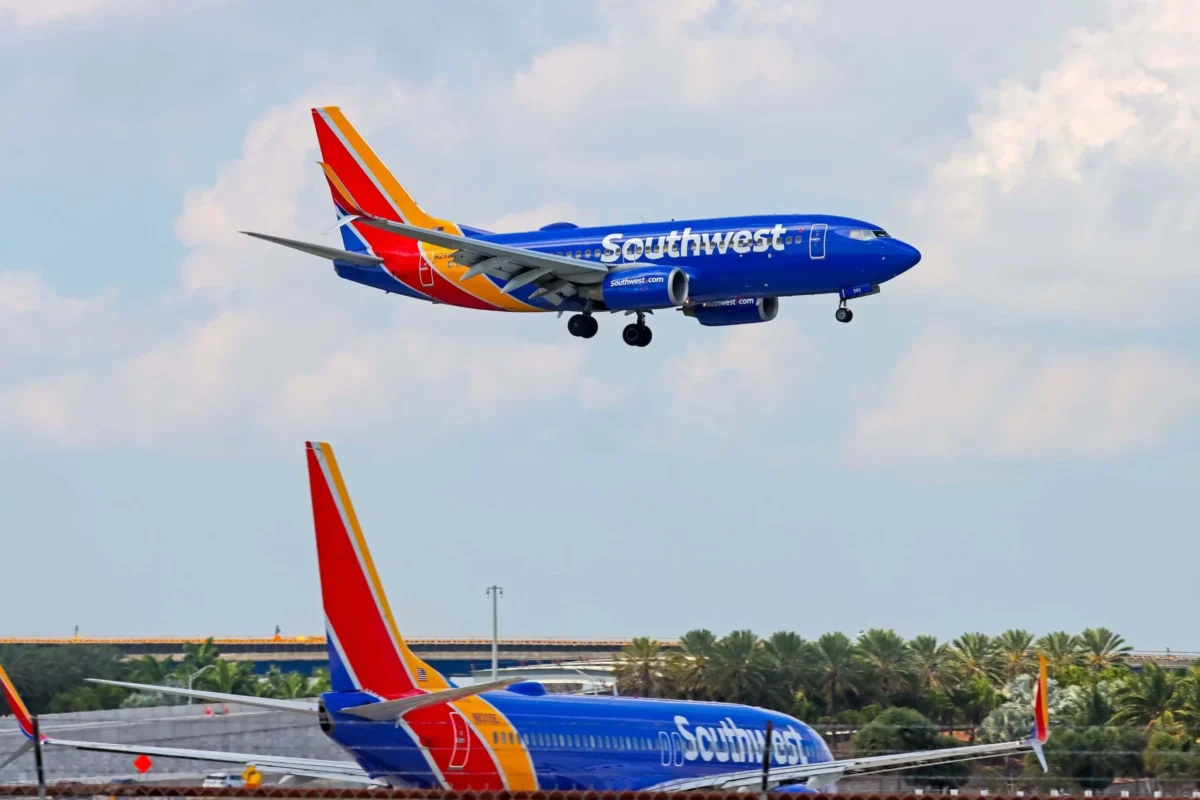
Shares of Southwest Airlines (LUV) declined 1.6% during Thursday’s trading session as escalating jet fuel expenses and ongoing Iran conflict concerns pressured the entire airline sector.
Investors had anticipated President Trump’s Wednesday address might signal a swift resolution to the conflict. However, his remarks indicated the confrontation could persist, suggesting elevated fuel expenses will continue affecting airline profitability.
Airline fuel costs have skyrocketed roughly 70% since hostilities with Iran commenced. The U.S. Gulf Coast Kerosene-Type Jet Fuel Spot price reached $4.344 per gallon on March 20—marking the highest reading since May 2022. For comparison, this metric registered just $2.428 per gallon on February 27, before the conflict began.

TD Cowen’s analyst Tom Fitzgerald revised his LUV price objective downward from $56 to $46 on Thursday, while maintaining his Buy recommendation. Despite the reduction, this updated forecast suggests potential upside of approximately 27.8% from Thursday’s closing level.
Fitzgerald expressed concerns about travel demand sustainability, citing the probability of persistently high energy costs and weakening credit card spending trends. His firm reduced earnings projections for all six major U.S. carriers, anticipating fuel prices will remain elevated through the remainder of 2026.
The weakness extended beyond Southwest. United Airlines dropped 3% to $92.21, while Delta decreased 1.2%, JetBlue retreated 0.7%, and American Airlines shed 2.6%. The U.S. Global JETS ETF fell 1.4%.
TD Cowen identified American Airlines, JetBlue, and Alaska Air Group as carriers facing the greatest vulnerability to fuel price volatility, pointing to their increased leverage and heightened fuel expense sensitivity.
Wall Street Downgrades Accelerate
The overall analyst sentiment toward LUV remains divided. Eight firms recommend Buy, eight suggest Hold, and four advise Sell. The consensus price objective stands at $43.72.
Goldman Sachs reduced its projection to $30 from $32 while maintaining a Sell stance. Bank of America lowered its forecast to $40 with an Underperform rating. Wells Fargo decreased its target to $44 alongside an Equal Weight view. Raymond James cut to $45 from $55, while BMO reduced to $45 from $57.50.
Among the more optimistic voices, Barclays upgraded LUV to Overweight in December with a $56 objective. Jefferies marginally increased its target to $42 while keeping a Hold rating.
Recent Financial Performance
Southwest released its latest quarterly results on January 28. The carrier reported earnings per share of $0.58, surpassing the Street’s $0.56 estimate by $0.02.
Revenue totaled $7.44 billion, falling slightly short of the anticipated $7.51 billion. Nevertheless, this represented a 7.4% increase compared to the same period last year.
Management has provided guidance calling for fiscal year 2026 EPS of $4.00 and first-quarter 2026 EPS of $0.45. The shares have traded within a 52-week band of $23.82 to $55.11.
The stock’s 50-day moving average currently stands at $45.70, considerably above its present trading price of $37.61.
