


TLDR
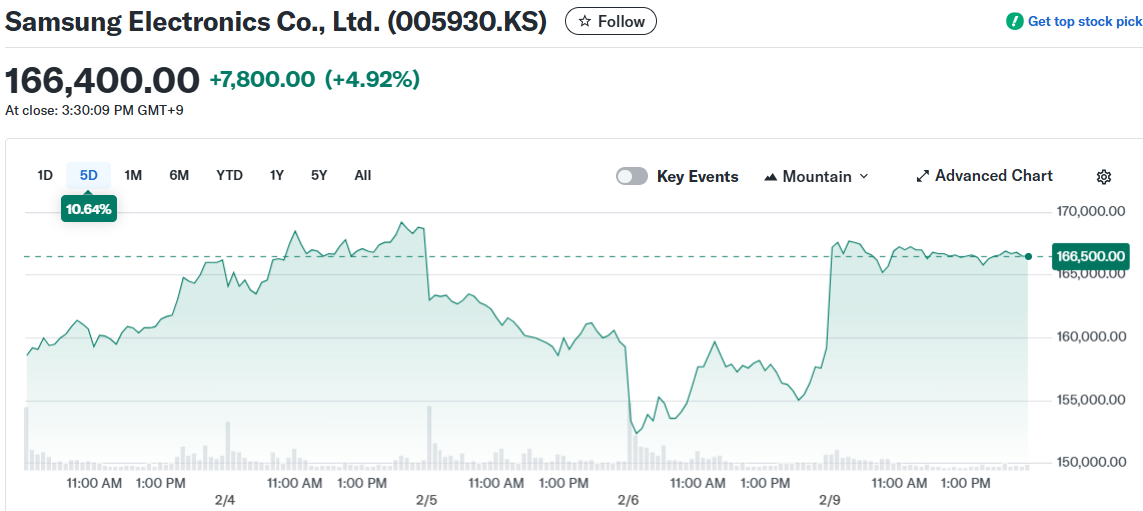
- Samsung Electronics stock jumped 4.9% to 6.4% after revealing plans to mass produce HBM4 memory chips this month.
- The company will ship HBM4 chips to Nvidia by mid-February for integration into Vera Rubin AI accelerators.
- Samsung’s production schedule puts it ahead of Micron Technology, which targets Q2 2026 for HBM4 rollout.
- Micron shares rose 3.08% as analysts believe the company can hold its 20%-25% HBM market position.
- AI chip vendors are moving to three-supplier strategies, creating opportunities for all major HBM manufacturers.
Samsung Electronics shares got a major lift Monday after reports surfaced about the company’s next-generation chip production plans. The stock climbed between 4.9% and 6.4% depending on the exchange.
Industry sources told Yonhap news agency that Samsung will begin mass producing HBM4 memory chips later this month. The timeline represents a crucial development in the AI chip supply race.
HBM4 chips are the latest version of high-bandwidth memory. These components are vital for powering cutting-edge artificial intelligence processors.
Samsung plans to deliver the first HBM4 chips to Nvidia by mid-February. The chips will go into Nvidia’s upcoming Vera Rubin AI accelerators.
Nvidia stock responded with a 7.87% gain. SK Hynix shares rose 5.72% on the Samsung news.

Micron Faces Increased Pressure
The announcement creates a competitive challenge for Micron Technology. The American chipmaker has been riding a wave of HBM demand that pushed its stock up more than 400% in 12 months.
Micron shares still gained 3.08% Monday. The company outlined plans to start HBM4 production in the second quarter of 2026 during its most recent earnings call.
Micron CEO Sanjay Mehrotra discussed the production timeline with analysts. Samsung’s February start gives it roughly a three-month advantage over Micron’s schedule.
Samsung’s stock has nearly tripled over the past year. The entire memory chip sector has benefited from surging AI infrastructure demand.
Both companies are competing for contracts with Nvidia and other AI chip manufacturers. HBM chips generate higher profit margins than traditional memory products.
Three Suppliers Better Than Two
Analysts aren’t worried about Micron losing ground in the market. Current demand levels can support multiple HBM suppliers comfortably.
UBS analyst Timothy Arcuri explained that AI accelerator vendors are adopting three-supplier sourcing strategies. Companies previously depended on just two HBM suppliers for their needs.
This industry shift creates space for Samsung, Micron, and SK Hynix to all capture market share. Wall Street expects Micron to maintain the 20%-25% market share it achieved last year.
The HBM market continues expanding as AI applications multiply. Demand for high-performance memory chips shows no signs of slowing down.
Solid Financial Foundation
Samsung operates with a market capitalization of $694.62 billion. The company generated $223.32 billion in revenue with a 7% growth rate over the past three years.
Financial metrics reveal a current ratio of 2.63 and a debt-to-equity ratio of 0.04. These numbers indicate strong liquidity and minimal debt burden.
The company posted a gross margin of 36.65% and an operating margin of 9.51%. An Altman Z-Score of 7.78 suggests robust financial health.
Samsung’s P/E ratio sits at 32.73, near its one-year high. The stock shows an RSI of 100, indicating potentially overbought conditions.
Samsung didn’t provide immediate comment when contacted about the production timeline. The HBM4 launch represents a key moment in the ongoing competition for AI chip supremacy.
