


Key Highlights
- PAYP shares launched at $19 per share, marking a 19% premium over the $16 initial public offering price
- The Japanese fintech company generated approximately $880 million by offering 55 million American Depositary Shares
- Initial trading day valuations placed the company between $12.7 billion and $14.7 billion
- The fintech platform serves approximately 72 million users and facilitates more than $100 billion in transaction volume
- A strategic collaboration with Visa was unveiled to evaluate opportunities in the United States market
On March 12, 2026, PayPay (PAYP) kicked off trading on the Nasdaq exchange with impressive momentum, launching at $19 per share — representing a substantial 19% increase over its initial offering price of $16. The Japanese digital payments giant, which counts SoftBank as a major backer, had set its share price beneath the anticipated $17–$20 range.
Through the public offering, which involved the sale of approximately 55 million American Depositary Shares, PayPay secured roughly $880 million in capital. Both PayPay itself and a SoftBank-affiliated investment vehicle participated as sellers.
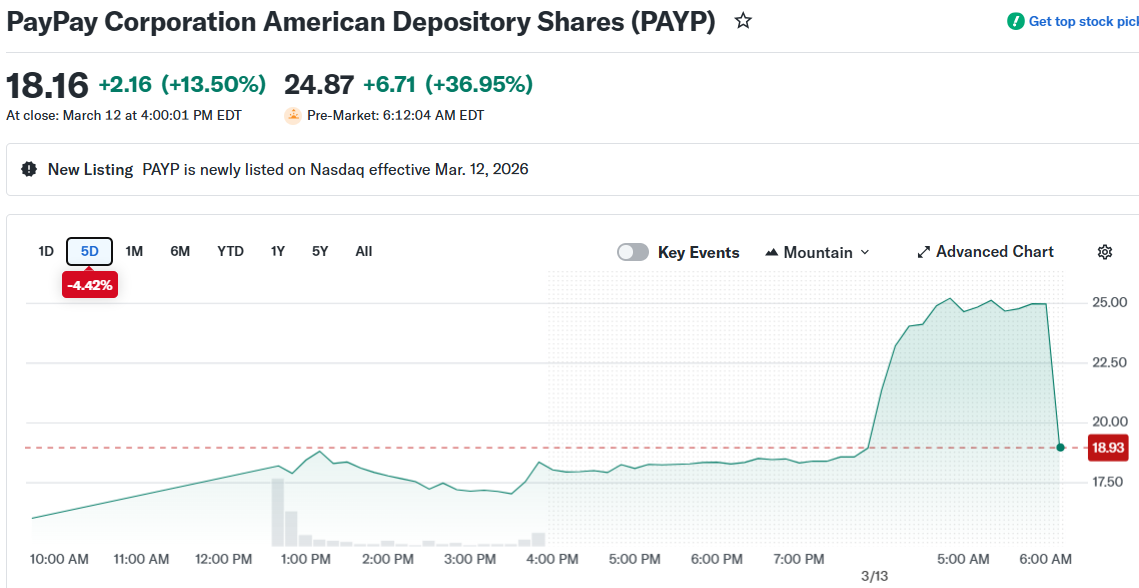
Based on various pricing calculations, the company’s market capitalization on day one ranged between approximately $12.7 billion and $14.7 billion. By Thursday afternoon, shares had moderated slightly to approximately $18.03, showing typical first-day trading fluctuations following the robust opening.
This marks the first time a SoftBank-majority investment has listed on U.S. exchanges since semiconductor designer Arm completed its public offering in 2023.

Originally scheduled for December, the public listing faced postponement when the U.S. government shutdown last autumn created delays in the Securities and Exchange Commission’s approval timeline.
Dominant Position in Japan
PayPay emerged from a 2018 joint venture between SoftBank and Yahoo Japan. To accelerate market penetration, the company implemented an aggressive growth strategy, eliminating transaction fees for small and medium-sized businesses for periods extending up to three years.
This approach delivered significant results. The platform now serves approximately 72 million registered accounts across Japan and has facilitated over $100 billion in total transaction volume.
“The appeal of the company is that it’s one of the few fintech IPOs that have already won its domestic market,” said IPOX Research Associate Lukas Muehlbauer.
Despite PayPay’s success, Japan continues to trail other developed nations in digital payment adoption, suggesting substantial opportunities for continued domestic expansion.
PayPay’s Chief Executive Officer Ichiro Nakayama ceremonially opened trading at the Nasdaq Market Site in New York Thursday morning. Speaking with Reuters, he outlined the company’s post-listing ambitions to transform from a payments-focused platform into a comprehensive financial services ecosystem.
The company has already diversified beyond its core payment processing business into lending products, banking services, investment offerings, and insurance products.
American Market Ambitions
February 2026 brought news of a strategic alliance between PayPay and Visa, signaling the Japanese company’s interest in entering the competitive U.S. payments landscape. Specific implementation plans and launch timelines have not been disclosed.
Visa stock declined approximately 0.55% to $307.25 during Thursday’s session, while PayPal shares decreased roughly 1.60% to close at $44.84.
Following the customary post-IPO quiet period, Wall Street analysts from the underwriting banks are anticipated to publish their research reports and price targets in early April.
Industry observers viewed PayPay’s public offering as an important barometer for the broader IPO market, which has experienced inconsistent performance recently. Geopolitical uncertainty stemming from Middle East conflicts had already caused several companies to reconsider or postpone their listing timetables.
“Given the backdrop, it’s a positive for the IPO market that PayPay is trading well so far,” said Nicholas Einhorn, Vice President of Research at Renaissance Capital.
