


TLDR
- European gas markets declined 9.5% Wednesday following Iran’s indication of readiness to engage in diplomatic discussions with Washington.
- Earlier this week, prices had jumped 54% after military actions involving the U.S. and Israel created disruptions in the Strait of Hormuz.
- Two Qatari LNG facilities suspended operations after Iranian drone strikes, creating concerns about global supply constraints.
- Shares of U.S. LNG exporters Cheniere Energy and Venture Global declined during premarket hours following the price retreat.
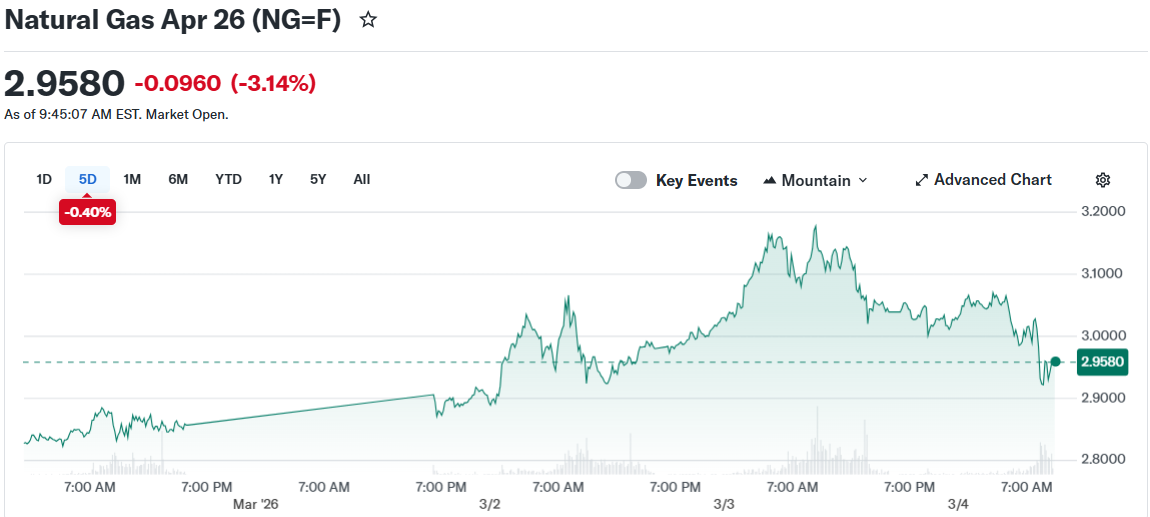
- U.S. natural gas contracts dipped back under $3, with market experts noting domestic markets remain relatively protected from international supply disruptions.
Global natural gas markets experienced significant volatility this week following military confrontations involving Iran that threatened a crucial energy transit route. However, Wednesday brought a sharp reversal as diplomatic signals emerged.
The Dutch TTF Gas benchmark, Europe’s primary pricing reference, tumbled 9.5% to 49 euros ($57) per megawatt hour during Wednesday’s session. Despite this decline, the contract remains elevated by 54% for the week.
The volatility began after coordinated U.S. and Israeli military operations against Iran escalated into broader regional tensions, creating obstacles for vessels navigating the Strait of Hormuz. This waterway serves as a vital artery for global energy transportation.
Qatar, ranking as the globe’s third-largest liquefied natural gas supplier, suspended operations at its Ras Laffan production complex following Iranian drone strikes targeting two facilities. This development heightened concerns about potential supply shortfalls.

Asian LNG markets showed pronounced sensitivity to these developments. The differential between JKM and TTF prices, measuring the gap between Asian and European benchmark rates, expanded beyond $6 per million British thermal units.
Over 80% of LNG shipments originating from Persian Gulf terminals are bound for Asian destinations. Approximately 90% of liquefied natural gas transiting the Strait of Hormuz ultimately reaches Asian markets.
While Europe doesn’t depend directly on Persian Gulf LNG supplies, the continent remains vulnerable to global spot market dynamics. Supply constraints in any major market create upward pressure on worldwide benchmark prices.
The price rally reversed course sharply after the New York Times disclosed that Iran had initiated contact with Washington through confidential diplomatic channels. Iranian officials communicated their willingness to pursue negotiations aimed at ending hostilities.
U.S. Defense Secretary Pete Hegseth and Chairman of the Joint Chiefs Gen. Dan Caine were expected to conduct a Pentagon briefing Wednesday morning, the Wall Street Journal reported.
LNG Stocks Fall on Price Drop
The retreat in natural gas valuations created headwinds for American LNG producers. Cheniere Energy shares decreased 0.4% while Venture Global stock fell 3.1% during premarket trading Wednesday.
Both corporations represent significant players in U.S. liquefied natural gas exports to international buyers. Elevated global pricing typically strengthens their revenue projections.
U.S. Market Largely Shielded
Domestic natural gas futures contracts slipped beneath the $3 threshold, declining 4.1% to $2.929 per million British thermal units for April delivery. Industry analysts emphasize that U.S. markets maintain considerable insulation.
“Nymex natural gas — fundamentally insulated near-term from global supply outages with LNG exports already at maximum capacity — may be on the verge of decoupling lower from oil,” said Eli Rubin of EBW Analytics.
Meteorological forecasts anticipate above-average temperatures extending through the coming week, diminishing heating fuel requirements. A return to colder conditions is anticipated around mid-March, potentially supporting price recovery.
For perspective, European gas valuations surged 293% during the February through August 2022 period following Russia’s military invasion of Ukraine. Wednesday’s pullback to 49 euros per megawatt hour follows TTF reaching a three-year peak in the prior trading session.
Dutch TTF had retreated 13% by mid-morning Wednesday trading, while U.S. Nymex gas futures showed a 4.1% decline.
