



Key Takeaways
- Brent crude reached $104.76 per barrel following U.S.-Israel operations against Iran disrupting critical Strait of Hormuz shipping routes
- Approximately 20% of global oil supply passes through the Strait, where tanker traffic has come to a near standstill
- European oil companies could achieve free cash flow yields approaching 14% if crude remains at $100, according to JPMorgan analysis
- Shell, TotalEnergies, Eni, and Galp represent JPMorgan’s preferred investment opportunities in the sector
- The Federal Reserve may postpone anticipated rate reductions due to oil-driven inflationary pressures
Wall Street analysts are turning their focus toward European oil stocks as crude oil prices breach the $100-per-barrel threshold, propelled by supply concerns stemming from the escalating U.S.-Israel military operations targeting Iran.
Brent crude futures advanced 1.3% to reach $104.76 per barrel during Wednesday trading, recovering from earlier session declines. The upward movement persisted despite an announcement from Iraq and Kurdish officials regarding the restart of oil shipments through Turkey’s Ceyhan terminal, which provided modest market support.
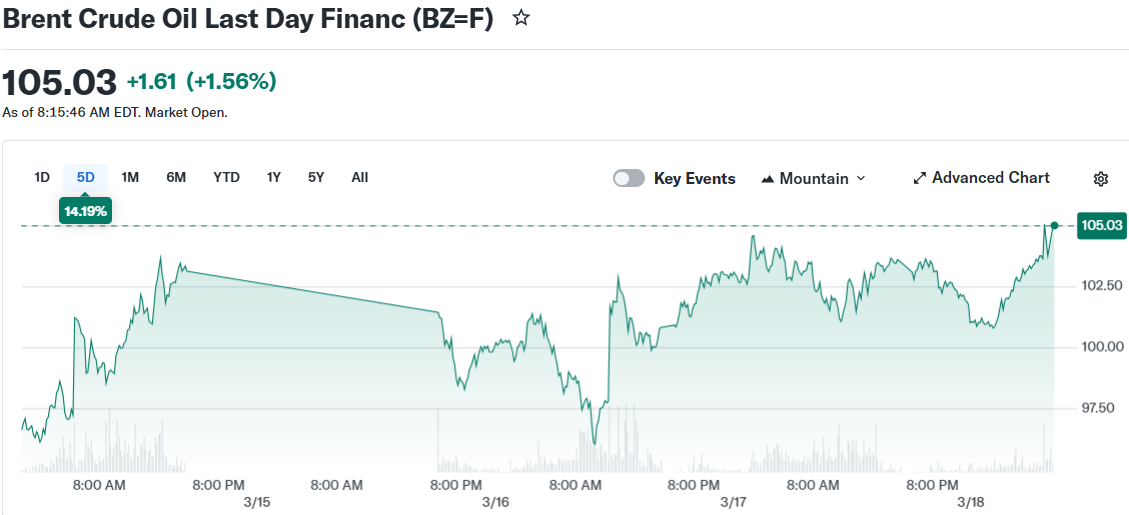
West Texas Intermediate declined 0.6% to settle at $94.95 per barrel during the same trading period.
The military conflict, entering its third week, has effectively paralyzed maritime traffic through the Strait of Hormuz. American forces have conducted strikes against Iranian coastal installations housing cruise missile systems capable of engaging vessels navigating the strategic passage.

Approximately 20% of the world’s petroleum flows through the Strait of Hormuz. Any extended interruption in this critical chokepoint carries significant ramifications for global energy markets.
JPMorgan equity analyst Matthew Lofting characterizes the financial implications for European energy producers as “clearly positive.” His analysis suggests that production volumes lost due to Hormuz-related disruptions reduce company cash flows by approximately $6 per barrel, with the most exposed operators facing up to $10 per barrel in losses.
These volume-related setbacks pale in comparison to the roughly $30 price appreciation oil has experienced since hostilities commenced, resulting in net positive outcomes for the majority of producers.
Cash Flow Projections Reach 14% Yields
Lofting’s financial models project that European oil sector free cash flow yields could climb from the current 10% baseline under existing forward price curves to approximately 14% should oil prices stabilize at $100. He characterizes current sector valuations as remaining “modestly cheap” relative to multiples observed during the 2022 energy supply crisis.
European energy sector equities have already appreciated more than 10% since the onset of the conflict.
JPMorgan identifies Shell, TotalEnergies, Eni, and Galp as its preferred sector investments. The investment bank emphasizes robust price sensitivity, extended production duration, and attractive valuation metrics as primary investment rationales.
Eni and Shell receive particular attention for their elevated oil price sensitivity. Galp’s price leverage appears underrepresented in near-term financial metrics, according to the analysis.
TotalEnergies, Shell, and OMV maintain the most substantial Middle Eastern asset exposure. Conversely, Equinor, Repsol, and Galp have minimal or zero direct regional presence and may demonstrate enhanced responsiveness to immediate price movements.
JPMorgan anticipates exceptional trading division performance to provide additional upside, with internal models projecting approximately $4 billion in potential trading gains for Shell independently.
Lofting identifies potential windfall tax reimplementation as a notable downside risk, drawing parallels to 2022–23 precedents. His models incorporate an additional 5% cash flow tax as a plausible headwind scenario.
Federal Reserve Decision Introduces Additional Market Variables
Investors adopted a cautious posture ahead of Wednesday’s Federal Reserve policy announcement. The central bank is broadly anticipated to maintain its benchmark rate within the 3.5% to 3.75% range.
Fed Chairman Jerome Powell, who will conclude his tenure in May, is scheduled to deliver remarks following the rate decision. Market participants will scrutinize his commentary for indications regarding how the oil price shock might influence monetary policy trajectory.
Prior to the military escalation, market participants had anticipated a rate reduction during the latter half of 2025. ING economists suggest the Fed may now signal postponement of those projected cuts.
Colder-than-average winter conditions combined with recent market dynamics are expected to bolster robust energy trading results during the first quarter, according to JPMorgan’s assessment.
