


TLDR
- The dollar index climbed as much as 1% to reach 99.34, marking its strongest position since January 2026.
- Against the euro and yen, the greenback has appreciated approximately 1% following the outbreak of Iran-related tensions.
- America’s self-sufficiency in energy production shields the dollar from crude oil price volatility.
- Surging natural gas costs are weighing heavily on Europe, with EUR/USD dropping roughly 1%.
- ING strategists forecast DXY could reach 99.50–100.00 territory as long as energy market volatility persists.
The greenback has surged to its strongest position since January 2026 as military tensions across the Middle East intensified, prompting market participants to pile back into the U.S. currency as their top safe-haven choice.
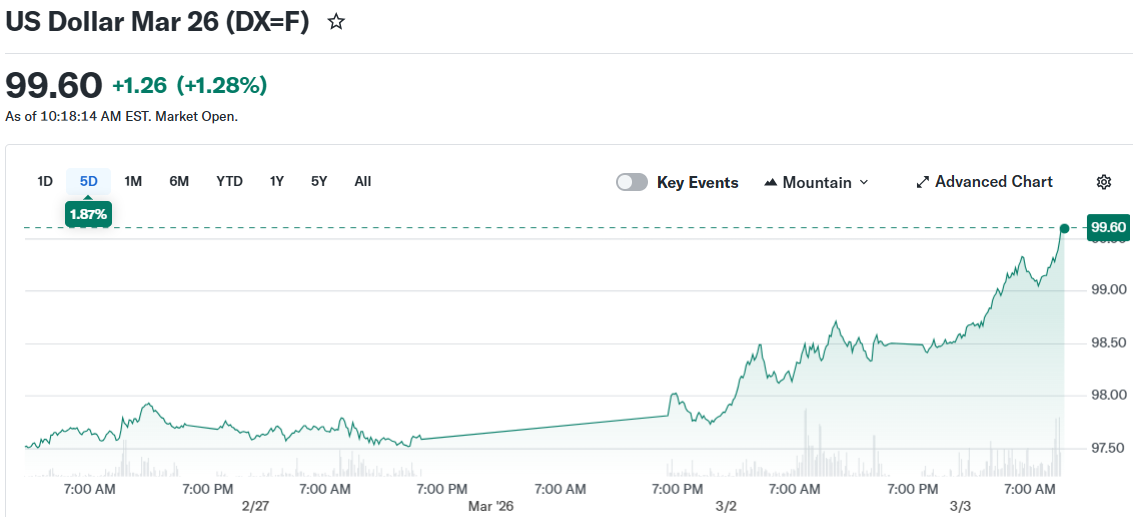
The dollar index, tracking the currency’s value versus six major trading partners, advanced approximately 1% during Tuesday’s session to settle at 99.34. This builds upon Monday’s nearly 1% appreciation.
Against both the euro and Japanese yen, the U.S. currency has strengthened by roughly 1% since tensions involving Iran first erupted. These two currencies had previously attracted attention from certain market participants as potential dollar alternatives in recent months.
What started primarily as a confrontation between Washington and Tehran has now expanded across the region. Multiple sources confirmed that the American embassy in Riyadh faced missile strikes. Data infrastructure operated by Amazon in both the UAE and Bahrain reportedly sustained damage during Iranian counterattacks.

On Tuesday, the State Department mandated the evacuation of non-essential diplomatic staff and their families from Bahrain, Iraq, and Jordan. Israeli defense forces announced simultaneous operations against both Iran and Lebanon following Hezbollah’s assault on Tel Aviv using missiles and unmanned aerial vehicles.
Why the Dollar Is Benefiting
Market strategists cite America’s energy self-reliance as a primary factor behind the dollar’s outperformance. With substantial domestic energy production capacity, the United States faces limited exposure to escalating petroleum costs compared to European and Asian economies.
“The dollar looks the best currency to take advantage of this energy shock,” ING analyst Chris Turner wrote. Countries like Australia and Norway, which are also large energy exporters, have also seen their currencies hold up.
This recent strength comes after extended skepticism regarding the dollar’s status as a premier safe asset. The currency notably failed to appreciate during last year’s tariff-induced market turbulence, prompting speculation about accelerating de-dollarization trends.
David Morrison, senior market analyst at Trade Nation, said the move was “a strong indication that the U.S. dollar remains the go-to safe-haven currency” and that those calling for further weakness “may be a bit early.”
Euro Under Pressure from Energy Costs
The EUR/USD pair declined approximately 1% to trade at 1.1581 on Tuesday. European economies depend heavily on energy imports, and natural gas valuations have skyrocketed due to the regional instability.
According to ING, substantial long positioning in the euro suggests limited appetite among traders to purchase during weakness absent concrete signals of conflict de-escalation. The Eurozone’s preliminary inflation data for February was scheduled for release Tuesday afternoon, with market consensus anticipating an annual rate of 1.7%. ING noted that any inflation reading above expectations might provide modest euro support by potentially making the European Central Bank more hesitant about additional monetary easing.
Despite the current strength, the dollar remains down approximately 6.5% over a twelve-month timeframe on the DXY index. ING strategists indicated the dollar index appears poised to maintain its bid tone in the immediate future, targeting the 99.50 to 100.00 zone while energy market prices stay elevated.
