


TLDR
- Precious metal prices advanced following renewed Israeli military operations in Tehran, though upside momentum was restricted by greenback appreciation
- The yellow metal fluctuated between $5,121 and $5,156 per ounce during Thursday’s session, posting gains approaching 20% for the year
- Prices reached an all-time peak of $5,594.82 in January 2026, later surging past $5,400 as U.S.-Israeli military operations against Iran commenced
- The central bank’s upcoming policy meeting is scheduled for March 18, with market participants anticipating unchanged interest rates
- The administration announced Kevin Warsh, a former Federal Reserve Governor, as the nominee for Fed chair on Wednesday
The precious metal market experienced bidirectional pressure Thursday as competing dynamics influenced prices: escalating Middle Eastern military tensions driving investors toward protective assets, while dollar appreciation made the yellow metal costlier for international purchasers.
The spot market saw prices oscillating between $5,121 and $5,156 per ounce throughout Thursday’s trading. Earlier in the session, valuations briefly exceeded $5,200 before retreating.
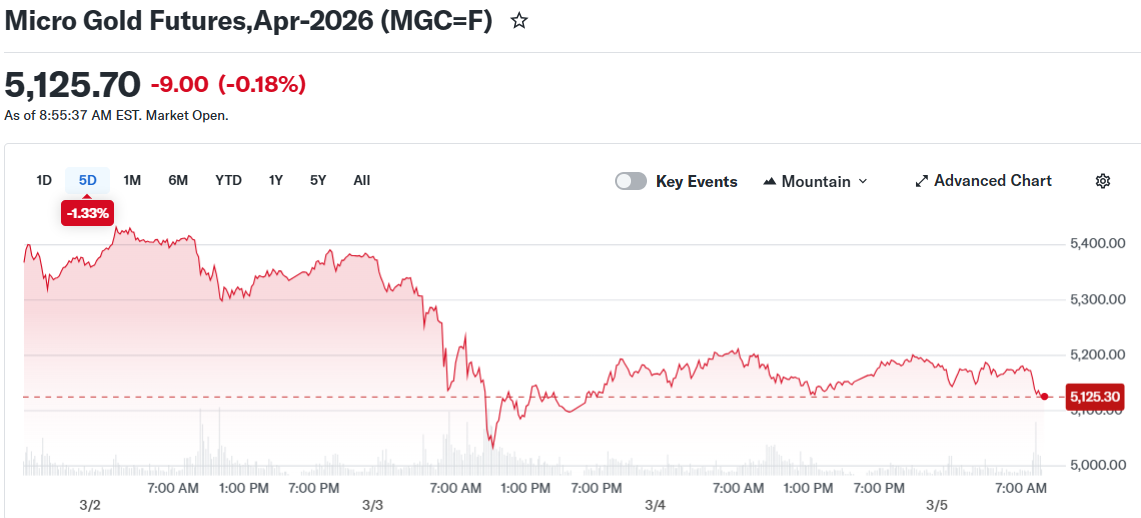
The metal has accumulated approximately 20% appreciation through 2026. Its historic zenith of $5,594.82 was established in January.
When military operations between the U.S.-Israel alliance and Iran intensified at the week’s start, the commodity surged beyond $5,400 on Monday. This upward movement reflected investor repositioning toward protective assets amid mounting regional hostilities.

Israel executed another substantial bombardment campaign against Tehran on Thursday. Military officials indicated the operations focused on facilities associated with Iranian governmental infrastructure.
The military action followed Iranian ballistic missile launches that forced millions of Israeli civilians into protective shelters.
Safe-Haven Demand vs. Dollar Strength
The U.S. dollar appreciated approximately 0.2% Thursday, temporarily retreating from three-month peaks. Greenback strength typically constrains the yellow metal’s advancement by increasing its cost in foreign currencies.
Hamad Hussain, a climate and commodities economist at Capital Economics, noted the military situation creates contradictory pressures for the precious metal. Protective asset demand elevates valuations, but rising energy costs could intensify inflationary pressures and diminish prospects for monetary easing — creating headwinds for prices.
Gold generates no yield, making it more attractive during periods of reduced interest rates.
Fed Policy in Focus
President Trump formally announced his selection of former Federal Reserve Governor Kevin Warsh for the position of Fed chair on Wednesday.
The central bank published its most recent Beige Book on Wednesday. The report indicated modest expansion in U.S. economic activity, continued price elevation, and steady labor market conditions.
Market participants currently anticipate the Fed will maintain current rate levels at its March 18 policy meeting, based on CME Group’s FedWatch tool projections.
Traders are additionally monitoring weekly unemployment claims data scheduled for Thursday release and the February employment report due Friday. Both datasets could provide additional insight into monetary policy trajectory.
Worries surrounding elevated energy costs are intensifying inflation anxieties throughout international markets.
Silver advanced 0.8% to $84.10 per ounce Thursday. Platinum climbed nearly 1% to $2,168.05, while palladium declined 0.9% to $1,659.35.
