


TLDR
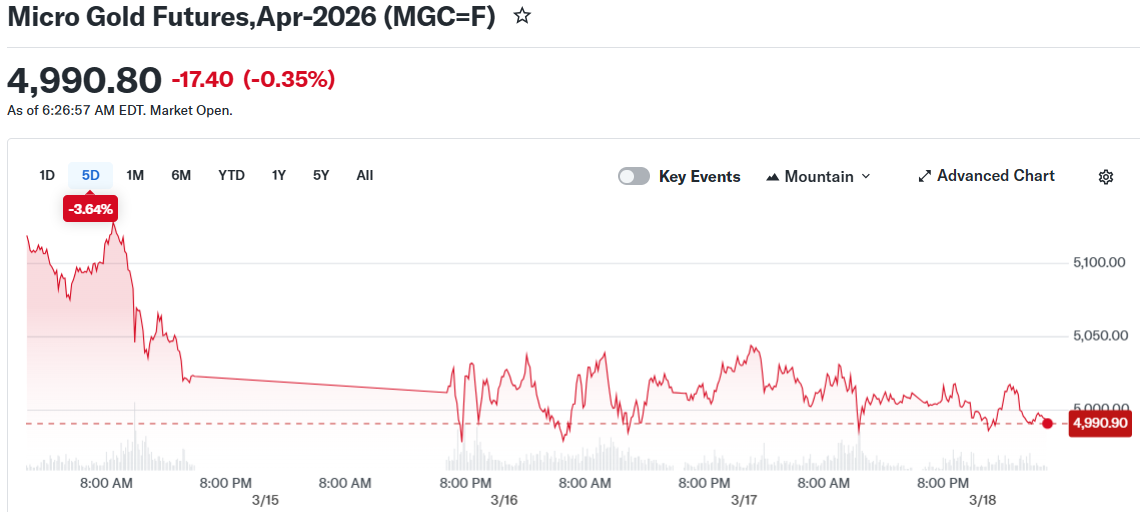
- Gold prices are currently trading close to $5,000 per ounce, registering an 18% gain year-to-date, following a dip to $4,967 on March 16, marking a four-week low
- The Federal Reserve is anticipated to maintain interest rates at 3.50–3.75% during today’s meeting, with market consensus showing a 99.2% likelihood of unchanged rates
- The precious metal spiked to $5,423 on February 28 following military strikes against Iran by U.S. and Israeli forces, though the rally reversed within days amid dollar appreciation and shifting rate cut expectations
- Iran has conducted missile and drone strikes targeting UAE, Saudi Arabia, and Kuwait; maritime traffic through the Strait of Hormuz has come to a virtual standstill
- Major financial institutions such as J.P. Morgan and Deutsche Bank project gold will reach $6,300 and $6,000 respectively by the end of 2026
The gold market is consolidating near the $5,000 per ounce level as market participants await the Federal Reserve’s policy announcement and subsequent press conference scheduled for today. Traders emphasize that the message from the Fed — rather than the rate decision itself — will be the primary price catalyst.
The Federal Reserve is broadly anticipated to keep its benchmark rate unchanged at 3.50–3.75%. According to CME FedWatch, there’s a 99.2% probability of no rate adjustment. The critical factor for markets will be Fed Chair Jerome Powell’s commentary regarding inflation trends, employment conditions, and the trajectory of potential future rate reductions.
Gold reached its peak at $5,423 on February 28 in the aftermath of coordinated U.S. and Israeli military operations against Iranian installations. The bullish momentum persisted for roughly three days before reversing course. By March 16, the spot price had retreated to $4,967, representing a one-month low.
Since that February spike, two primary factors have exerted downward pressure on gold valuations. The U.S. dollar has appreciated as market participants flocked to safe-haven currencies, which increases the cost of gold for international buyers using foreign currencies. Additionally, elevated oil prices — with Brent crude maintaining levels above $100 per barrel — have amplified inflation concerns, diminishing expectations for imminent monetary policy easing.

How the Middle East Conflict Is Affecting Markets
Geopolitical tensions have maintained consistent pressure across energy commodities. Iraq recently finalized an agreement to restart oil shipments through Turkey, which provided some relief to supply concerns and contributed to oil lower prices on Wednesday. However, shipping activity through the strategically important Strait of Hormuz continues to be severely restricted.
Iran acknowledged the death of Ali Larijani, its national security chief, following targeted strikes during the night. In response, Tehran initiated additional missile and drone attacks against targets in the UAE, Saudi Arabia, and Kuwait.
The energy supply disruption has elevated inflation forecasts at a time when the Fed’s preferred inflation metric, core PCE, registered 3.1% in January. Consumer Price Index data for March and April — which would reveal the extent of oil price pass-through to consumer prices — has not yet been released.
What the Fed Could Signal for Gold
Current market pricing reflects expectations for just one rate reduction in 2026, likely occurring in December. This represents a significant shift from the beginning of the year, when traders anticipated multiple cuts throughout the period.
The Federal Reserve’s dot plot projection, scheduled for release at 2:00 p.m. ET today, will reveal policymakers’ collective outlook on the interest rate path forward. Should the median projection indicate zero or one cut, it would reinforce tighter monetary policy expectations and likely pressure gold prices downward. Conversely, projections showing two or more cuts could provide support for the precious metal.
Powell’s press conference commences at 2:30 p.m. ET. This marks his penultimate scheduled press conference before his chairmanship concludes in May.
From a technical perspective, gold has maintained the $4,996 support level on a closing basis since mid-March. The Relative Strength Index currently registers approximately 47, indicating neutral momentum. The immediate resistance level to watch stands at $5,053.
Central bank gold purchases have averaged approximately 1,000 tons annually beginning in 2022. J.P. Morgan maintains a year-end 2026 price target of $6,300 for gold. Deutsche Bank projects a $6,000 target for the same timeframe.
Spot gold was quoted at $5,012.29 during early Wednesday trading hours in Singapore. Silver advanced 0.6% to reach $79.75. Following today’s Federal Reserve decision, the next significant economic data release will be the March CPI report on April 10.
