



Key Highlights
- DOGE climbed approximately 15% over a 24-hour period while Bitcoin surged past the $73,000 mark
- Trading activity for Dogecoin spiked 78%, reaching $2.39 billion in daily volume
- The Relative Strength Index reached approximately 70, signaling potential overbought conditions
- Critical resistance remains at the $0.12 level, with analysts eyeing $0.15 as a potential secondary objective
- Social sentiment data shows “Altseason” discussions hitting historic lows, a pattern that has often signaled DOGE price bottoms
The popular meme cryptocurrency Dogecoin experienced a significant price surge on Thursday, gaining nearly 15% in a 24-hour span. This upward movement aligned with a broader cryptocurrency market recovery, spearheaded by Bitcoin’s advance beyond the $73,000 threshold.
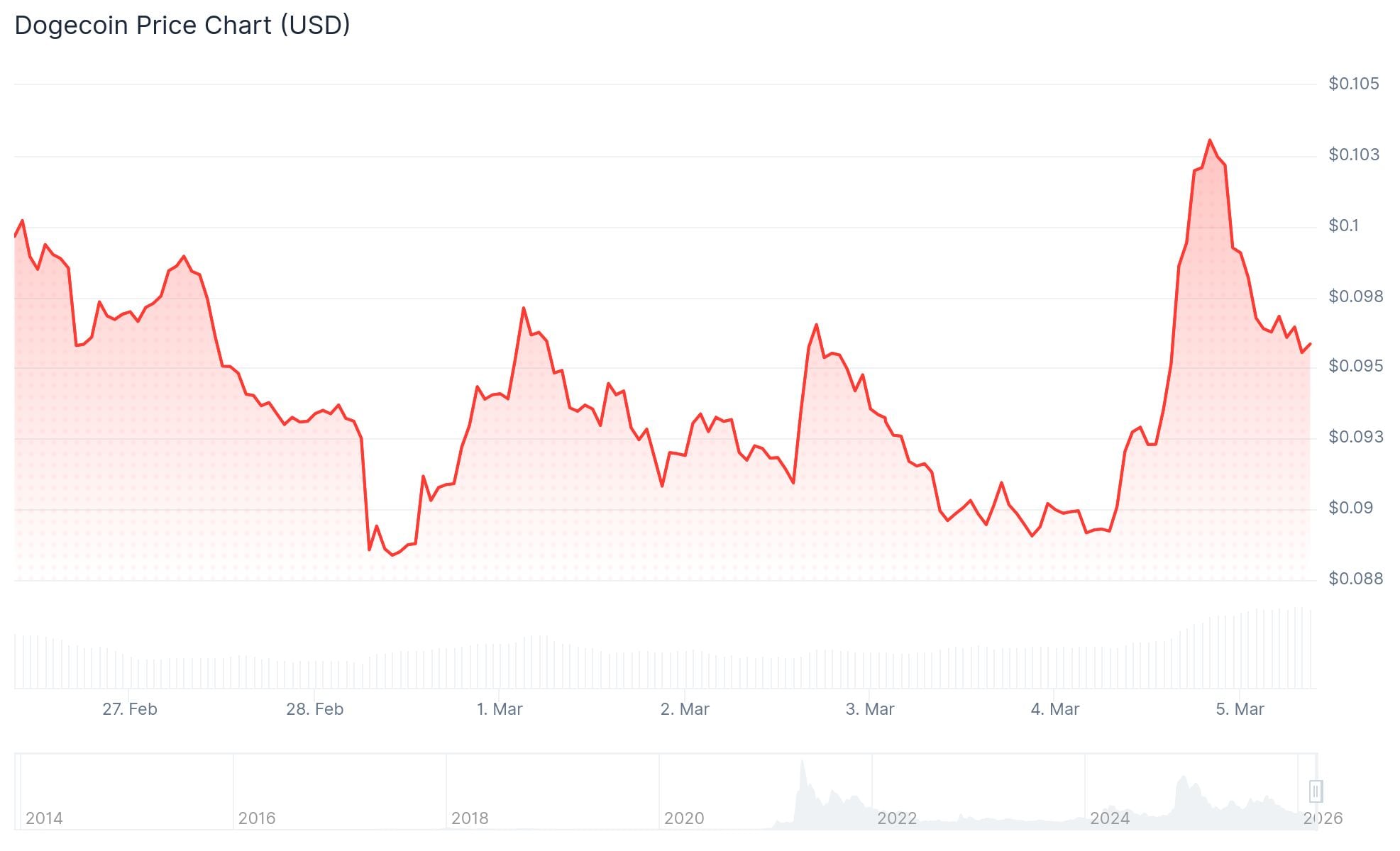
During the reporting period, DOGE was changing hands near the $0.102 mark. The digital asset successfully breached the psychologically important $0.10 price point, a level that had previously served as crucial support.
Ethereum similarly experienced upward momentum, appreciating roughly 8% during this timeframe. The aggregate cryptocurrency market capitalization expanded by 6% within 24 hours, climbing to $2.49 trillion.
Among major cryptocurrencies by market capitalization, Dogecoin emerged as the strongest performer during this rally. Its percentage gains eclipsed both Bitcoin and Ethereum throughout the 24-hour measurement period.

Dogecoin’s trading volume surged to $2.39 billion during this window. This figure marks a substantial 78% uptick in market activity when compared to the previous trading session.
The entire meme token category experienced widespread gains. Alternative meme coins including PEPE, SHIB, BONK, and PUMP all registered positive price movements in tandem with DOGE. The combined meme coin market valuation climbed to $35.2 billion, representing a 5% increase.
Catalysts Behind the Price Movement
Market sentiment improved following favorable macroeconomic developments. News surfaced indicating Iran’s Ministry of Intelligence expressed willingness to participate in diplomatic negotiations, potentially reducing geopolitical tensions involving the United States and Israel.
This development provided a boost to risk-on assets across multiple markets. Cryptocurrency prices responded positively alongside conventional financial instruments.
Institutional interest in Bitcoin also contributed to the improved market atmosphere. Bitcoin spot exchange-traded funds recorded cumulative net inflows of $225 million on March 3.
BlackRock’s IBIT product dominated inflows with approximately $322 million. Meanwhile, both Bitwise and Grayscale maintain Securities and Exchange Commission-approved investment vehicles linked to Dogecoin.
Critical Technical Indicators
Examining the four-hour timeframe, DOGE successfully pushed above the $0.10 threshold with increasing bullish momentum. The Relative Strength Index advanced to roughly 70, indicating robust buying interest while approaching technically overbought conditions.
The Chaikin Money Flow metric continues registering positive readings. This technical indicator points to ongoing capital accumulation in Dogecoin.
The immediate resistance barrier is positioned at $0.12, a price level where previous rallies have encountered selling pressure. A decisive breakthrough above this zone could establish a pathway toward $0.13.
Should purchasing momentum persist, market observers are monitoring $0.15 as an additional upside objective. Conversely, an inability to sustain prices above $0.10 might trigger a retracement toward $0.095.
Blockchain analytics provider Santiment highlighted that social media discourse regarding “altseason” has declined to exceptionally low levels. According to historical patterns, comparable low readings have frequently coincided with local price bottoms for Dogecoin.
Santiment emphasized that while this pattern has manifested previously, it should not be interpreted as a definitive trading indicator.
Prior to Thursday’s rally, DOGE was trading near $0.093 in the most recent available data, representing a 1% decline across the preceding seven-day period.
