



Quick Summary
- Brent and WTI futures gained approximately 3% Thursday following Wednesday’s historic 13%+ plunge
- Wednesday’s collapse followed Trump’s announcement of a temporary ceasefire agreement with Iran
- Continued Israeli military operations in Lebanon cast doubt on the ceasefire’s effectiveness
- Iran continues blocking oil tanker passage through the Strait of Hormuz
- Goldman Sachs projects Brent crude could exceed $100/barrel average if the strait closure extends another month
Crude oil markets staged a significant recovery Thursday after experiencing their steepest single-session decline since April 2020. Brent crude futures advanced 2.8% to settle at $97.68 per barrel, while West Texas Intermediate climbed 3.3% to reach $97.50 per barrel.
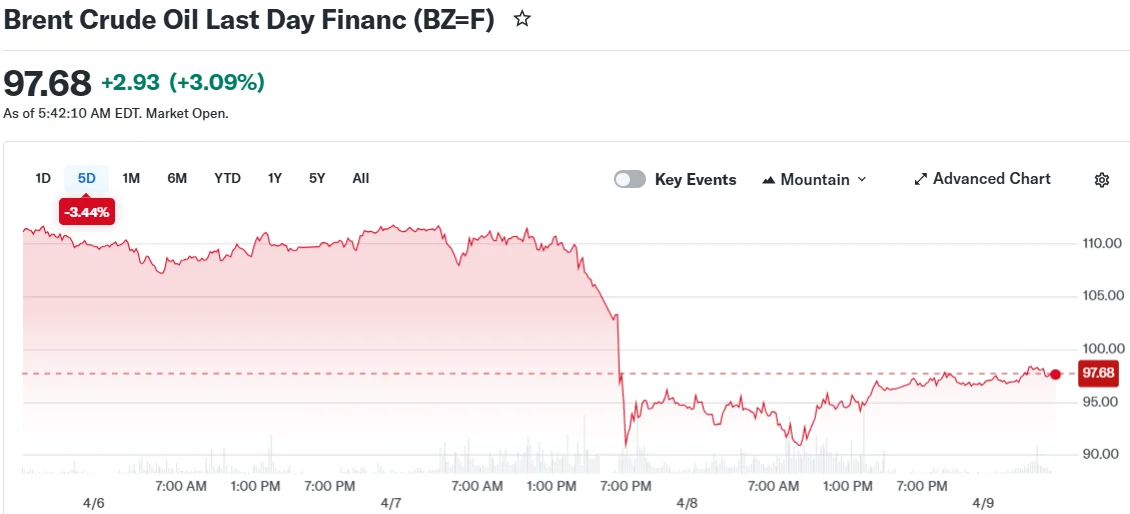
Wednesday’s dramatic selloff followed President Donald Trump’s declaration of a two-week cessation of hostilities with Iran. Market participants initially interpreted this development as an indication that supply disruptions would soon diminish.
However, optimism quickly evaporated. Israeli military forces continued conducting strikes against targets in Lebanese territory following the ceasefire announcement, prompting uncertainty about the agreement’s actual scope.
Israeli officials clarified that their military operations targeting Hezbollah fall outside the ceasefire parameters. Iran responded by characterizing peace negotiations with Washington as “unreasonable” given current circumstances and accusing Israel of breaching the agreement.

Iran continues to suspend oil tanker traffic through the Strait of Hormuz. This critical waterway facilitates approximately one-quarter of global seaborne petroleum commerce and has remained substantially closed following the February U.S. and Israeli military strikes on Iran.
Goldman Sachs Outlines Potential Price Trajectories
Goldman Sachs market analysts cautioned that prolonged closure of the strait for an additional month could push Brent crude to average above $100 per barrel during the latter half of 2026.
Their baseline projection anticipates shipping activity resuming this weekend, with Persian Gulf exports returning to pre-conflict levels within approximately 30 days. This scenario forecasts Brent averaging $82 per barrel during the third quarter and $80 in the fourth quarter.
A more pessimistic outlook, incorporating extended closure duration and diminished regional production capacity, positions Brent at $120 during the third quarter and $115 in the fourth quarter.
Goldman analysts noted that risks surrounding their price projections are “skewed to the upside.” Vice President JD Vance was also cited characterizing the ceasefire as unstable.
Trump stated via social media that it had been established “a long time ago” that the Strait of Hormuz would remain open and secure. He cautioned that military operations against Iran could recommence if agreement terms are violated.
U.S. Petroleum Inventories Reach Three-Year Peak
The U.S. Energy Information Administration disclosed that domestic crude reserves increased by 3.1 million barrels to 464.7 million barrels during the week concluded April 3. This represents the highest inventory level in almost three years and significantly exceeded analyst forecasts of a 1 million barrel build.
Refined product inventories presented a contrasting picture. Distillate reserves, encompassing diesel and heating oil, declined by 3.1 million barrels driven by robust export activity. Gasoline stockpiles decreased by 1.6 million barrels.
Iran’s Ports and Maritime Organization designated two approved safe passage corridors for vessels transiting the strait, concentrated around Larak Island in proximity to Bandar Abbas.
ING market analysts indicated that complete reopening of the strait appears unlikely in the immediate term and anticipate prices will maintain support as supply disruptions require substantial time to resolve.
Brent futures previously reached $119.50 during peak crisis conditions before plummeting sharply following Wednesday’s ceasefire announcement.
