


TLDR
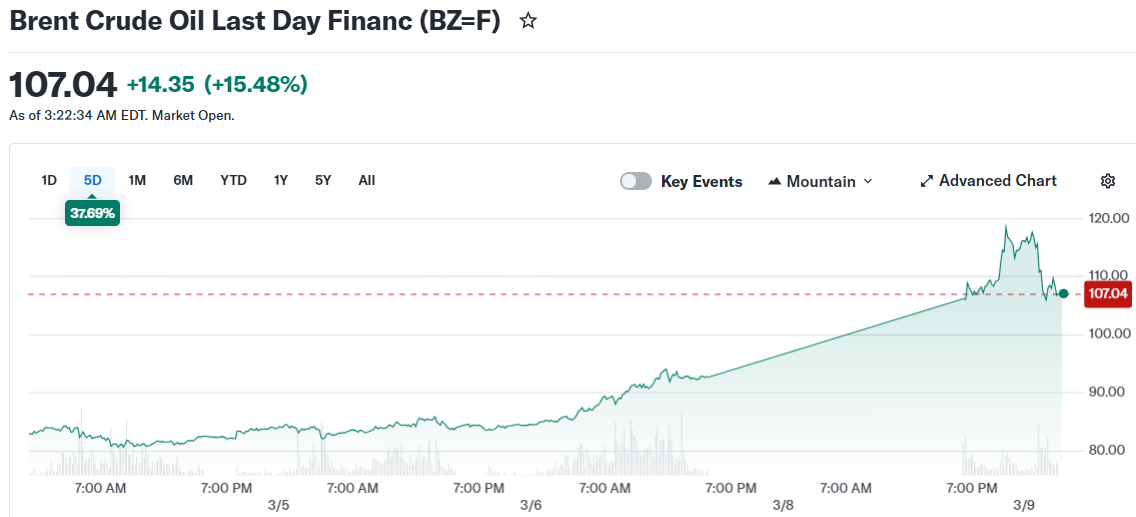
- Both Brent crude and WTI touched $119.50 per barrel during Monday trading before retreating, marking the highest price points since the summer of 2022.
- Over the weekend, Israeli forces targeted Iranian petroleum facilities while Iran launched counterstrikes against oil infrastructure across Gulf nations.
- The Strait of Hormuz faces effective blockade by Iran, disrupting approximately 20% of global crude oil shipments.
- Finance ministers from G7 nations are convening Monday to evaluate coordinated emergency petroleum reserve deployment.
- American gasoline futures jumped more than 10%, approaching four-year peaks beyond $3.00 per gallon.
Crude oil markets experienced explosive gains Monday following unprecedented Israeli military operations targeting Iranian petroleum infrastructure for the first time since hostilities erupted in early March. The assault drove both Brent crude and West Texas Intermediate contracts to intraday peaks of $119.50 per barrel, representing price levels unseen since the middle of 2022.
By the afternoon session, Brent had moderated to $106.80 per barrel while WTI traded at $102.79, retreating from overnight highs. The decline followed Financial Times reporting that G7 finance officials would convene Monday to evaluate deploying strategic petroleum stockpiles.
The emergency session is anticipated to include coordination through the International Energy Agency framework. At least three G7 nations, including America, have already indicated willingness to participate in a synchronized reserve deployment.
Oil markets had already climbed over 25% following the outbreak of the Iran crisis in early March. Weekend military escalation drove prices higher as trading commenced Sunday evening.

Israeli forces struck petroleum storage infrastructure in Tehran on Saturday. Iran retaliated by deploying drones against a Bahraini oil refining facility, the Wall Street Journal reported.
Critical Hormuz Passage Faces Near-Total Disruption
Iranian forces also targeted vessels transiting the Strait of Hormuz. This critical waterway facilitates roughly 20% of worldwide petroleum demand, with current shipping activity described as drastically reduced.
OCBC Bank analysts noted that “tail risks from a sustained Hormuz stoppage remain in play,” drawing parallels to the 2022 energy disruption caused by the Russia-Ukraine war.
Deutsche Bank’s Jim Reid suggested that while G7 reserve releases might provide relief, “the duration and intensity of the conflict will still be far and away the most important driver.”
Both Kuwait and the United Arab Emirates indicated plans to reduce petroleum production over the weekend, following similar output cuts announced by Iraq in recent days. Storage capacity limitations resulting from supply chain disruptions are compelling certain producers to curtail operations.
Saudi Arabia took the unusual step of offering crude supplies through spot market channels, suggesting efforts to address supply shortfalls created by the escalating conflict.
Trump Forecasts Continued Near-Term Price Pressure
President Donald Trump addressed the petroleum price surge Sunday, acknowledging that costs would likely stay elevated temporarily but would “drop rapidly” following resolution of the Iran situation.
Trump had earlier minimized concerns about rising domestic gasoline costs, informing Reuters that military operations against Iran took precedence over energy prices.
American gasoline futures advanced over 10% Monday, crossing $3.00 per gallon and approaching the highest levels recorded since mid-2022.
Jefferies economist Mohit Kumar observed that attacks on Iran’s petroleum infrastructure “suggests a shift in war strategy,” cautioning that targeting essential infrastructure escalates both humanitarian and economic consequences.
OCBC analysts projected that under a moderately severe scenario involving partial shipping resumption with naval protection, Brent crude could maintain levels near $100 per barrel through the year’s midpoint.
