



TLDR
- Chainlink’s LINK token is currently priced at $8.62 as of March 2, 2026, showing a 24-hour decline of 1.27% but a weekly gain of 3.86%
- Daily trading volume experienced a significant 71.12% increase, reaching $746.57 million according to Binance metrics
- Canton Network has implemented Chainlink’s Cross-Chain Interoperability Protocol alongside data standards for real-world asset tokenization
- Market technicals indicate neutral momentum, with critical support established at $8.00 and resistance forming between $9.20–$9.30
- Bulls targeting a push above $9.30 could see prices reach $9.80–$10.20; bears forcing a drop under $8.00 may drive LINK toward $7.50–$7.70
As of March 2, 2026, Chainlink (LINK) is changing hands at $8.62. The digital asset has shed 1.27% over the most recent 24-hour period, though it maintains a positive weekly performance with a 3.86% advance.
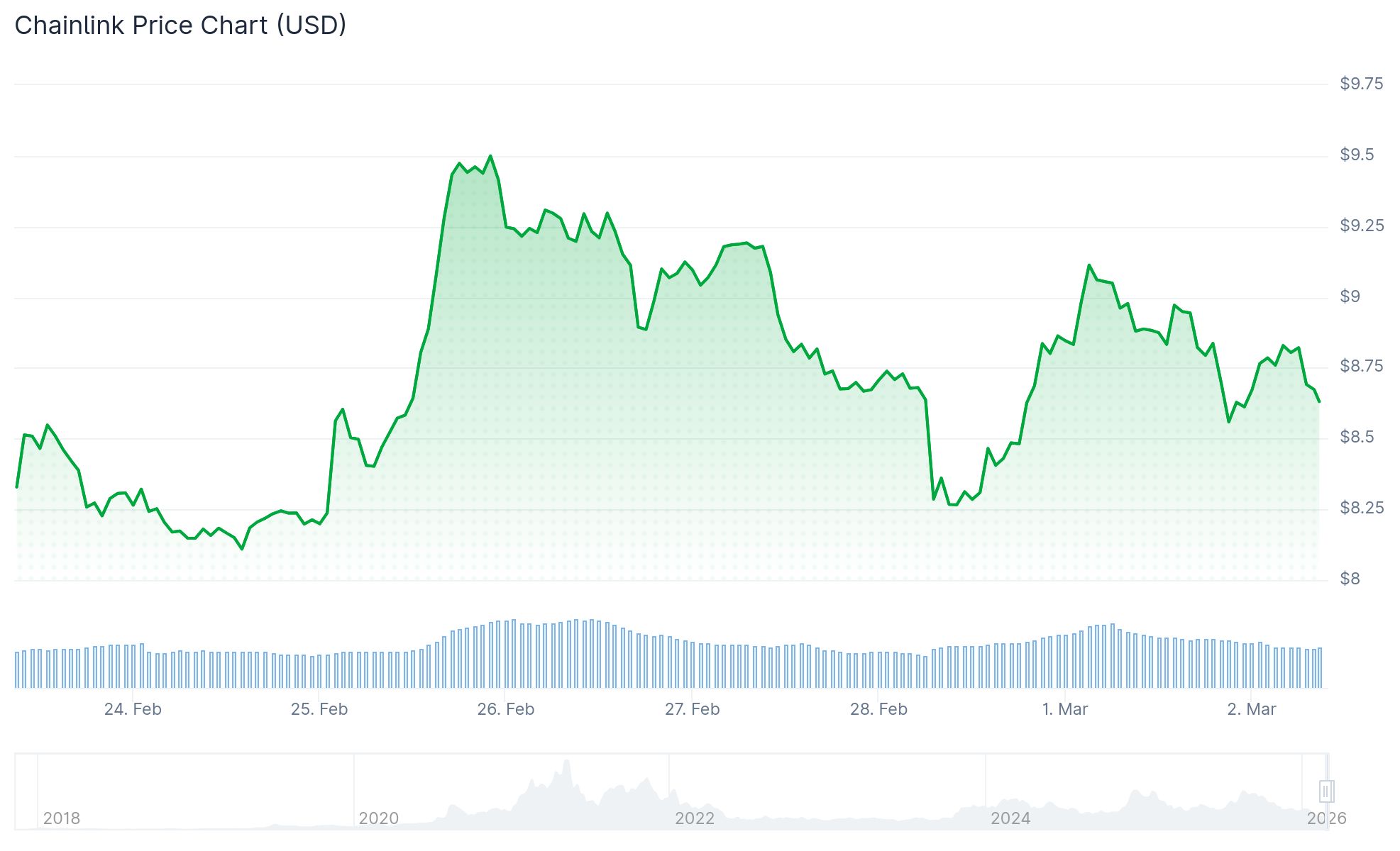
Binance data reveals trading volume climbed 71.12% to reach $746.57 million. This substantial uptick in activity contrasts sharply with the relatively muted volumes observed in preceding trading sessions.
The token has been trading within a rectangular consolidation pattern, oscillating between a floor at $8.00 and a ceiling ranging from $9.20 to $9.30. Market analyst CryptoPulse characterized this as a neutral zone where traders have opportunities on both the long and short sides until a decisive directional move emerges.
The Relative Strength Index on the 4-hour timeframe hovers within the 40-60 range, indicating equilibrium in market forces. This positioning suggests neither bullish nor bearish participants have established dominance.

The Moving Average Convergence Divergence indicator displays a modest bullish crossover, though the histogram bars remain relatively flat. This configuration implies the crossover signal lacks strong momentum and a definitive trend direction has yet to materialize.
Should LINK vault above the $9.30 resistance level, market observers anticipate potential upside targets between $9.80 and $10.20. Conversely, a breach below the $8.00 support floor could expose the $7.50–$7.70 zone.
Canton Network Adopts Chainlink’s Cross-Chain Protocol
Canton, a purpose-built public blockchain designed for compliant tokenized assets, has integrated Chainlink’s Cross-Chain Interoperability Protocol (CCIP) along with its data infrastructure standards. This deployment broadens institutional pathways to tokenized real-world assets across multiple blockchain networks.
Chainlink’s Data Streams, SmartData NAV and AUM data feeds, and Proof of Reserve functionality are now operational on the Canton Network. Applications such as BitSafe’s CBTC, Unhedged, and Thetanuts Finance have already begun leveraging this infrastructure.
Since launching its mainnet in May 2024, Canton has facilitated over $8 trillion in tokenized real-world assets on-chain. The network currently processes approximately $350 billion in U.S. Treasury repo transactions daily.
Chainlink Labs operates as a Canton Super Validator, responsible for governance functions and transaction sequencing operations.
Eric Saraniecki, Co-Founder of Digital Asset, stated: “The Canton ecosystem has rapidly adopted Chainlink’s standards in production, expanding offerings and growth opportunities.”
Johann Eid, Chief Business Officer at Chainlink Labs, commented: “This partnership enables regulated markets to move on-chain with the security and reliability required at scale.”
Current Market Position for LINK
LINK’s total market capitalization stands at $6.31 billion. The circulating token supply is estimated at approximately 708.10 million LINK.
The cryptocurrency remains more than 80% below its all-time high of roughly $52.70, achieved during the 2021 bull market cycle.
Examining the daily chart structure, LINK has been printing lower peaks since the closing months of 2025. The resistance band extends from $9.20–$9.50, while support has maintained near the $8.50 level.
As trading continues on March 2, 2026, LINK is positioned marginally above the $8.50 support zone, accompanied by elevated volume levels and the newly activated Canton integration.
