



Key Highlights
- On April 8, Covenant AI publicly withdrew from Bittensor, citing allegations of centralized governance by co-founder Jacob Steeves
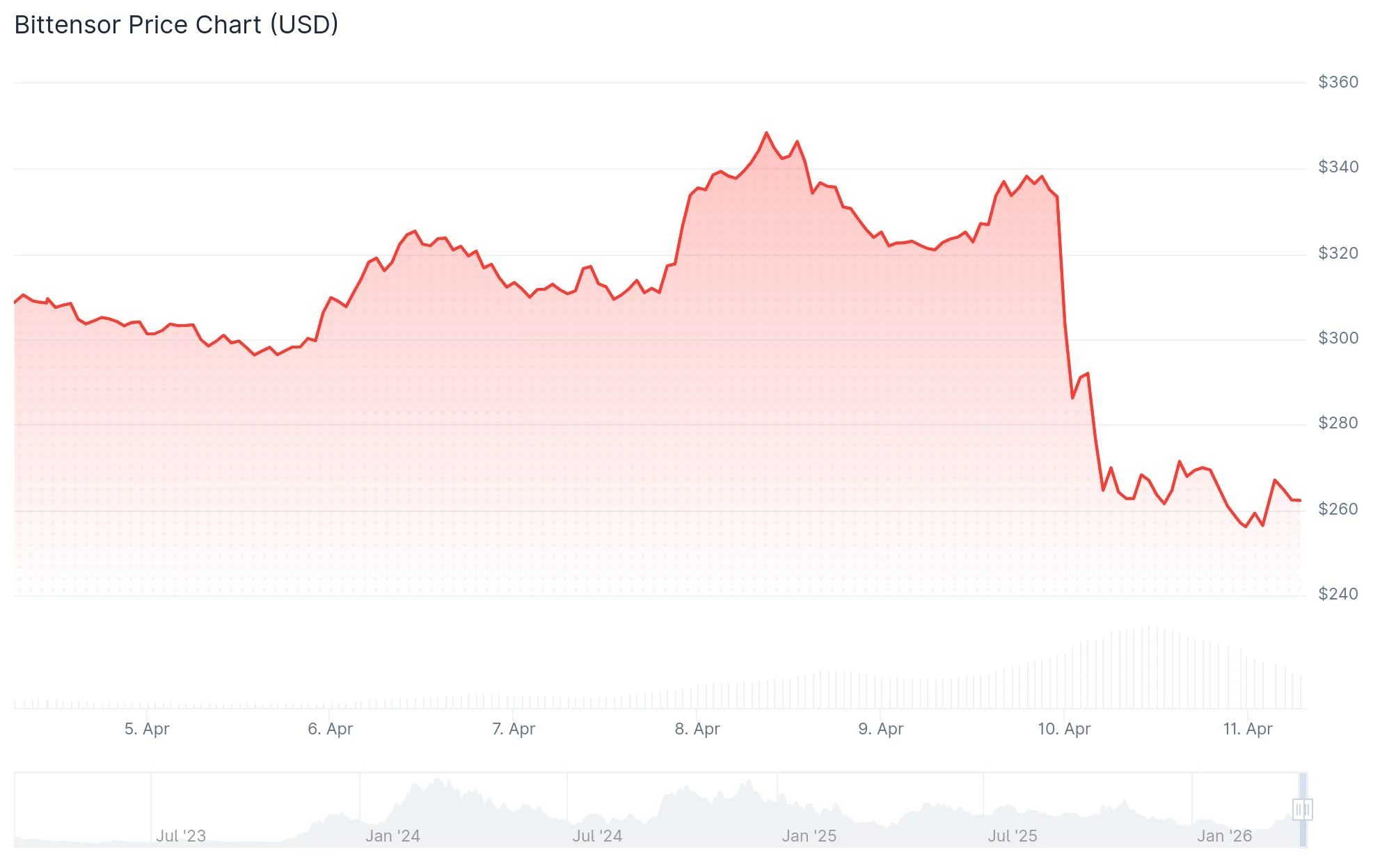
- The token experienced a ~25–30% plunge from its weekly peak, sliding from $337 down to approximately $249–$253
- Market capitalization contracted by more than $650 million, while long positions faced $9.1 million in liquidations
- Daily trading activity exploded to $1.72 billion on April 10, compared to roughly $500 million earlier in the month
- Chart analysis suggests a possible additional 25–45% downturn toward the $144–$230 support zone
The Bittensor protocol’s native cryptocurrency, TAO, experienced a significant downturn this week following public accusations from a prominent subnet operator regarding the project’s leadership structure.
On April 8, Covenant AI declared its complete withdrawal from the Bittensor network. Two days afterward, founder Sam Dare published an extensive explanation outlining the motivations behind this decision.
Dare’s statement accused co-founder Jacob Steeves of maintaining singular authority over the protocol’s operations. These claims stand in stark opposition to Bittensor’s fundamental value proposition as a decentralized, open artificial intelligence network designed for fair competition among subnets.
The accusations encompass several specific instances, including the unilateral suspension of a subnet’s emission rewards, the overriding of subnet owners’ decisions within their own governance channels, and the removal of projects without adhering to proper procedural frameworks.

Perhaps most significantly, Dare contended that Steeves utilized prominent token sales as “punitive” mechanisms to enforce compliance during disagreements. “These weren’t governance choices made via transparent consensus mechanisms,” Dare stated. “They represented unilateral actions by a single individual who never truly decentralized control.”
Dare further suggested that other members of the project’s leadership triumvirate function primarily as “legal shields” while Steeves remains protected from accountability.
Market Response
TAO experienced approximately 25% decline within six hours following the announcement, plummeting from $337 to $253. This dramatic selloff eliminated over $650 million from the market capitalization, reducing it to $2.57 billion.
Daily trading volume surged to $1.72 billion on April 10, substantially exceeding the $500 million average observed during the month’s earlier period. The downturn coincided with approximately 250% increase in trading activity, indicating widespread market involvement in the downward movement.
Within derivatives markets, $9.1 million worth of long positions were forcibly closed, with bullish traders absorbing $9.71 million in total liquidations. Numerous investors maintaining optimistic positions found themselves unexpectedly exposed, intensifying the downward selling pressure.
TAO has experienced modest recovery since the initial drop but continues trading 12.8% lower across the past seven-day period. Despite recent turbulence, the token maintains a 37% gain over the previous 30 days.
Technical Analysis
TAO is presently trading within the 0.382–0.5 Fibonacci retracement band. During November 2025, a breakdown from this identical zone triggered a decline exceeding 30%. A comparable pattern observed in June 2025 witnessed TAO finding stability around the 0.618 Fib level prior to rebounding.
Potential Price Levels
Should the June 2025 pattern materialize again, TAO might decline toward the 0.618 Fib support level around $230. Alternatively, if the November 2025 fractal repeats itself, the 1.0 Fib target positions near $144, representing approximately 45% below present levels.
On April 10, trading volume reached $1.72 billion, marking its highest level recorded this month.
