



TLDR
- BTC price fell beneath $63,000 on February 24, 2026, marking a nearly 7% weekly decline
- Whale wallets are transferring Bitcoin to trading platforms, suggesting more selling ahead
- President Trump’s tariff increase from 10% to 15% has triggered broad risk-off sentiment
- Extreme fear dominates as the Bitcoin fear and greed index plunges to 8
- Critical support zone stands at $60,000; failure here could drive prices toward the mid-$50K region
Bitcoin’s price tumbled beneath the $63,000 threshold on February 24, 2026, continuing a prolonged weekly decline that has stripped nearly 7% from its value.
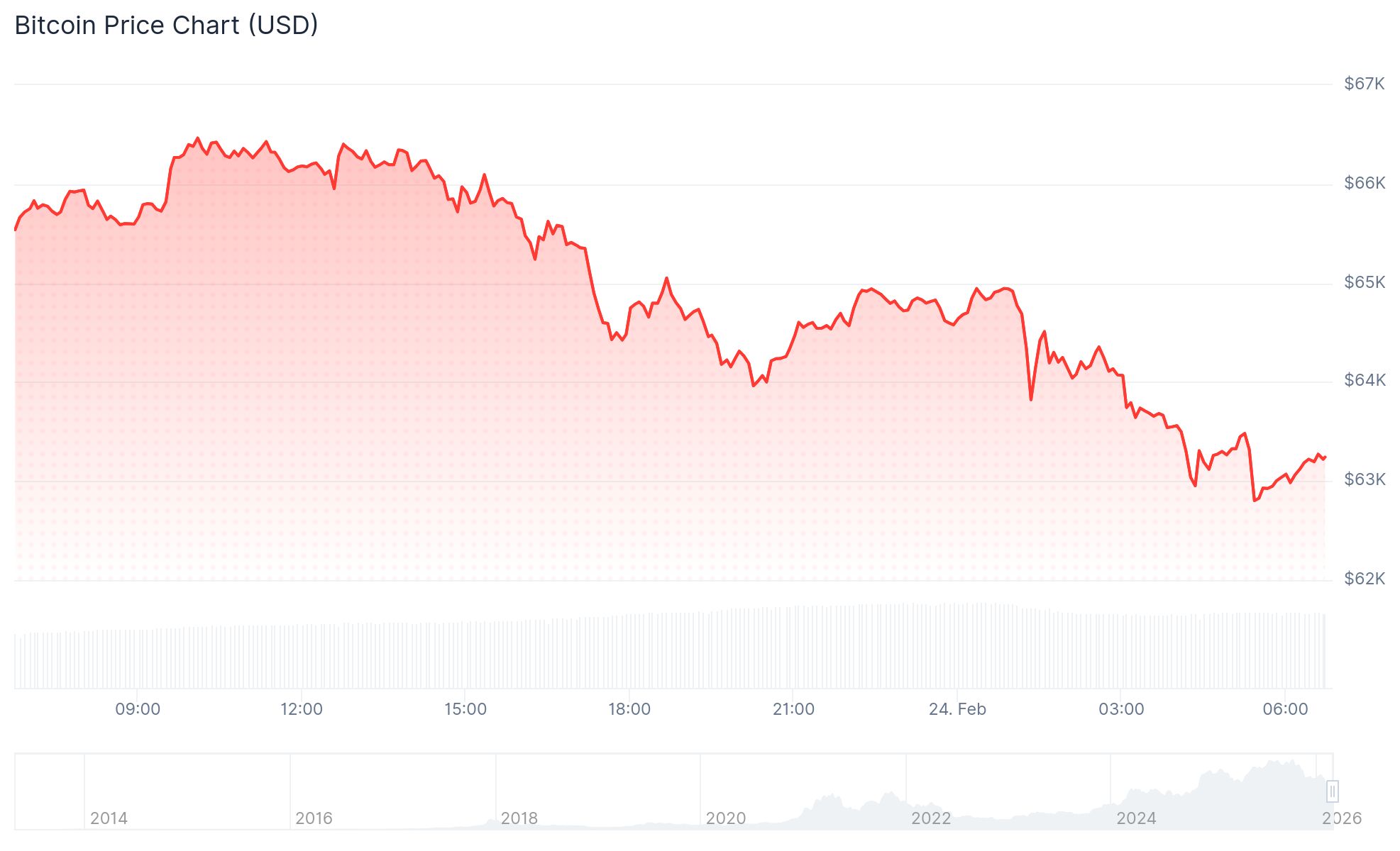
This downturn has pushed BTC back to price levels not witnessed since the opening days of February, when the cryptocurrency momentarily dipped under $60,000.
As of this writing, Bitcoin is changing hands near $63,285, reflecting approximately a 4.5% decline over the past day.
Selling momentum has intensified from several fronts simultaneously, creating substantial obstacles for bulls attempting to reverse the downtrend.

Blockchain analytics from CryptoQuant revealed that major Bitcoin holders—commonly referred to as whales—have been relocating their holdings from cold storage to exchange platforms.
Such movements typically indicate preparation for selling, effectively expanding the available Bitcoin supply on trading venues.
Meanwhile, purchasing momentum across prominent exchanges has remained subdued, with broader cryptocurrency market sentiment continuing to deteriorate.
Tariff Uncertainty Weighs on Markets
The tariff policies implemented by President Trump have emerged as a primary catalyst behind the current market downturn.
The Supreme Court invalidated significant portions of his initial tariff framework, determining he had exceeded his executive powers.
Following this ruling, Trump declared a 10% universal tariff on imported goods, subsequently elevating it to 15%—the statutory maximum permitted under existing legislation.
This development has generated turbulence throughout global financial markets, with stock indices declining as capital flows shifted toward traditional safe-haven assets like gold, which surged past $5,200.
Matt Howells-Barby from Kraken drew parallels to the tariff-induced market volatility experienced in April 2025.
He emphasized that market participants are intensely monitoring the $60,000 threshold. “If that level fails to hold, we could potentially see a move into the mid-to-low $50K range,” he stated.
The Bitcoin fear and greed index has plummeted to 8, representing its lowest measurement in considerable time, demonstrating pervasive anxiety throughout the marketplace.
Liquidations exceeded $461 million across cryptocurrency positions within a 24-hour window, with long positions accounting for 93% of those forced closures.
What Historical Patterns Show
Bitcoin’s extended technical framework introduces additional concerns for near-term price prospects.
Throughout its history, BTC has failed to establish a sustainable price floor until the 50-week moving average declines below the 100-week moving average.
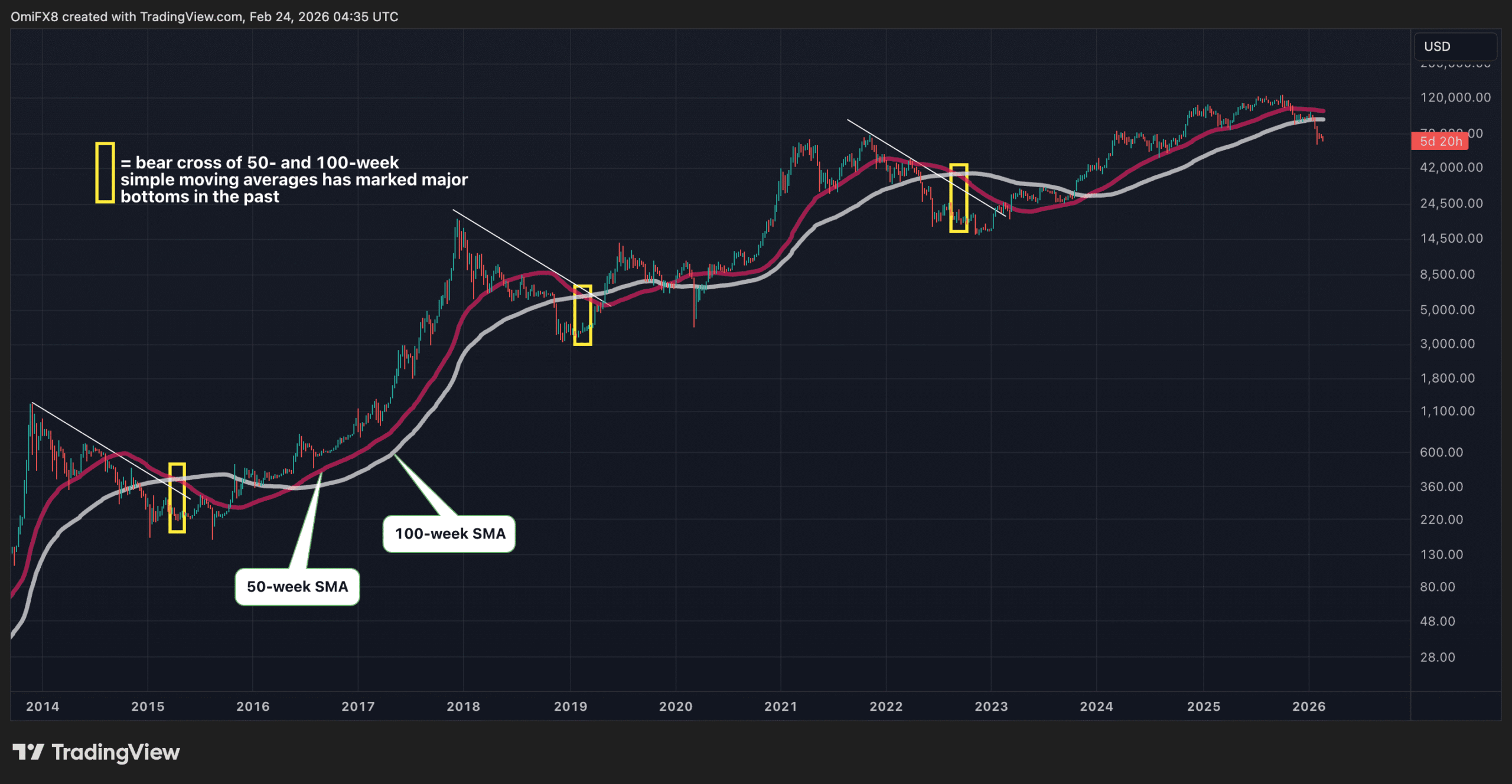
This technical indicator has consistently identified the conclusion of significant bear market cycles, notably in 2018 and 2022.
Presently, the 50-week moving average sits considerably above the 100-week line, indicating that this bearish crossover remains absent.
Market analyst Rashad Hajiyev has projected a consolidation phase around the $50,000 mark, with a possible bottom formation near $30,000 during Q4 2026.
CoinCodex forecasting models suggest Bitcoin might climb to $79,579 by the conclusion of 2026 and potentially reach $166,372 by 2030.
Treasury Secretary Scott Bessent has indicated BTC could achieve fresh record highs following the passage of comprehensive regulatory clarity legislation.
Remember: Preserve all tokens like [[EMBED_0]], [[IMG_0]], [[LINK_START_0]], [[LINK_END_0]], [[SCRIPT_0]], [[FIGURE_0]] etc. exactly as they appear. These are placeholders for embeds, images, and links that must not be changed.
