



TLDR
- Despite Bitcoin showing a 0.5 correlation coefficient with S&P 500 and Nasdaq, equity market dynamics account for merely 25% of its price fluctuations
- Crypto-native elements including ETF capital flows, derivative market positioning, and blockchain network growth drive the remaining 75% of price action
- NYDIG’s research director maintains that Bitcoin continues to function effectively as a portfolio diversification tool
- Market discourse has evolved from questioning Bitcoin’s viability to debating its potential as a strategic reserve asset for nations
- According to NYDIG, Bitcoin’s expansion trajectory doesn’t require central bank participation to maintain momentum
Despite Bitcoin’s increasing synchronization with technology equities, the cryptocurrency maintains its fundamental value as a portfolio diversification instrument, according to analysis from digital asset research firm NYDIG.
In his weekly market commentary, Greg Cipolaro, who serves as NYDIG’s global head of research, acknowledged that Bitcoin has demonstrated stronger correlations with prominent U.S. stock indices in recent periods. The benchmark S&P 500, tech-heavy Nasdaq 100, and the software-focused IGV exchange-traded fund have all exhibited tighter price relationships with Bitcoin.
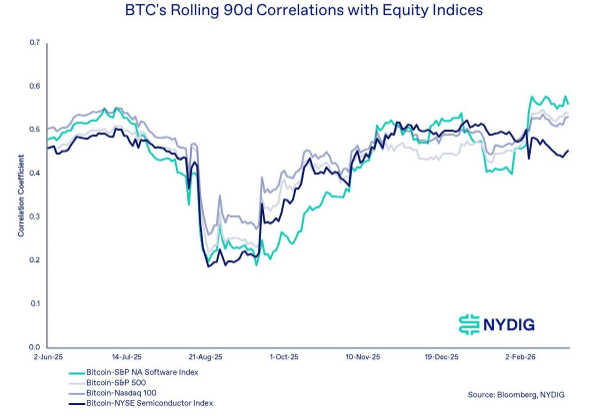
Certain market analysts have interpreted this pattern as evidence that Bitcoin now functions primarily as a technology sector proxy. However, Cipolaro disputes this characterization.
While acknowledging the 90-day rolling correlation coefficient approaches 0.5, Cipolaro emphasizes this metric indicates traditional equity market dynamics influence approximately one-quarter of Bitcoin’s price variations. The substantial majority—roughly three-quarters—stems from dynamics unique to digital asset markets.

These cryptocurrency-specific drivers encompass institutional and retail inflows into Bitcoin spot ETF products, changing sentiment in futures and options markets, blockchain adoption metrics, and evolving regulatory frameworks across jurisdictions.
Bitcoin’s Distinct Price Dynamics Separate From Traditional Equities
According to Cipolaro’s analysis, the present alignment between Bitcoin and growth-oriented technology stocks probably mirrors current macroeconomic conditions rather than indicating a fundamental structural convergence. Both asset categories respond simultaneously to shifting liquidity environments and prevailing investor risk sentiment.
“Cross-asset correlations with equities are currently elevated, but they remain far from determinative of Bitcoin’s returns,” Cipolaro wrote.
The research note also examined recent public statements from well-known investors. Chamath Palihapitiya, who famously described Bitcoin as “Gold 2.0” over a decade ago, has lately expressed skepticism about whether the asset meets requirements for sovereign treasury holdings. Meanwhile, Ray Dalio has consistently voiced concerns regarding Bitcoin’s price volatility, regulatory uncertainty, and potential vulnerabilities to emerging quantum computing technologies.
Cipolaro interprets these critiques as evidence of Bitcoin’s evolution into mainstream financial discourse rather than indicators of fundamental weakness. The conversation has progressed from existential questions about Bitcoin’s survival to substantive debates about its appropriateness for national reserve portfolios.
Central Bank Adoption Not Essential for Bitcoin’s Continued Expansion
NYDIG’s position holds that official sector adoption by central banking institutions isn’t necessary for Bitcoin to sustain its growth trajectory. The network has already achieved significant penetration beyond retail participants, encompassing high-net-worth family offices, institutional asset management firms, and regulated investment vehicles.
This adoption pattern diverges from conventional financial innovation cycles, which typically begin with institutional capital deployment before filtering down to individual investors. Bitcoin’s development has followed an inverted trajectory.
“Central bank ownership may ultimately validate the asset class further, but it is not a prerequisite for continued growth,” Cipolaro wrote.
The NYDIG analysis concluded by highlighting Bitcoin’s foundational characteristics: its decentralized global infrastructure, apolitical design, and technical architecture enabling permissionless value transfer and programmatic scarcity outside the control of any single government or monetary authority.
Bitcoin was changing hands near $67,769 when the research report was released.
