



Key Takeaways
- BTC recovered to approximately $68,000 following a weekend decline to $63,000
- Institutional investors injected $1.45 billion into spot Bitcoin ETFs across five consecutive trading sessions
- Market analysts attribute the rebound primarily to short-covering rather than new bullish sentiment
- Technical indicators improved: RSI increased from 36 to 41, while daily volume surged from $6.6B to $9.6B
- Polymarket data indicates declining probability of BTC reaching $65K or $60K in March
Bitcoin’s valuation staged a notable recovery on March 4, climbing back toward the $70,000 threshold and hovering around $68,000 during Hong Kong’s midday trading session.
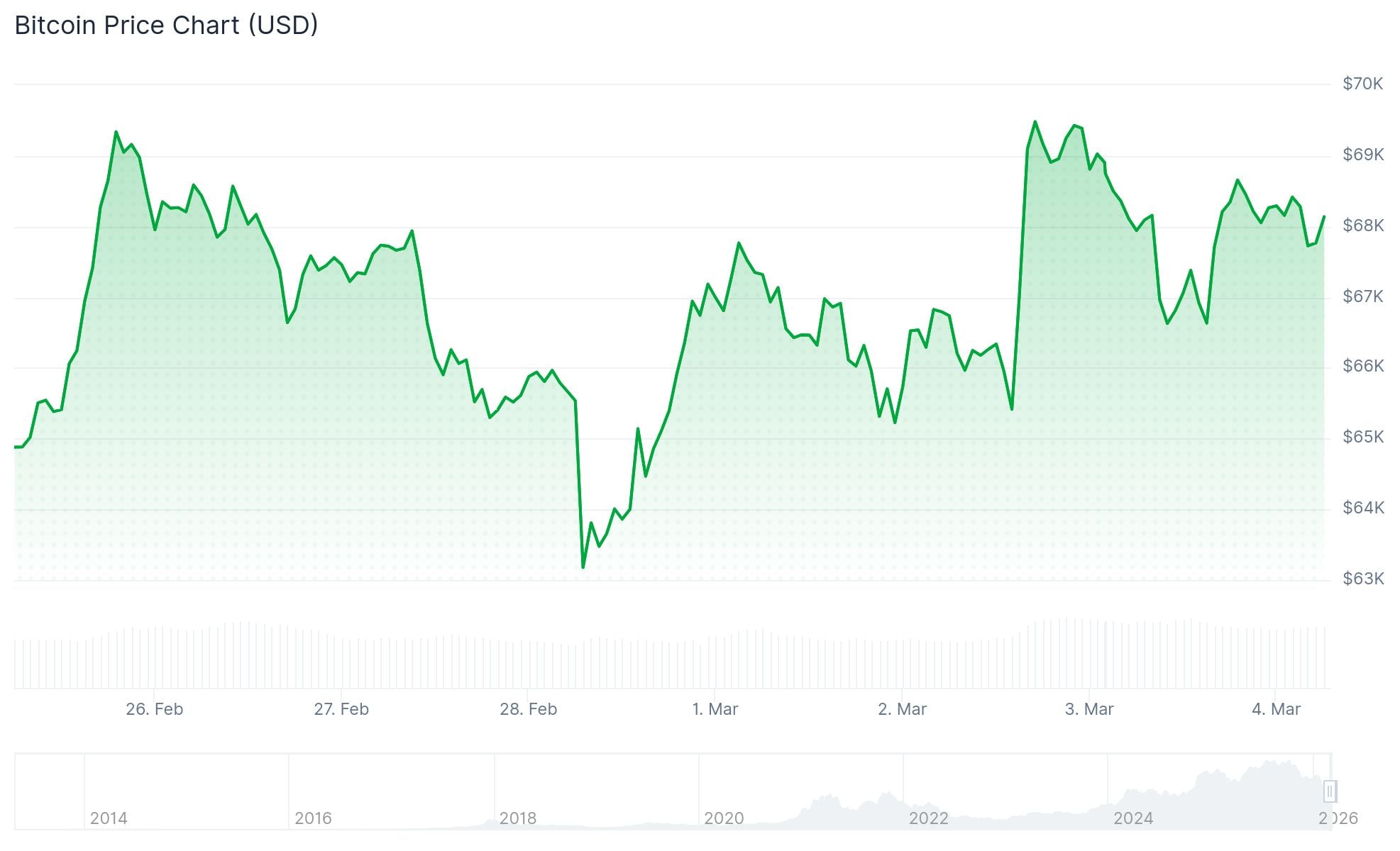
This resurgence came after a dramatic weekend selloff that sent BTC tumbling to approximately $63,000, sparked by escalating geopolitical tensions across the Middle East region.
According to market maker Enflux, the upward price movement stemmed primarily from short position liquidations. Bears who wagered on continued downside were forced to close their positions when anticipated military escalation failed to materialize.
“Current market pricing reflects neither apocalyptic scenarios nor complete resolution,” Enflux explained in correspondence with CoinDesk.
Cryptocurrency markets demonstrate heightened sensitivity to geopolitical developments compared to traditional financial markets. Enflux characterized Bitcoin as functioning like a “pressure valve” for capital flows during periods of global uncertainty.

Spot ETF Capital Inflows Establish Support Levels
Institutional participation has emerged as a critical stabilizing force. Spot Bitcoin exchange-traded funds accumulated approximately $1.45 billion in net positive flows throughout the most recent five-day trading period.
Matt Hougan, Chief Investment Officer at Bitwise, revealed during a March 2 conversation that numerous institutional allocators are strategically utilizing price corrections as entry opportunities. He cited one prospective client who committed $11 million after maintaining discussions with Bitwise for two years.
“These investors understand crypto’s volatile nature,” Hougan explained. “They’ve been patiently waiting for optimal entry conditions.”
Hougan emphasized that typical Bitwise clients require an average of eight consultation meetings before committing capital, with many conducting reviews only on a quarterly basis. He contends this apparent deliberation reflects standard institutional investment protocols rather than hesitation.
By the fourth quarter, three among the four leading wirehouses gained authorization to proactively present Bitcoin investment opportunities to their clientele.
Blockchain Metrics Reveal Measured Optimism
Glassnode analytics indicate gradual improvement, though conviction remains subdued.
Bitcoin’s Relative Strength Index advanced to 41 from the previous week’s reading of 36. However, it continues trading beneath 50, the critical level indicating buyer dominance.
Daily transaction volume expanded to $9.6 billion from $6.6 billion, while spot market order flow has achieved greater equilibrium between purchasing and selling pressure.
Derivatives marketplace activity continues reflecting seller advantage over buyers, with financing costs for leveraged long positions declining.
Polymarket data reinforces the cautious market sentiment. The likelihood of Bitcoin declining to $65,000 during March decreased by 11 percentage points to 73%. Meanwhile, probability estimates for reaching $60,000 dropped 10 points to 41%.
A separate Polymarket proposition tracking whether Bitcoin touches $60,000 before $80,000 declined 12 percentage points to 61%.
As of publication, BTC was exchanging hands at $66,360.
