



Key Takeaways
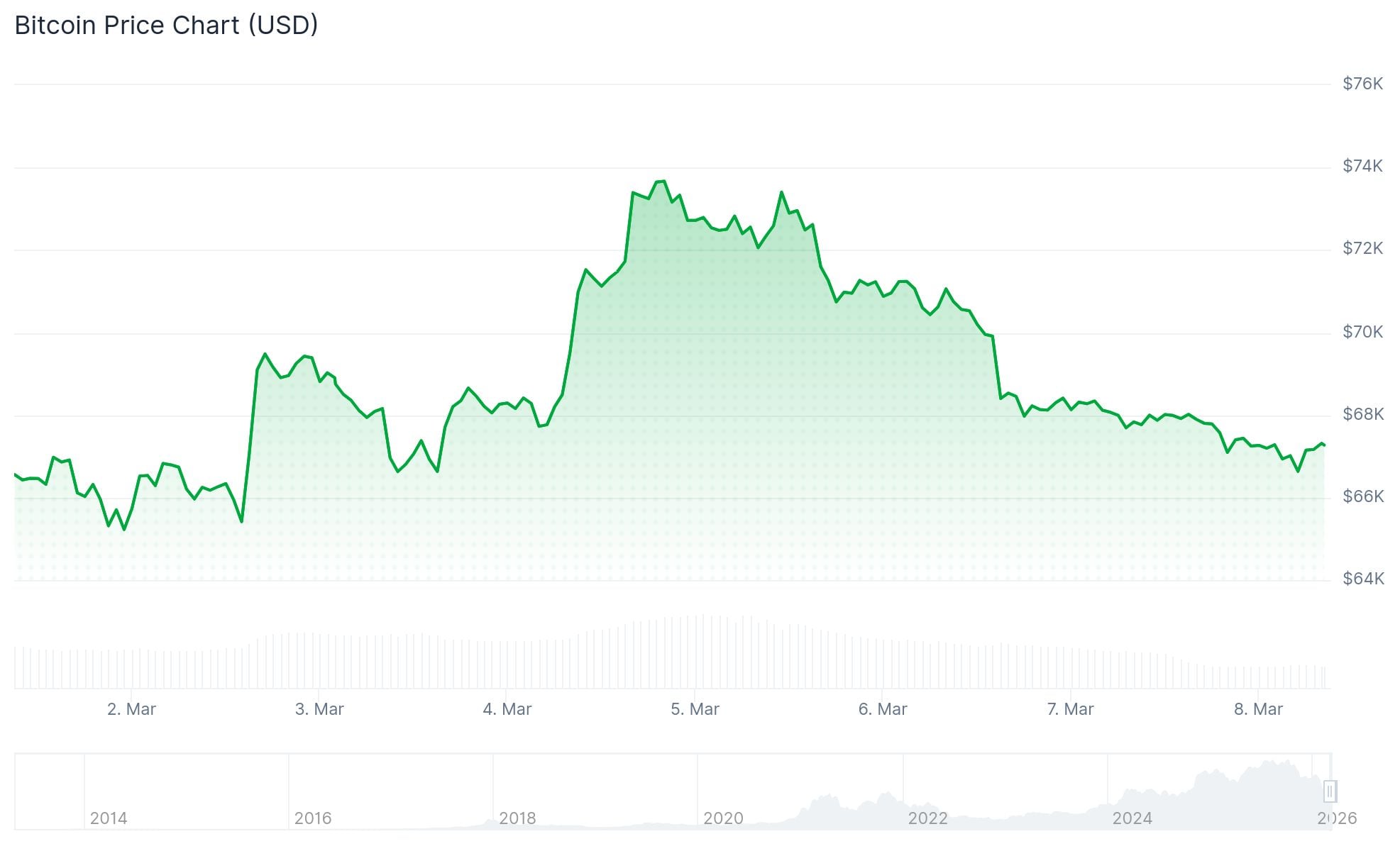
- BTC declined to approximately $67,127 while the Crypto Fear & Greed Index plummeted to 12—denoting “extreme fear”
- Large holders accumulated between $62,900 and $69,600, then distributed roughly 66% of those coins at $74,000
- Small investors are accumulating below $70K, a behavioral pattern that often precedes further declines
- U.S. Bitcoin ETFs recorded $348.83 million in net outflows on March 6, with Fidelity and BlackRock leading withdrawals
- Critical price zones: $60,000 acting as support and $74,000 serving as resistance
Bitcoin is currently hovering around $67,127 as of Sunday, March 8, representing a 0.85% daily decline. The wider cryptocurrency market capitalization has followed suit, mirroring Bitcoin’s downward trajectory.
The Crypto Fear & Greed Index registered a reading of 12 on Saturday—marking one of the most depressed levels witnessed since October. This measurement places investor sentiment squarely within “extreme fear” classification.
Blockchain analytics from Santiment reveal that major Bitcoin holders, commonly referred to as whales, engaged in substantial accumulation between February 23 and March 3. Throughout this timeframe, BTC prices fluctuated within a range of $62,900 to $69,600.
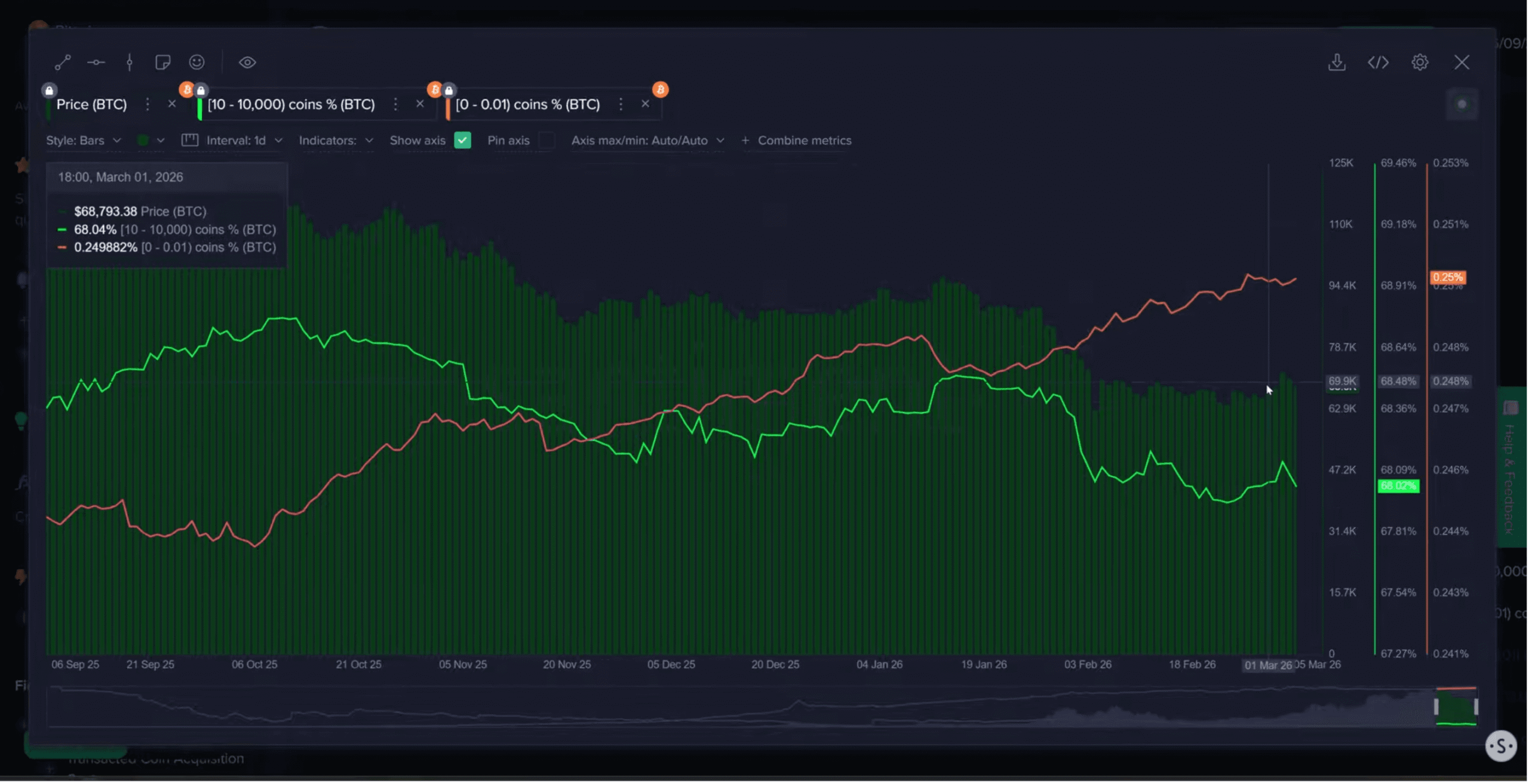
As Bitcoin climbed to $74,000 on March 5, these identical addresses initiated distribution activities. Data indicates they have subsequently liquidated approximately 66% of their previously accumulated positions.

Conversely, smaller wallets containing less than 0.01 BTC have been consistently increasing their holdings as prices retreated beneath the $70,000 threshold. Santiment identified this contrasting behavior as a cautionary indicator.
Divergence Between Large and Small Holders
“When retail buys while whales sell, it typically signals that the correction is not yet over,” Santiment said in a weekend note.
Glassnode analytics indicate approximately 43% of Bitcoin’s circulating supply is presently held at unrealized losses. This dynamic generates persistent selling pressure at elevated price levels, as holders attempt to minimize losses near their acquisition costs.
Market analyst Captain Faibik identified a bearish flag pattern developing on the 8-hour timeframe. Should this technical formation break down, he projects Bitcoin could decline toward $55,000.
Analyst Ted Pillows emphasized that Bitcoin must recapture the $70,000 level promptly. Failure to do so, he suggests, could trigger a retest of the $65,000–$66,000 range before any meaningful recovery materializes.
Exchange-Traded Fund Withdrawals Intensify
Bitcoin spot exchange-traded funds experienced $348.83 million in net withdrawals on March 6, based on SosoValue tracking data.
Fidelity’s FBTC product led all outflows with $159 million in redemptions. BlackRock’s offering witnessed $143.5 million exit during the identical session.
Analyst Crypto Patel provided perspective: BlackRock had acquired $1.163 billion in Bitcoin—approximately 17,645 BTC—throughout the preceding ten trading days.
Ethereum experienced similar weakness, falling 1.34% to settle at $1,946.57. Aggregate daily trading volume across cryptocurrency markets maintained levels around $61.44 billion, indicating adequate liquidity remains available.
Crude oil valuations have surged more than 60% year-to-date, propelled by escalating U.S.–Iran geopolitical tensions. Financial markets currently assign merely a 4.4% probability to a Federal Reserve interest rate reduction at the upcoming policy meeting.
Transactions from whale-sized addresses comprised over 70% of total exchange deposits to Binance across multiple days this week, according to CryptoQuant analyst Darkfost.
Bitcoin has oscillated within a $60,000 to $74,000 corridor throughout the past three weeks, with minimal net directional progress.
