



TLDR
- Crude markets declined more than 1% Monday following progress in US-Iran nuclear negotiations that reduced regional tension concerns
- President Trump increased worldwide tariffs to 15% from 10% following Supreme Court rejection of his initial tariff strategy
- Geneva will host the third session of US-Iran nuclear discussions this Thursday
- Goldman Sachs elevated its Q4 2026 Brent projection by $6 to $60/barrel, pointing to reduced OECD stockpiles
- Goldman projects a worldwide oil oversupply of 2.3 million barrels daily in 2026, with potential downward pressure if Iranian or Russian sanctions are relaxed
Crude markets experienced downward pressure Monday as two significant factors simultaneously impacted trading: fresh tariff announcements from Washington and diplomatic advancement on the Iran nuclear file.
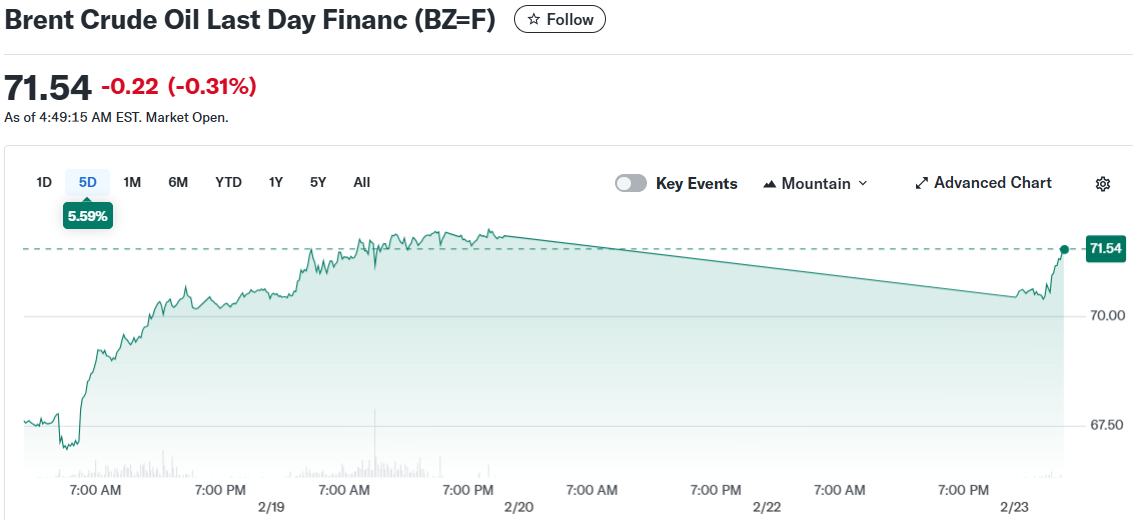
Brent benchmark declined 73 cents, settling at $71.03 per barrel. The US West Texas Intermediate benchmark dropped 75 cents to $65.73.
The decline followed President Trump’s declaration that he would escalate tariffs on all American imports to 15% from the previous 10% level. Following the Supreme Court’s rejection of his initial tariff framework, the president invoked the International Emergency Economic Powers Act for this updated policy.
The tariff escalation sparked concerns regarding diminished global economic expansion and reduced petroleum consumption. Market analysts indicated the announcement created a risk-off environment throughout financial markets, pressuring crude alongside American equity futures and gold.

Iranian Diplomatic Progress Weighs on Prices
Tehran and Washington are scheduled to convene Thursday in Geneva for their third session of nuclear discussions. Oman’s Foreign Minister provided confirmation of the meeting Sunday.
The diplomatic progress helped diminish concerns about potential military conflict within the region. Both Brent and WTI had climbed more than 5% during the previous week based on such concerns.
A high-ranking Iranian representative informed Reuters that Tehran stands prepared to offer compromises on its nuclear activities. Tehran seeks sanctions removal and acknowledgment of its uranium enrichment rights in exchange.
This reduction in regional tension pushed prices downward. Market observers highlighted that as a potential agreement became more likely, the geopolitical risk premium embedded in oil valuations began dissipating.
Goldman Sachs Revises Oil Price Projections Upward
Goldman Sachs adjusted its Q4 2026 crude price projections upward Sunday. The investment bank now forecasts Brent at $60 and WTI at $56 for that quarter, representing a $6 increase from previous estimates.
The financial institution attributed the revision to diminished OECD inventory levels. For calendar year 2026 overall, Goldman now anticipates Brent averaging $64, elevated from $56, while WTI is expected to average $60, up from $52.
Goldman maintained its 2026 oversupply projection at 2.3 million barrels daily. This calculation assumes no significant supply interruptions and no Russia-Ukraine peace agreement.
The investment bank reduced supply projections for Kazakhstan, Venezuela, Iran, and Iraq reflecting production shortfalls. Conversely, it raised supply expectations for the Americas and primary OPEC member states.
Goldman anticipates OPEC+ will begin incrementally increasing production during Q2 2026, as OECD inventory accumulation has fallen short of projections.
The bank identified downside risks of $5 for Brent and $8 for WTI should sanctions relief for Iran or Russia accelerate supply expansion.
Goldman projects Brent and WTI averaging $65 and $61 throughout 2027, climbing to $70 and $66 by year-end December 2027.
