



Key Takeaways
- Washington and Tehran reach agreement on two-week cessation of hostilities, reopening critical Strait of Hormuz passage
- Major equity indexes surge with Dow futures climbing 1,300+ points and Nasdaq 100 futures gaining 3.5%
- Energy markets face dramatic selloff as Brent crude tumbles 15% and WTI plunges approximately 17%
- Cryptocurrency markets rally strongly with Bitcoin breaking through $70,000 threshold alongside Ethereum and XRP gains
- Precious metals climb 3.3% as market participants adjust inflation expectations downward
In a late Tuesday announcement, President Trump revealed that Washington would pause military operations against Iran for a fortnight, contingent upon Tehran’s commitment to reopen the strategically vital Strait of Hormuz. Iran’s top diplomat, Foreign Minister Seyed Abbas Araghchi, swiftly validated his nation’s agreement to permit unrestricted maritime transit through the waterway in exchange for the suspension of strikes.
Shortly past midnight, Trump took to Truth Social to announce American assistance in managing the anticipated vessel backlog in the strait. Tehran’s Supreme National Security Council granted formal approval to the ceasefire conditions.
Global financial markets responded with extraordinary velocity to the diplomatic breakthrough. Capital that had retreated to safety during the escalating tensions flooded back into higher-risk investment vehicles.
Futures contracts for the Dow Jones Industrial Average surged 1,306 points, representing approximately 2.8% growth. The S&P 500 futures contract matched that 2.8% advance. Technology-heavy Nasdaq 100 futures posted the session’s strongest performance with a 3.5% spike.

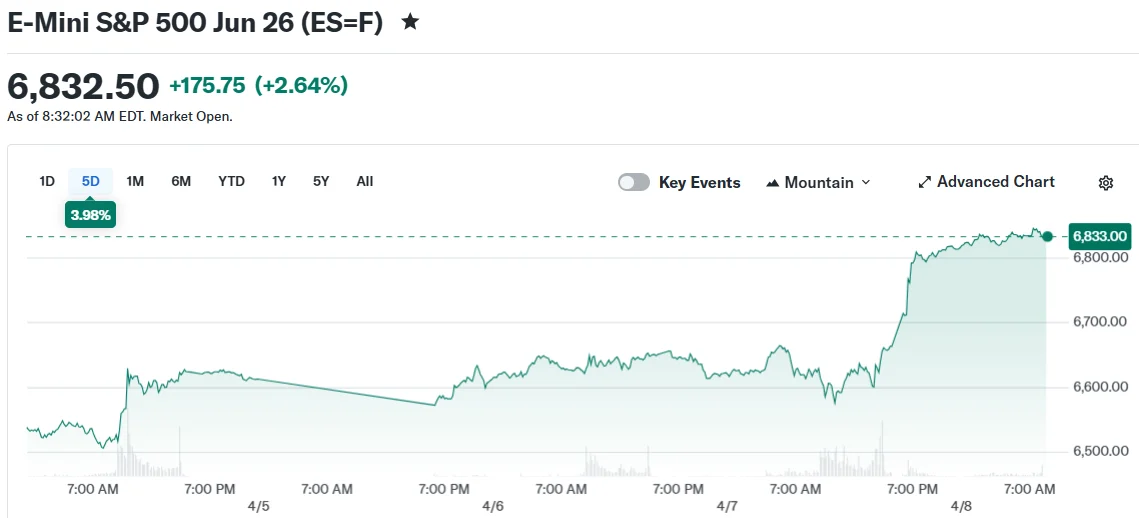
The previous trading session had seen all three benchmark indexes drift without clear direction as market participants digested Trump’s warnings about potential attacks on Iranian critical infrastructure, including transportation networks and electrical generation facilities.
Energy Sector Experiences Sharp Reversal
Oil prices experienced their most dramatic decline in months following the ceasefire announcement. Brent crude futures contracts collapsed nearly 15% to trade around $94.69 per barrel. West Texas Intermediate suffered an even steeper 17% plunge to approximately $96.22 per barrel.
The Strait of Hormuz represents a critical 21-mile maritime chokepoint responsible for transporting a substantial portion of worldwide petroleum supplies. The prospect of its imminent reopening immediately stripped away the geopolitical risk premium that had inflated crude prices.
Collapsing energy costs reinforced market expectations that the Federal Reserve might soon restart its monetary easing cycle. Declining fuel prices alleviate inflationary pressures, providing central bankers additional flexibility for policy adjustments.
Minutes from the Federal Reserve’s March policy meeting were slated for Wednesday release, with market observers anticipating insights into how committee members assessed the economic ramifications of Middle Eastern hostilities.
Digital Assets and Precious Metals Advance
Bitcoin pushed beyond the $70,000 price level. Alternative cryptocurrencies including Ethereum and XRP posted comparable gains as digital asset markets participated in the widespread appetite for risk.
Gold futures contracts jumped 3.3% to reach $4,840 per ounce. Declining interest rate expectations typically provide support for precious metals, as the non-yielding asset class gains appeal when fixed-income returns diminish.
The U.S. dollar index retreated 1% versus a collection of major global currencies. Benchmark 10-year Treasury note yields declined 6 basis points to settle at 4.24%.
Aviation Sector Under Scrutiny
Delta Air Lines was set to publish quarterly financial results ahead of Wednesday’s opening bell. Market participants paid particularly close attention following widespread flight cancellations and soaring aviation fuel expenses throughout the conflict period.
Robert Edwards, chief investment officer at Edwards Asset Management, suggested the diplomatic progress alone proved sufficient to transform market psychology. “Just the scent of thawing tensions is enough for forward-looking stocks to keep climbing the wall of worry,” he stated.
Foreign Minister Araghchi validated on X that secure maritime passage through the Strait of Hormuz would be achievable “via coordination with Iran’s Armed Forces” throughout the fourteen-day ceasefire window.
