


Key Takeaways
- Bittensor implements a 21 million token maximum supply with a halving mechanism similar to Bitcoin, recently reducing daily emissions from 7,200 to 3,600 TAO in December 2025.
- Unlike many crypto AI initiatives, TAO launched without a premine or initial coin offering, offering a more transparent distribution model.
- The token’s fully diluted valuation exceeds $6.6 billion, suggesting the market has already factored in substantial anticipated growth.
- Bittensor operates through specialized subnets functioning as discrete AI marketplaces, though the mechanism for TAO value accrual from these markets remains ambiguous.
- Despite the halving event, token issuance persists at reduced rates, meaning holders continue experiencing dilution albeit at a decelerated pace.
Bittensor represents more than a conventional AI cryptocurrency. The platform comprises interconnected subnets, each operating dedicated markets for AI services including computational inference, decentralized storage, and data provision. TAO serves as the native asset underpinning this entire ecosystem.
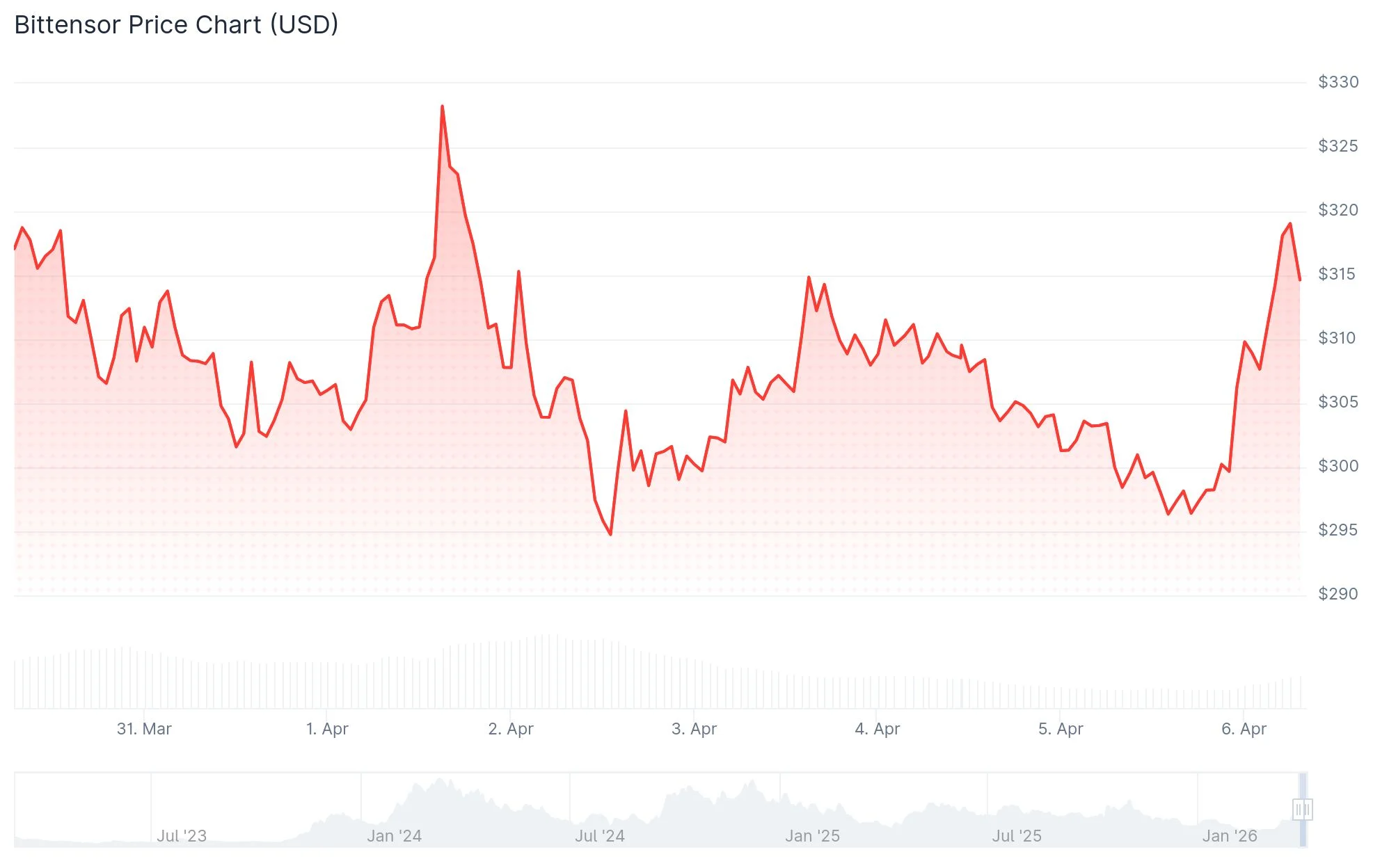
The initiative has cultivated considerable interest within the crypto community. However, an innovative technical architecture doesn’t necessarily translate into compelling investment fundamentals.
TAO’s economic model distinguishes itself from competing crypto AI ventures. The protocol enforces a 21 million token hard limit, mirroring Bitcoin’s supply constraints. The Opentensor Foundation has verified that the token distribution involved zero premine allocations and no initial coin offering, eliminating common red flags associated with nascent token projects.
Bittensor implements a halving mechanism similar to Bitcoin. This first reduction occurred mid-December 2025, decreasing daily token emissions from approximately 7,200 TAO to 3,600 TAO, as documented by Grayscale.

Fixed Supply Doesn’t Eliminate Ongoing Dilution
Even following the emission reduction, fresh tokens continuously enter circulation daily. This reality means current token holders remain subject to persistent dilution, merely at a moderated velocity.
Data from CoinGecko indicates TAO’s fully diluted valuation surpasses $6.6 billion. Numerous market participants focus exclusively on circulating supply metrics while overlooking the comprehensive picture. For TAO, understanding the complete supply dynamics remains essential.
A capped maximum supply doesn’t inherently validate current pricing. It simply establishes known boundaries.
The Critical Question: Does TAO Accrue Value?
This represents the fundamental consideration. While Bittensor may cultivate thriving AI marketplaces within its subnet architecture, this doesn’t guarantee TAO captures the economic benefits these markets generate.
TAO functions within staking mechanisms and network incentive structures. This provides utility. However, internal network utility differs substantially from robust external demand that propels price appreciation based on fundamentals rather than speculative sentiment.
Across numerous blockchain ecosystems, network activity can expand while the associated token trades predominantly on narrative. Bittensor confronts this identical structural challenge.
The subnet framework introduces considerable complexity. This intricacy complicates assessment for typical investors attempting to monitor genuine network development versus activity artificially inflated by emissions.
Grayscale highlighted that token emissions can distort activity metrics, creating appearances of higher utilization than actual usage.
TAO’s inaugural halving executed in December 2025, cutting the daily token influx by fifty percent.
Bottom Line
Bittensor ranks among the more credible initiatives within the cryptocurrency AI sector. The token economics demonstrate greater transparency than competitors, the distribution model was equitable, and the subnet architecture presents genuine innovation. Nevertheless, TAO currently commands a multi-billion dollar valuation, dilution remains ongoing, and whether the token effectively captures tangible economic value from network operations continues to be unresolved.
