


Key Takeaways
- Coinbase’s Chief Legal Officer Paul Grewal anticipates a CLARITY Act agreement on stablecoin yields within the next 48 hours
- Central dispute revolves around whether cryptocurrency platforms can provide yield on dormant stablecoin holdings
- Traditional banking institutions worry about deposit migration, though Grewal contends no data supports this concern
- Senate Banking Committee expected to hold markup session following congressional recess this month
- Polymarket traders place 51% probability on Trump approving the legislation in 2026
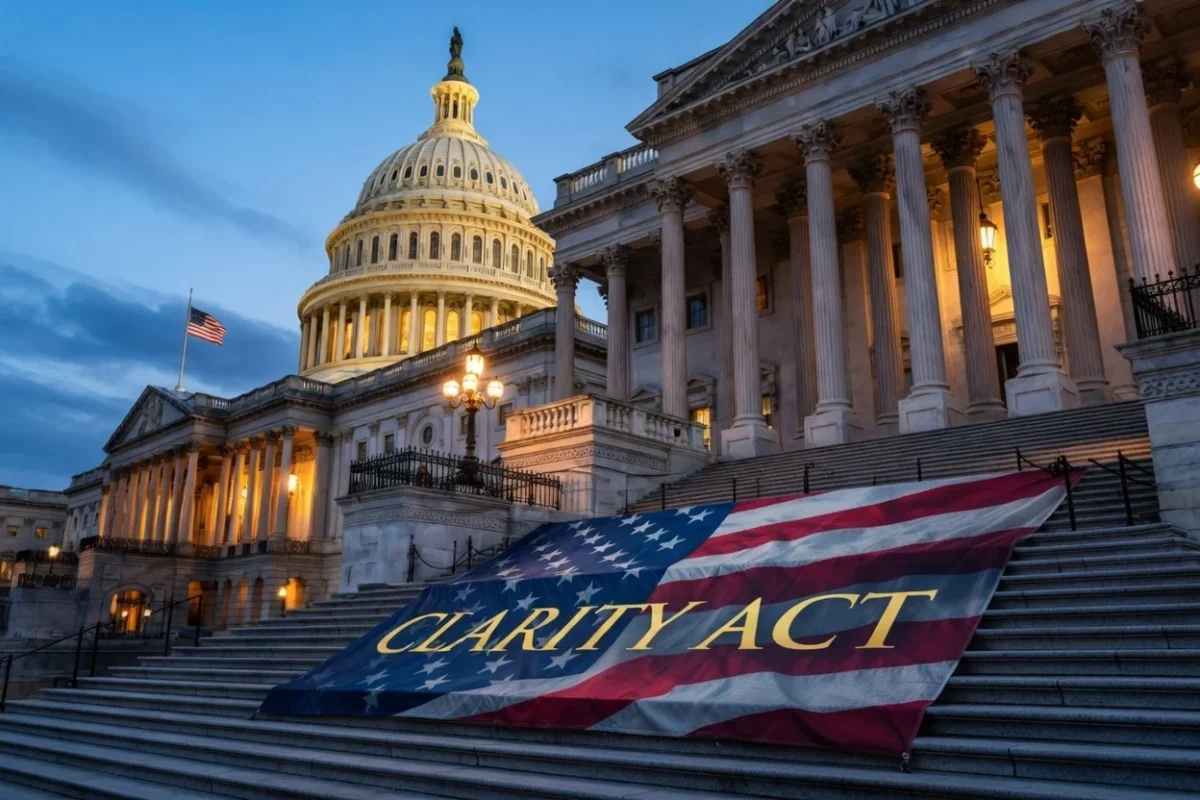
America’s landmark cryptocurrency regulatory framework bill, the CLARITY Act, appears poised for a breakthrough, with Coinbase’s leading legal executive indicating a stablecoin yield compromise could materialize by week’s end.
🚨 BULLISH: Coinbase CLO, Paul Grewal says CLARITY Act Progress in the next 48 hours
“I’m very confident we’re going to see progress.”
This is the unlock:
“Deciding which tokens… fall under the SEC… and which are better served by the CFTC.”
“We need to finish the job.”… pic.twitter.com/fT45vjw7ZI
— Mark (@markchadwickx) April 1, 2026
During a Fox Business interview, Paul Grewal, who serves as Chief Legal Officer at Coinbase, revealed that negotiations between digital asset companies and traditional financial institutions have intensified, with both parties approaching consensus.
The CLARITY Act represents comprehensive legislation designed to establish regulatory guardrails for America’s cryptocurrency sector. Among its critical components is a framework determining which digital tokens belong under Securities and Exchange Commission jurisdiction versus Commodity Futures Trading Commission authority.
However, legislative progress has stalled over disagreements surrounding stablecoin yield programs. The central question: should cryptocurrency exchanges have permission to compensate users with interest on their stablecoin deposits?
Traditional banks oppose this feature. They’ve mounted significant lobbying efforts to eliminate this provision, contending that digital asset platforms should operate under identical regulatory constraints as conventional banking institutions. Additionally, they assert that offering stablecoin interest could incentivize consumers to withdraw funds from traditional bank accounts.

Grewal challenged this position. He emphasized that no empirical evidence demonstrates stablecoin yield programs cause deposit outflows from banks, characterizing it as conjecture unsupported by actual market behavior.
Understanding the CLARITY Act’s Scope
Grewal characterized the CLARITY Act as the most consequential cryptocurrency legislation currently under congressional consideration. He noted it advances momentum from last year’s GENIUS Act passage, which he termed a transformative milestone for the sector.
The CLARITY Act would establish comprehensive market infrastructure for digital assets throughout the United States. It would additionally establish definitive classification standards for various tokens under federal regulatory frameworks.
Coinbase Chief Executive Brian Armstrong has similarly criticized legislative versions that would prohibit stablecoin interest programs. He’s maintained that such restrictions would disadvantage consumers while stifling technological advancement.
Senate leadership has decided against publishing the most recent legislative draft this week. A representative for Senator Thom Tillis explained that premature disclosure might enable adversaries to orchestrate procedural delays.
Discussions between cryptocurrency advocates and banking sector representatives have persisted throughout recent days. Both constituencies had previously rejected an earlier compromise negotiated by Senators Tillis and Angela Alsobrooks.
Coinbase (COIN) Stock Performance and Industry Perspective
Coinbase (COIN) stock has experienced approximately 50% decline during the preceding six-month period, settling at $172.99 on Wednesday, representing a 0.9% daily decrease. The equity trades on the Nasdaq exchange.
Grewal emphasized that Coinbase prioritizes developing enduring infrastructure rather than chasing immediate trading volume. He highlighted the organization’s overarching mission to fundamentally transform financial system accessibility for ordinary Americans.
Polymarket prediction markets currently assign a 51% likelihood that President Trump will sign the CLARITY Act into law during 2026.
The Senate Banking Committee markup session is projected to occur this month following lawmakers’ return from recess.
