


Key Highlights
- A proposal for a singular $20 million LDO token repurchase using 10,000 stETH from Lido DAO’s treasury has been introduced.
- The LDO governance token currently trades at $0.30, representing a 95.9% decline from its peak of $7.30 reached in August 2021.
- The token’s ratio against Ethereum sits approximately 63% beneath its two-year median value, indicating what the DAO describes as unprecedented undervaluation.
- Implementation would occur through incremental purchases of 1,000 stETH each, with individual tokenholder votes required for every transaction.
- Protocol revenue for 2025 dropped 23% to $40.5 million, yet Lido maintains dominance with 23.2% of all staked Ethereum.
Lido DAO has introduced a treasury proposal aimed at repurchasing $20 million of its native governance token, LDO. The initiative was formally presented last Friday and has entered the tokenholder voting phase.
The proposal seeks authorization to deploy 10,000 stETH—valued at approximately $20 million—from the organization’s treasury reserves to acquire LDO tokens through open market transactions.
According to the DAO’s assessment, LDO currently trades at one of its most severe discounts relative to Ethereum throughout the token’s existence. The LDO/ETH exchange rate presently stands at 0.00016, approximately 63% beneath its two-year historical median.
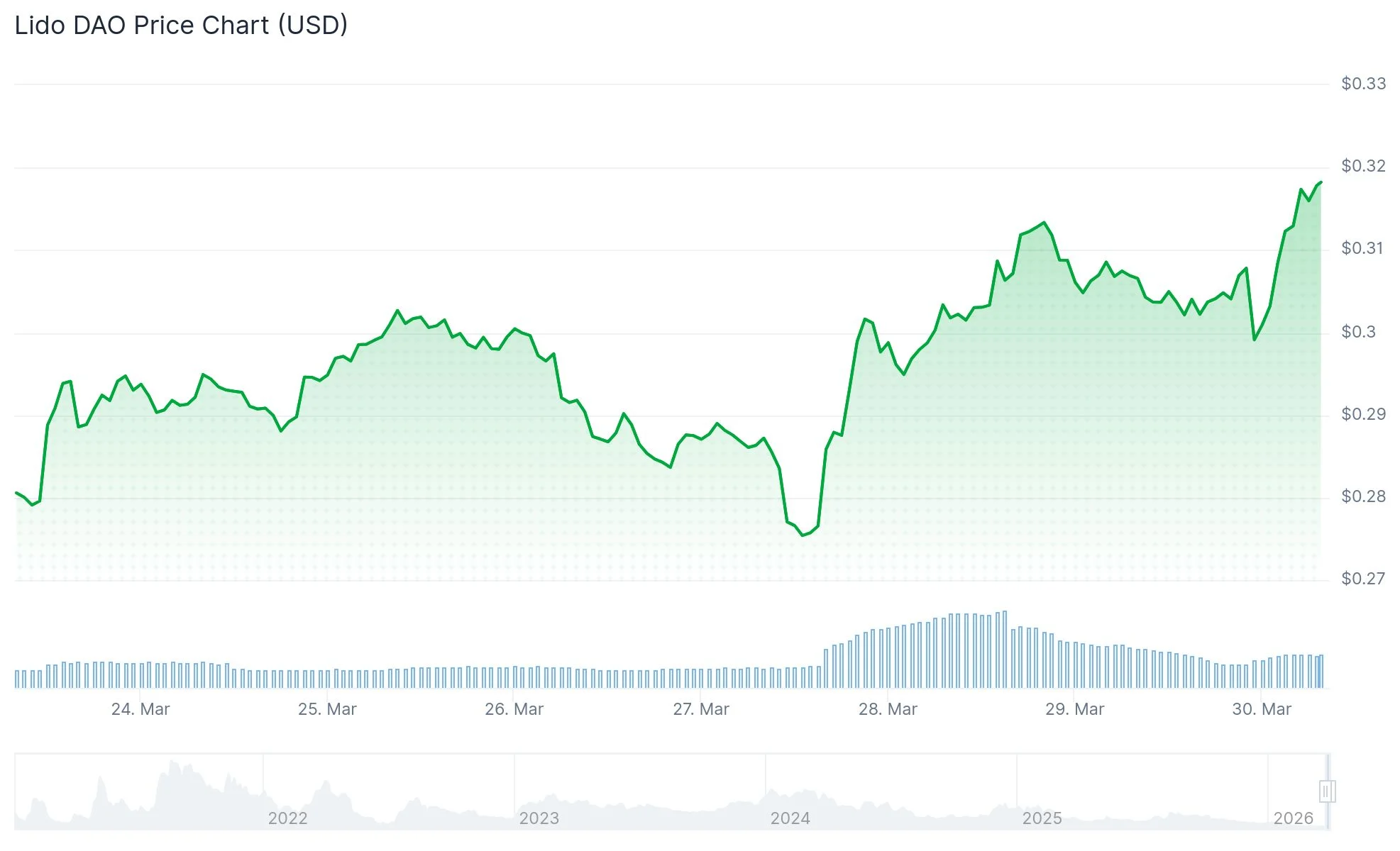
Based on CoinGecko data, LDO trades at $0.30 as of this writing. This represents a staggering 95.9% decrease from its all-time peak of $7.30, which occurred in August 2021.

With a current market capitalization hovering around $255 million, the token ranks as the 141st largest cryptocurrency by total market value.
“That dislocation is not justified by a proportional deterioration in protocol performance,” Lido DAO stated in the proposal documentation.
Implementation Strategy for Token Repurchase
The buyback program would unfold gradually rather than through a single transaction. The DAO intends to execute purchases in incremental tranches of 1,000 stETH each, accumulating to the full 10,000 stETH allocation.
Each individual tranche requires independent tokenholder approval before execution can proceed. Additionally, the DAO indicated it would employ limit order strategies or dollar-cost averaging techniques to minimize adverse effects from market fluctuations.
Following completion of each purchase batch, detailed results must be published before authorization for subsequent tranches can be sought.
A comparable automated repurchase framework was initially proposed in November 2024 but failed to advance to implementation.
Financial Performance Declines While Market Position Remains Intact
Lido’s total revenue for 2025 reached $40.5 million, marking a 23% year-over-year contraction. Staking fee revenue, representing the protocol’s primary income source, similarly declined 23% to $37.4 million.
While acknowledging the revenue decrease, the DAO emphasizes alternative metrics it believes demonstrate fundamental resilience. Operating costs improved by 13% compared to the previous year, and Lido’s take rate—the percentage of staking rewards retained by the protocol—increased from 5% to 6.11%.
Despite the governance token’s dramatic price erosion, Lido continues commanding the leading position within Ethereum’s liquid staking ecosystem. Data from Dune Analytics indicates the protocol controls 23.2% of all staked Ether on the network.
This market dominance has previously attracted criticism regarding potential centralization vulnerabilities affecting Ethereum’s security model.
The proposal has now advanced to the tokenholder voting stage, where LDO holders will determine whether to greenlight the initial 1,000 stETH purchase tranche.
