



Key Highlights
- Brent crude surged past $106 per barrel on Thursday with gains exceeding 4%, as West Texas Intermediate reached $93.66
- Nearly 20% of worldwide oil transport remains halted due to the effective closure of the Strait of Hormuz
- Tehran dismissed Washington’s diplomatic efforts while Iranian lawmakers draft legislation to impose transit fees on vessels navigating the strait
- BlackRock’s leadership cautioned that crude prices could surge to $150 per barrel regardless of immediate ceasefire agreements
- American government officials are conducting confidential assessments on economic impacts if oil reaches $200 per barrel
Energy markets experienced significant volatility on Thursday as diplomatic discord between Washington and Tehran maintained pressure on crude prices. Brent crude registered approximately 4% growth, settling at $106.34 per barrel. West Texas Intermediate posted a 3.7% increase, reaching $93.66.
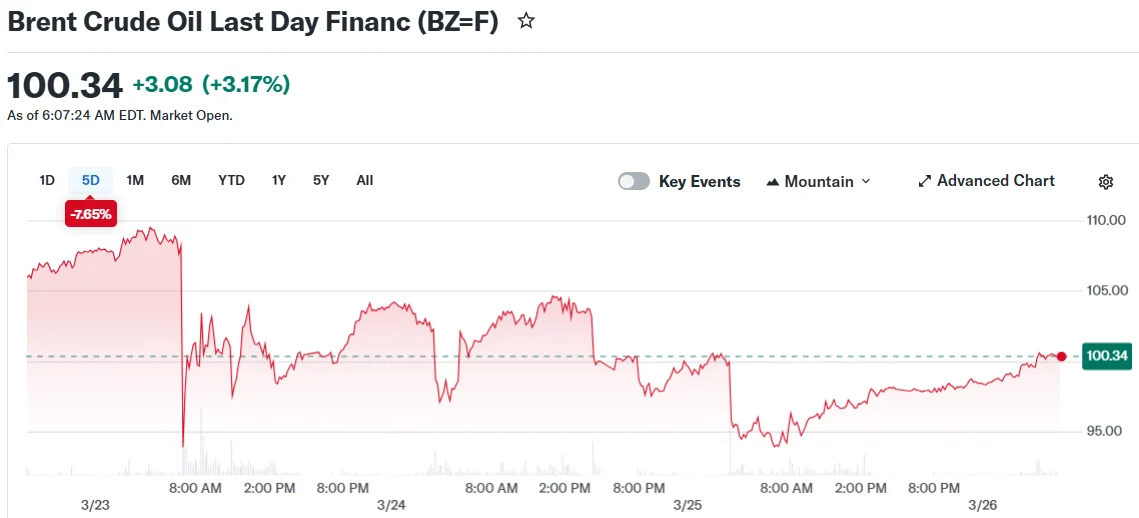
These advances followed a previous session where prices declined over 2% on tentative hopes surrounding diplomatic engagement. Those expectations quickly dissipated.
Tehran officially rejected claims of direct diplomatic channels with Washington. Iranian authorities emphasized substantial disagreements persist while presenting their own stipulations, prominently featuring complete authority over the Strait of Hormuz.
The administration in Washington countered these assertions, maintaining that dialogue continues. During a Wednesday evening fundraising gathering, President Trump stated that Iran “desperately wants an agreement, but they’re reluctant to admit it publicly.”
Legislators in Iran are advancing proposed legislation to levy charges on maritime vessels transiting through the strait under the guise of providing security services. The proposal is anticipated to reach completion within the coming week, as reported by the semi-official Fars news agency.

The Strait of Hormuz represents a critical maritime chokepoint linking the Persian Gulf to international energy markets. Approximately 20% of global petroleum supplies transit through this passage. Following hostilities that erupted in late February, tanker movement through the strait has essentially ceased.
Vessels requesting passage under Iranian oversight must submit comprehensive crew manifests, detailed cargo inventories, and complete voyage information to the Islamic Revolutionary Guard Corps for authorization.
Energy Prices Face Additional Upward Pressure
BlackRock president Rob Kapito suggested market participants might be insufficiently accounting for ongoing risks. During Thursday remarks at a Melbourne gathering, Kapito projected crude could still climb to $150 per barrel even with an immediate cessation of hostilities, citing the extended timeline needed for supply chain normalization.
Government representatives in the United States are also conducting behind-the-scenes evaluations of situations where petroleum reaches $200 per barrel, according to individuals with knowledge of these discussions.
Brent crude is tracking toward its most substantial monthly appreciation since 1990. Earlier this month, prices briefly approached $120 per barrel before moderating.
A drone attack damaged a Turkish-flagged vessel transporting Russian petroleum near Istanbul in the Black Sea on Wednesday, introducing additional uncertainty for market observers monitoring various geopolitical flashpoints.
Worldwide Economic Strain Intensifies
Researchers at Capital Economics cautioned that extended supply interruptions could inflict economic damage comparable to the aftermath of Russia’s 2022 Ukraine invasion, potentially compelling central banking institutions to resume interest rate increases.
Nations throughout Asia are experiencing mounting challenges. Thailand implemented gasoline price hikes reaching 22% on Thursday. The Philippines temporarily halted its wholesale electricity spot market operations. Agricultural producers in India and China are confronting elevated costs for chemical inputs.
Fuel prices throughout the United States have demonstrated consistent upward movement since hostilities commenced.
The White House confirmed on Thursday that a planned meeting between President Trump and Chinese President Xi Jinping has been rescheduled for May 14–15 in Beijing
