



Quick Summary
- Brent crude declined almost 4% to approximately $100 per barrel following news of a US-orchestrated 15-point ceasefire proposal for Iran
- WTI crude decreased 4% to $88.70, accompanied by an 8% drop in UK natural gas prices
- President Trump confirmed the US is “in negotiations right now” with Iran, though Iranian officials dispute any dialogue is occurring
- Despite diplomatic overtures from Washington, Israel conducted strikes on Tehran
- International equity markets experienced gains, including the FTSE 100, Germany’s DAX, and France’s CAC 40
Brent crude was hovering near $100.41 per barrel with a decline approaching 4%, while WTI crude descended to $88.70 during Wednesday morning trading.
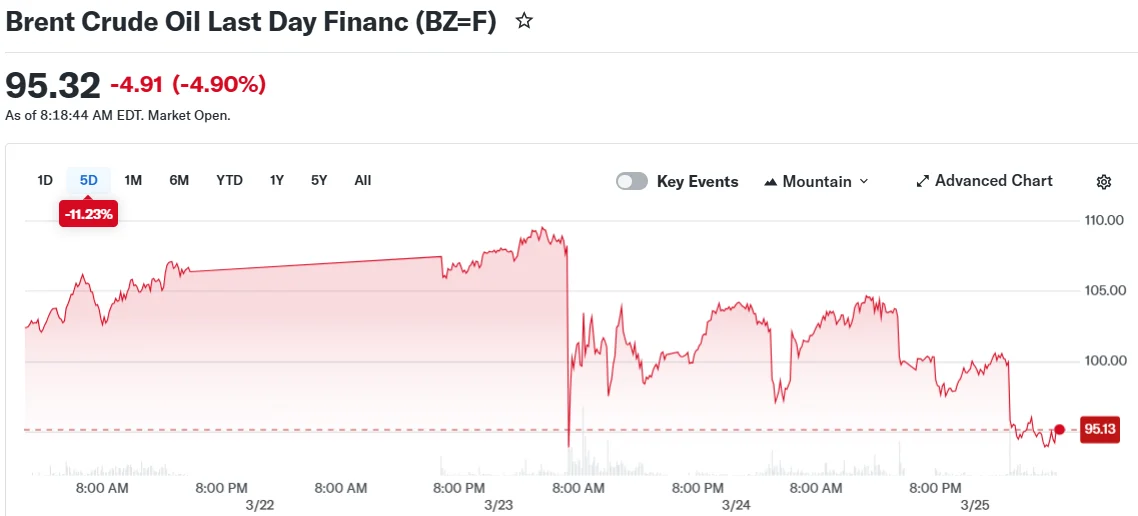
Energy markets experienced a significant pullback on Wednesday following revelations that the Trump administration transmitted a 15-point framework to Iran designed to resolve the ongoing Middle East crisis. The diplomatic initiative was conveyed through Pakistani mediators, who have additionally proposed hosting renewed discussions between Washington and Tehran.
President Trump stated the US is “in negotiations right now” with Iran, indicating that Tehran was “talking sense.” He had previously characterized Monday’s discussions as “productive.”
However, Iranian representatives categorically rejected claims of any ongoing negotiations — asserting that American officials were merely engaging in self-dialogue.

This conflicting narrative established the foundation for a turbulent trading day. Market participants exhibited clear optimism regarding potential de-escalation while remaining cognizant that circumstances could rapidly transform.
Brent crude touched an intraday bottom at $97.30 before experiencing a modest rebound. WTI crude similarly experienced substantial losses, declining 4% to $88.70 per barrel. UK natural gas valuations simultaneously dropped 8%.
Equity Markets Surge Following Energy Price Decline
The downturn in energy valuations provided momentum for stock markets. London’s FTSE 100 advanced more than 1%, climbing 103 points to reach 10,068. Germany’s DAX soared 1.6% while France’s CAC 40 increased 1.5%. Asian trading sessions had already recorded robust gains earlier.
Matt Britzman, senior equity analyst at Hargreaves Lansdown, commented: “Oil prices have shifted lower on the developments, providing some respite to equities that had been pressured by concerns over inflation and the subsequent effect on interest rates.”
Richard Hunter, head of markets at interactive investor, adopted a more measured perspective, highlighting that the FTSE 100 remains approximately 8% beneath its record peak from late February.
Strait of Hormuz Continues as Critical Factor for Market Stabilization
The primary concern has centered on the Strait of Hormuz, the vital maritime corridor that has been essentially blocked by threats of Iranian attacks on commercial vessels. This disruption has propelled prices substantially higher in recent weeks.
Analysts at ING noted: “Despite the initial market relief, uncertainty remains high. Overall, volatility remains elevated and a geopolitical risk premium persists.”
Meanwhile, even during the transmission of diplomatic communications, Israel executed strikes on Tehran on Wednesday — introducing another dimension of inconsistency to an already complex scenario.
The US military is simultaneously preparing to station at least 1,000 additional troops in the region, supplementing the 50,000 already deployed there.
Britzman articulated clearly what will be required to achieve lasting price reductions: “Social media posts and press conferences can only go so far, and it will likely take a full reopening of the Strait of Hormuz to drive any meaningful and sustained move lower from here.”
Prices continue to trade substantially above pre-conflict thresholds, and the Strait of Hormuz has not yet reopened.
