



Key Highlights
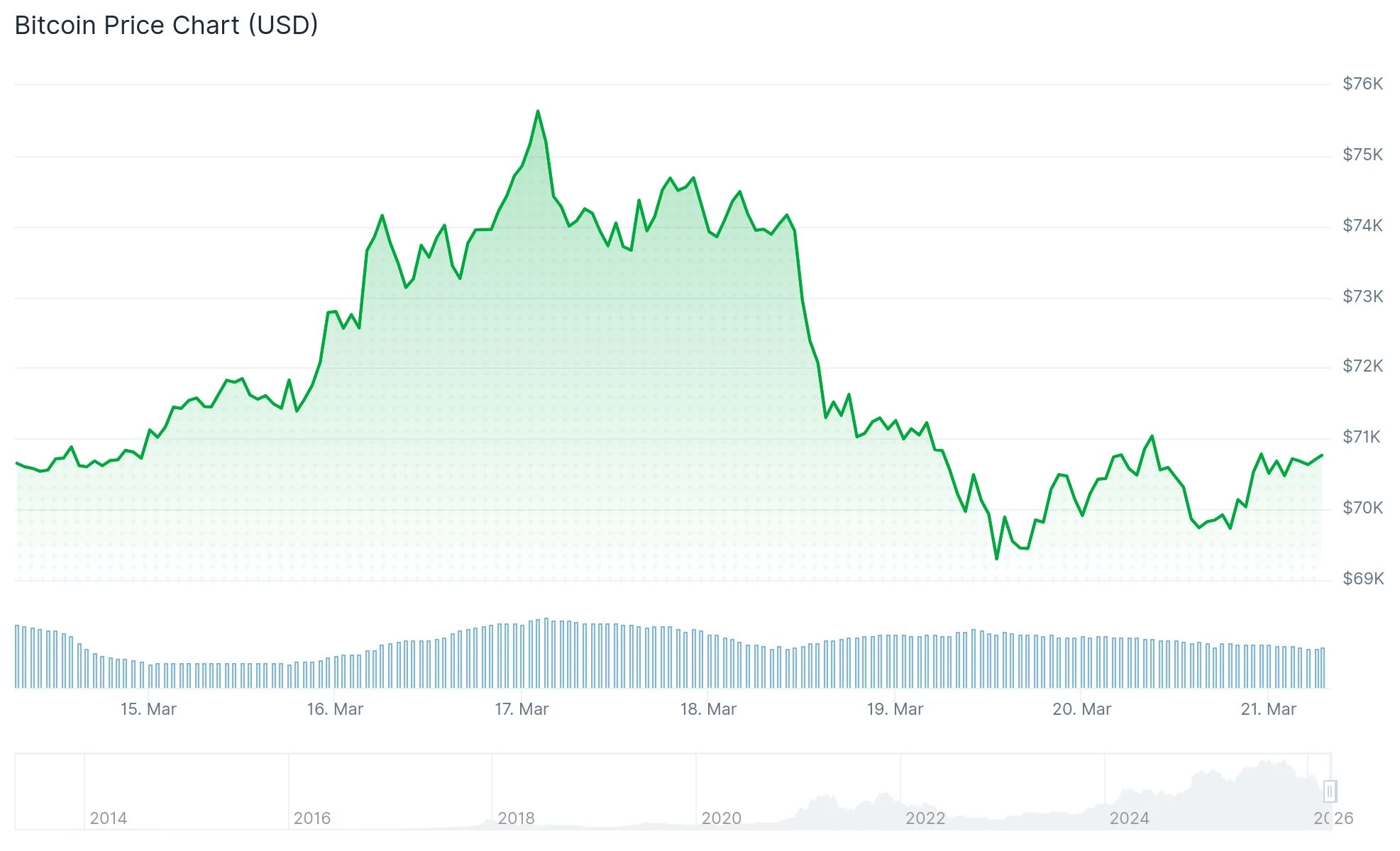
- BTC experienced a nearly 3% weekly decline, sliding from $76,000 to approximately $70,000
- Federal Reserve maintained current rates while projecting just one reduction in 2026, dampening risk asset sentiment
- Citi revised its BTC forecast downward from $143,000 to $112,000 due to legislative roadblocks
- Strategy added 22,337 BTC to its treasury, pushing total reserves to 761,068 BTC
- Morgan Stanley submitted updated S-1 documentation for spot Bitcoin ETF with proposed MSBT ticker
The week began with promising gains for Bitcoin, which surged to $76,000 on Tuesday — marking its strongest performance since the first week of February. However, this upward trajectory proved short-lived.
On Wednesday, the Federal Reserve maintained its benchmark interest rate at the 3.50%–3.75% range, marking consecutive meetings without adjustment. Chairman Jerome Powell expressed concerns that escalating tensions involving Iran could drive inflation upward, diminishing the probability of rate reductions this year. The central bank’s updated projections now anticipate a single cut in 2026 and another in 2027, while elevating its PCE inflation forecast to 2.7%.
This more restrictive monetary outlook triggered selling pressure across speculative assets. Bitcoin dipped beneath $69,000 on Thursday before staging a partial recovery to approximately $70,843 by Friday — representing a weekly decline approaching 3%.
Monetary Policy Pressures Markets
Aurelie Barthere, who serves as Principal Research Analyst at Nansen, observed that the Fed upgraded its projections for both inflation and economic expansion. She characterized the press conference as having a pronounced emphasis on inflationary concerns, with an overall “rather hawkish” sentiment.

Escalating oil prices, spurred by Israel’s strikes on Iran’s South Pars gas infrastructure, compounded market pressures. Gracy Chen, who leads Bitget as CEO, commented: “Increasing energy expenses, postponed monetary easing expectations, and a strengthening dollar are fostering a more discriminating investment landscape.”
The $70,000 threshold has emerged as a critical technical level. Nexo Dispatch analyst Iliya Kalchev suggested that maintaining this level “invites a stabilization trade,” whereas breaking below it “reopens the path toward the next support cluster.”
Wall Street Reduces Projections, Congressional Action Stalls
Citi’s Alex Saunders lowered his Bitcoin price projection to $112,000, down from a previous $143,000 target. This revision reflects the Clarity Act — proposed crypto market structure regulation — encountering obstacles in Congress. Polymarket odds for passage this year have declined to 60%, compared to approximately 90% in February.
President Trump wrote on Truth Social: “The U.S. needs to get market structure done, ASAP. Americans should earn more money on their money.”
Despite the challenging market conditions, Strategy’s Michael Saylor revealed on Monday that the company acquired an additional 22,337 BTC. The firm’s cumulative position now reaches 761,068 BTC, purchased at an average cost of $75,696.

Bitcoin spot ETF activity displayed inconsistent patterns throughout the week. Monday and Tuesday recorded net inflows totaling $201 million and $199 million respectively, before reversing to outflows of $163 million and $90 million on Wednesday and Thursday.
Separately, technical analysis highlighted by crypto analyst CryptoBullet identified a rising wedge formation in BTC price action, suggesting a possible decline toward $50,000 should the pattern confirm with a downside break.
Morgan Stanley submitted a second amended S-1 registration statement to the SEC for a spot Bitcoin ETF, planned for listing on NYSE Arca with the MSBT ticker symbol. Approval would establish it as the inaugural spot BTC ETF launched directly by a leading US banking institution.
