


Key Highlights
- Federal Reserve maintained interest rates at 3.50%–3.75% during its March 18, 2026 meeting with an 11-1 voting outcome
- Bitcoin experienced a decline of approximately 4%, settling near $71,600 after the announcement
- Major equity indices including Nasdaq and S&P 500 declined 0.55% during trading
- Central bank revised its 2026 inflation projection upward from 2.4% to 2.7% due to Middle East geopolitical risks
- CME Group data indicates zero probability of rate reduction at upcoming April policy meeting
The United States Federal Reserve opted to maintain its benchmark interest rate at the current range of 3.50%–3.75% during Wednesday’s policy meeting on March 18, 2026. Market participants had broadly anticipated this outcome.
The decision passed with an 11-1 vote count. Stephen Miran stood alone in dissenting, advocating for a 25-basis-point reduction instead.
The central bank pointed to geopolitical instability stemming from the U.S.-Iran military engagement as a significant consideration influencing its monetary policy stance. Crude oil valuations have surged toward $100 per barrel, representing a substantial increase from the sub-$60 levels observed at the beginning of the year.
“The implications of events in the Middle East for the US economy are uncertain in the near term,” Fed Chair Jerome Powell said. “Higher energy prices will push up overall inflation, but it is too soon to know the scope and duration of the potential effects.”
Powell indicated that economic growth has maintained a robust trajectory. Household consumption patterns demonstrate continued strength and corporate capital expenditure shows positive momentum. However, residential real estate activity remains subdued and employment trends indicate cooling.

The Federal Reserve adjusted its inflation outlook for 2026 upward to 2.7%, revising from the previous 2.4% projection. The central bank anticipates inflation moderating to 2.2% by 2027.
Financial Markets Respond to Policy Decision and Geopolitical Developments
Bitcoin experienced significant downward pressure in advance of the Federal Reserve’s announcement. Following the decision, the leading cryptocurrency traded around $71,600—representing nearly a 4% intraday decline. This sell-off coincided with elevated crude oil prices and disappointing inflation figures released earlier in the trading session.
Both the Nasdaq Composite and S&P 500 indices retreated 0.55%. The benchmark 10-year Treasury yield climbed modestly to 4.21%.
Reduced borrowing costs generally provide tailwinds for speculative assets such as Bitcoin and equities by making fixed-income securities less attractive. Conversely, elevated interest rates tend to channel capital toward more conservative investment vehicles.
The Federal Reserve’s Summary of Economic Projections, commonly referred to as the “dot plot,” continues to signal expectations for a single 25-basis-point reduction during 2026, followed by an additional cut in 2027. This projection remains unaltered from previous guidance.
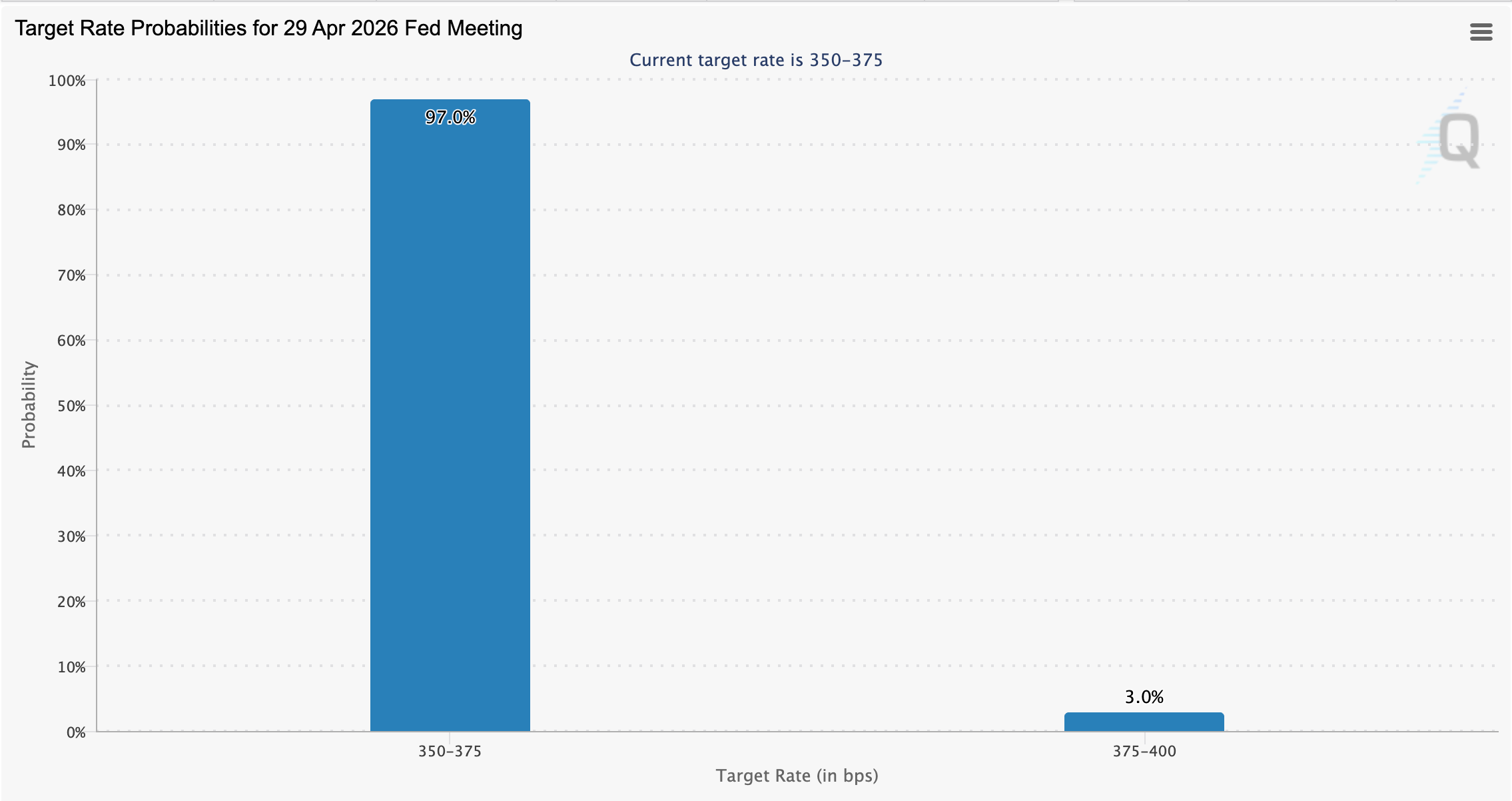
Based on CME Group futures pricing, 97% of market participants anticipate no policy adjustment at the April 2026 Federal Open Market Committee gathering. A marginal 3% expect a 25-basis-point increase, which would elevate the target range to 3.75%–4.00%.
Market Observer Perspectives
BitMEX co-founder Arthur Hayes indicated he is positioned on the sidelines, awaiting Federal Reserve rate reductions before accumulating additional Bitcoin. He further speculated that the Iran military situation could potentially compel the Fed toward accommodative policy to facilitate defense expenditure financing.
Macroeconomic analyst Lyn Alden characterized the Fed’s current approach as a “gradual print” phase, wherein monetary expansion occurs at a measured pace, incrementally supporting asset valuations over extended timeframes.
The Federal Reserve faces mounting challenges in balancing its dual mandate of price stability and full employment. Inflation metrics continue exceeding the 2% objective while labor market indicators signal deceleration.
Powell emphasized the uncertain magnitude and timeline of economic repercussions stemming from the Middle East military conflict. The central bank will maintain its data-dependent approach, carefully evaluating economic conditions before implementing subsequent policy adjustments.
