


Key Takeaways
- Bitcoin plunged beneath the $70,000 threshold following the Federal Reserve’s decision to maintain current interest rates and project just a single rate reduction in 2026.
- Federal Reserve officials increased their inflation projection for 2026 to 2.7%, attributing the adjustment to escalating oil prices amid Middle Eastern tensions.
- Oil markets saw crude prices rocket beyond $110 per barrel following Iranian strikes on regional energy infrastructure.
- Veteran Bitcoin holders liquidated more than 1,650 BTC valued at approximately $117 million during the downturn.
- Broad-based selloff hit cryptocurrencies, equities, and precious metals, with the Nasdaq declining 1.5% and Ether shedding over 6%.
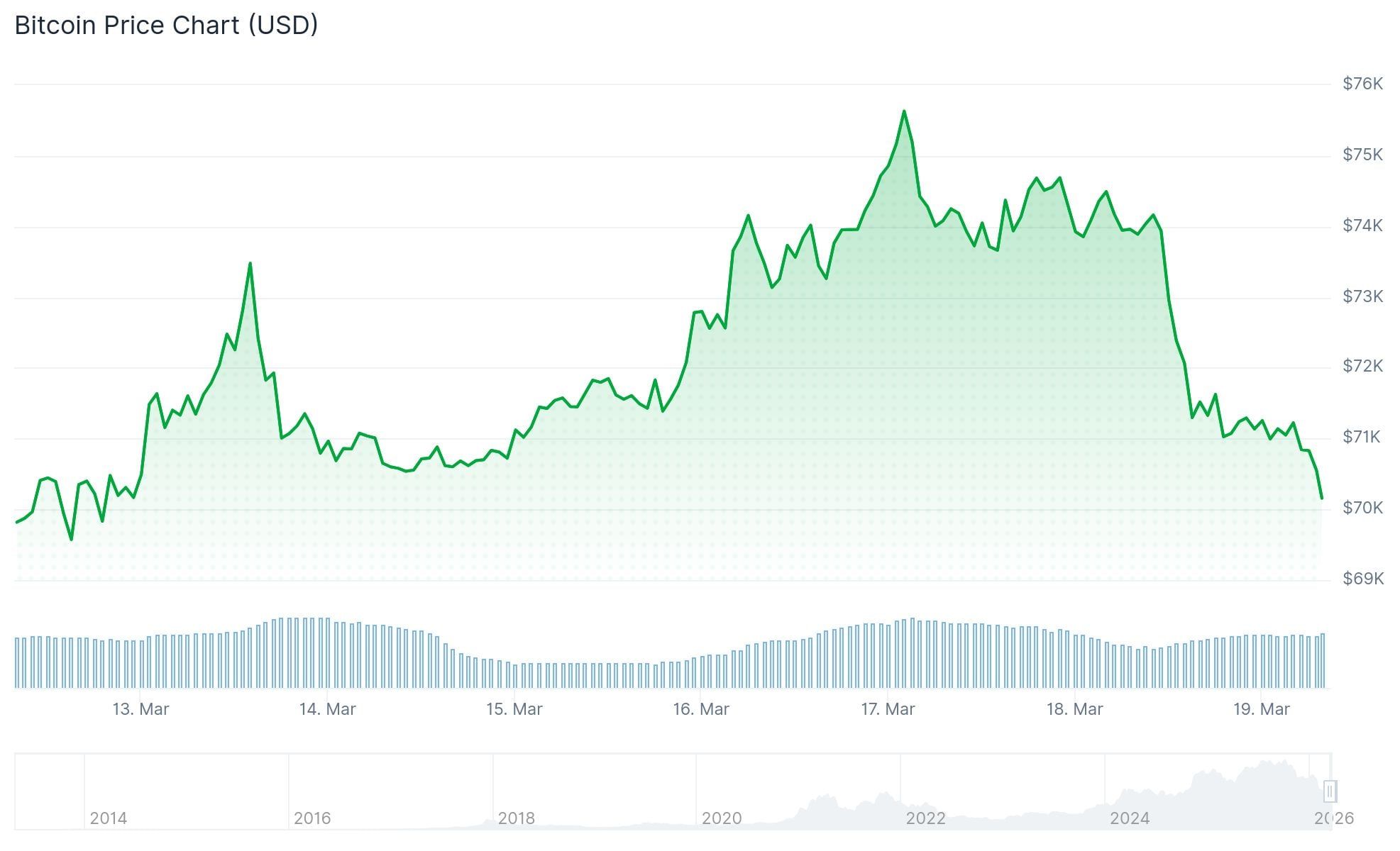
Bitcoin (BTC) experienced a significant downturn this week, breaking below the $70,000 level after the Federal Reserve maintained its current interest rate policy while indicating a more conservative approach to future rate reductions than market participants anticipated.
The Federal Reserve maintained its policy rate within the 3.5%–3.75% corridor. However, the primary catalyst for market anxiety emerged from Federal Reserve Chairman Jerome Powell’s remarks during the post-meeting briefing.
Powell highlighted escalating crude oil prices as an emerging inflationary threat. “The oil shock for sure shows up,” he acknowledged, addressing its impact on the institution’s economic projections.
The Federal Reserve elevated its 2026 inflation projection to 2.7%, a notable increase from the previous 2.4% estimate. This upward revision alarmed market participants who had anticipated continued disinflationary trends.

The central bank’s policy rate projection matrix, commonly referred to as the “dot plot,” now indicates a consensus expectation of merely one rate reduction throughout 2026. Just thirty days earlier, financial markets had anticipated two to three cuts.
Market expectations shifted dramatically on platforms including Polymarket and CME Fed funds futures contracts. The likelihood of only a single rate cut this year surged to approximately 80%, compared to just 38% probability one month earlier.
Crude Oil Surge Compounds Market Pressure
Oil prices had begun climbing before the Federal Reserve convened. Crude oil breached the $110 per barrel mark following Iranian military operations targeting energy infrastructure throughout the Middle East, in response to strikes on its South Pars natural gas facility.
Elevated oil prices drove Treasury yields higher and bolstered the U.S. dollar index, creating headwinds for risk-sensitive assets including Bitcoin.
The Bank of Japan similarly maintained its policy stance on Thursday while identifying the Middle Eastern conflict as a potential inflation risk factor for the Japanese economy.
Bitcoin had traded above $74,000 during the early part of the week, momentarily approaching $76,000. By Thursday morning, the cryptocurrency had declined to approximately $70,817, representing a 24-hour decrease of roughly 4.2%.
Ether declined more than 6%, while alternative cryptocurrencies including XRP, Solana, and Dogecoin registered losses ranging from 3% to 5%. The CoinDesk 20 Index retreated 3%.
Long-Term Bitcoin Holders Liquidate $117 Million Worth of BTC
On-chain analytics monitored by Lookonchain revealed that a minimum of two established Bitcoin holders executed significant sales during the market decline.
One veteran holder who had previously liquidated an 11,000 BTC position sold an additional 650 BTC. Another long-term holder maintaining a 5,000 BTC portfolio completely liquidated a recent 1,000 BTC holding.
Collectively, these two entities disposed of more than 1,650 BTC valued at over $117 million.
Cryptocurrency-related equities experienced steep declines as well. Strategy (MSTR) and Bitmine (BMNR) retreated 5%–6%. Galaxy (GLXY) declined nearly 7%, while Gemini (GEMI) plummeted 15%, reaching its lowest valuation since its initial public offering.
Gold continued its downward trajectory, falling 3.1% to trade below $4,850 per ounce — marking its weakest price level in more than a month.
Powell rejected parallels to 1970s-style stagflation, emphasizing that unemployment remains at historically normal levels while inflation sits only marginally above the Federal Reserve’s target. Financial markets are now incorporating expectations for a more restrictive monetary policy environment throughout the remainder of 2026.
