


Key Highlights
- Chairman Chey Tae-won of SK Group projects the worldwide memory chip shortage will persist through approximately 2030.
- Artificial intelligence applications requiring high-bandwidth memory (HBM) are consuming massive quantities of wafers, creating supply constraints.
- Current wafer production capacity falls short of demand by over 20% throughout the semiconductor industry.
- SK Hynix commands a dominant 57% market share in HBM and controls 32% of worldwide DRAM production.
- The company is exploring the possibility of launching an American Depository Receipt listing in the United States.
During a press briefing on Monday, SK Hynix Chairman Chey Tae-won captured industry attention by projecting the worldwide memory chip shortage would extend another four to five years. His remarks came during Nvidia’s GTC conference held in San Jose, California.
According to Chey, artificial intelligence is the primary culprit. “AI actually wants to have a lot of HBM, and once you make the HBM… we have to use a lot of wafers,” he explained to journalists, as reported by Reuters.
The underlying issue is straightforward: wafer manufacturing cannot match consumption rates. Chey highlighted that the industry-wide disparity between wafer supply and demand exceeds 20%. This substantial gap cannot be resolved quickly.
Expanding wafer production capacity requires significant investment and time — Chey estimated a minimum of four to five years — establishing a baseline for when the shortage might alleviate. This projection suggests 2030 as the earliest point when supply and demand could reach equilibrium.
Price Surge Already Underway
The shortage is already impacting current markets. According to Counterpoint Research, server memory chip prices skyrocketed between 60% and 76% during Q4 2025. Industry analysts anticipate continued price increases throughout Q1 2026.

SK Hynix has emerged as a major winner from these price increases. The firm dominates the HBM market with a commanding 57% share and holds second place in worldwide DRAM with 32% market control, based on Counterpoint figures.
Additionally, the company serves as the leading HBM provider to Nvidia, whose processors power the AI infrastructure expansion fueling current demand levels.
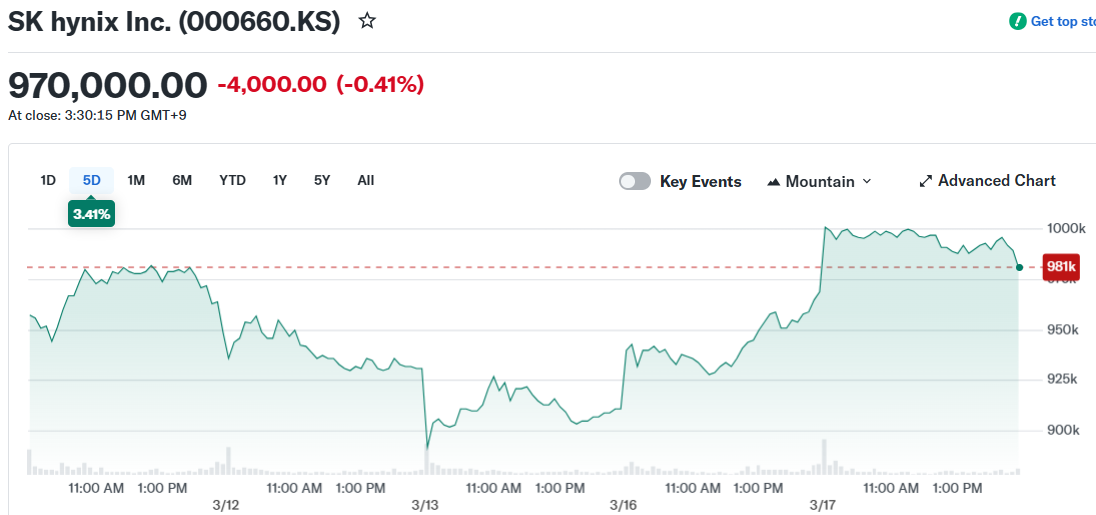
Shares of SK Hynix advanced more than 2% on Tuesday in response to the chairman’s statements.
Chey indicated the company would develop strategies aimed at stabilizing DRAM pricing, though concrete details remain undisclosed.
Exploring US Market Access
In related news, Chey verified that SK Hynix is evaluating an American Depository Receipt offering. This ADR structure would enable US-based investors to purchase SK Hynix shares directly through American stock exchanges rather than accessing Korean markets.
The company has not disclosed any specific timeline or finalized plans regarding this initiative.
Samsung Electronics alongside American-based Micron complete the top three global memory producers. Micron holds the third position internationally in memory and storage chip manufacturing, following Samsung and SK Hynix.
Chey’s projections arrive as the artificial intelligence sector continues generating unprecedented demand patterns throughout semiconductor supply networks. SK Hynix shares have appreciated substantially over the previous three years as AI-related purchases have expanded.
Counterpoint research indicates server memory demand has consistently risen parallel to AI infrastructure investments, with no indicators of deceleration.
The latest available market data confirms server memory pricing remains firmly positive entering 2026, with additional increases anticipated as supply limitations continue.
