



TLDR
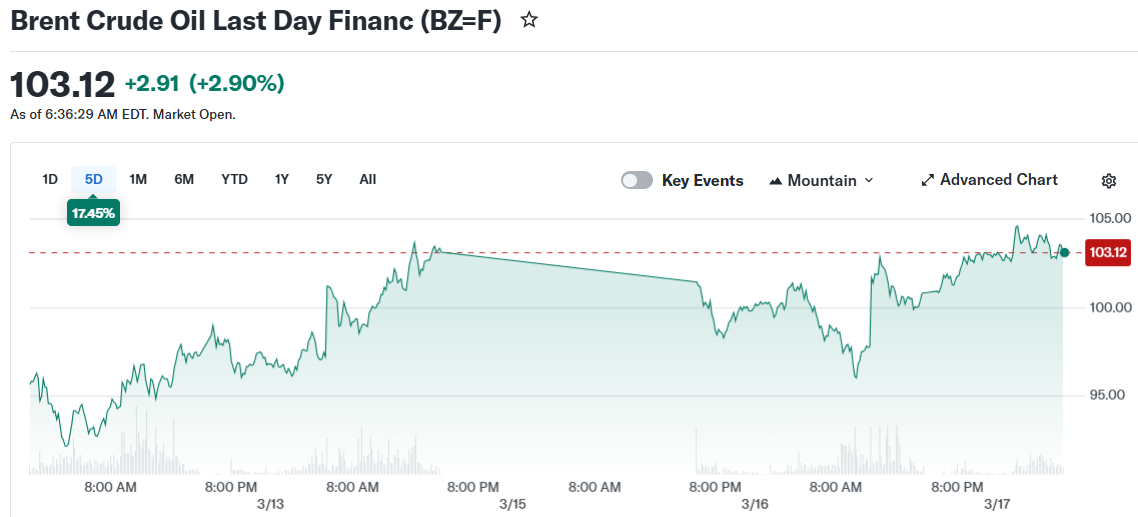
- Brent crude surged past $104 per barrel while WTI approached $97 amid continued Iranian strikes on regional energy facilities
- UAE’s Shah gas field operations were disrupted and crude shipments from Fujairah port came to a halt
- The Hormuz Strait blockade persists, impacting approximately 20% of worldwide petroleum supply
- Crude prices have jumped over 40% in the three weeks since hostilities commenced
- Key central banks worldwide, including the Federal Reserve, ECB, and Bank of Japan, convene this week amid rising energy-linked inflation pressures
Crude oil markets witnessed another significant rally on Tuesday following a momentary retreat, as the military confrontation involving the United States, Israel, and Iran moved into its third week with escalation continuing.
Brent crude surpassed the $104 per barrel threshold while West Texas Intermediate climbed near $97. The recovery came after both benchmarks experienced declines of approximately 3-5% during Monday’s trading session.
Iranian forces maintained their assault on energy installations throughout the Middle East. Operations at the UAE’s Shah gas field were forced into suspension. An oil production facility in Iraq also sustained damage from drone and missile attacks.
Shipments of crude from the Fujairah port in the United Arab Emirates were suspended once more, based on communications from Inchcape Shipping Services. Both the UAE and Kuwait have implemented additional production cuts in reaction to the persistent attacks.

Oil values have climbed more than 40% since the conflict’s outbreak, despite Monday’s temporary decline following Washington’s announcement to deploy the initial portion of strategic petroleum reserves.
Hormuz Strait Remains Epicenter of Supply Disruption
The Strait of Hormuz, a critical chokepoint responsible for transporting roughly 20% of global oil supplies, continues to face severe restrictions. Iranian authorities effectively closed the strategic waterway earlier this month.
Modest advancement occurred Monday when tankers operating under Indian and Pakistani flags successfully traversed the passage. Tehran has indicated it will grant passage to vessels from select nations while blocking ships associated with Washington and allied countries.
Analysts at JPMorgan noted that passage through the waterway is expected to become “increasingly conditional,” with Iranian authorities granting access based on vessel nationality and ownership.
Several vessels have managed transit by utilizing a navigation route that passes remarkably near to Iranian territorial waters, based on Bloomberg maritime tracking information.
Saudi Arabia is expediting efforts to increase export capacity through an alternate pipeline network that completely avoids the Hormuz passage.
US President Donald Trump reached out to no fewer than seven nations, including China, requesting assistance in reopening the strategic waterway. These diplomatic overtures received minimal positive response. Trump issued warnings about potentially expanding military operations at Kharg Island to include Iranian petroleum infrastructure, having previously avoided targeting energy assets at that location.
Treasury Secretary Scott Bessent informed CNBC that Washington is permitting Iranian crude shipments to continue flowing through the channel and has refrained from intervening in energy futures trading.
Rising Energy Costs Spark Global Inflation Concerns
The dramatic increase in petroleum prices has intensified worries regarding energy-related inflationary pressures. Multiple prominent central banking institutions, including the Federal Reserve, the European Central Bank, and the Bank of Japan, have scheduled policy meetings during the current week.
Numerous Asian nations maintain substantial dependence on petroleum imports transiting through Hormuz, rendering the extended closure particularly problematic for regional economies.
Israeli authorities announced Tuesday the elimination of high-ranking Iranian government officials, including security chief Ali Larijani. Iranian sources had not verified these assertions as of Tuesday evening.
The volume of Iranian vessels navigating the waterway reached a wartime peak on Monday, including a crude carrier bound for Chinese ports, according to Bloomberg shipping data.
