



Key Highlights
- Wall Street futures (Dow Jones, S&P 500, Nasdaq) posted gains Friday following Thursday’s sharp decline, benefiting from a modest retreat in crude oil prices.
- Brent crude temporarily exceeded $100 per barrel for the first time since August 2022, subsequently falling back to approximately $99.
- The Iranian conflict, entering its second week, has triggered what analysts describe as the most significant oil supply disruption ever recorded, with the Strait of Hormuz remaining blocked.
- Bitcoin climbed above $70,000, potentially influenced by a social media message from Trump, according to market observers.
- Market participants now assign a 47% probability that the Federal Reserve will skip rate reductions entirely in 2026, a dramatic increase from the 3% likelihood estimated one month earlier, driven by mounting inflation concerns.
Equity futures in the United States advanced Friday morning, recovering from a challenging Thursday session that pushed the three primary indices to their 2026 lows. Dow Jones Industrial Average, S&P 500, and Nasdaq 100 futures each registered increases of approximately 0.3% to 0.4% during premarket hours.
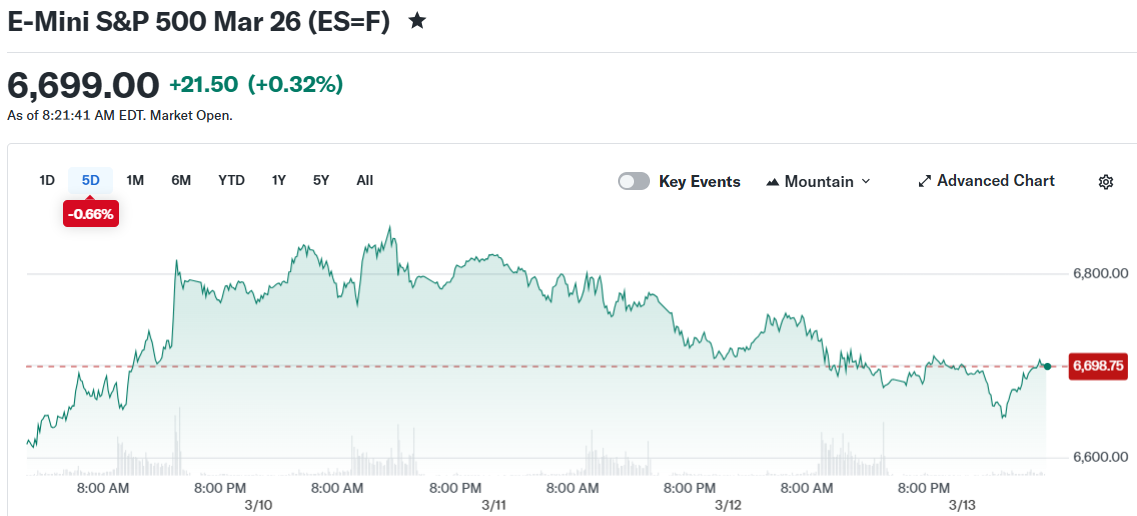
The upward movement came after a temporary rally sparked by an Axios report. The report indicated that President Donald Trump informed international leaders during a Wednesday virtual conference that Iran is “about to surrender.” These statements have not received official White House confirmation.
Contrary to this reported optimism, Iran’s newly appointed supreme leader, Mojtaba Khamenei, declared Thursday his commitment to continuing military operations. He additionally confirmed Iran’s intention to maintain the Strait of Hormuz closure. This waterway represents one of the planet’s most vital oil transportation corridors.
The Iranian-Israeli conflict marked its second week Friday. Israel conducted additional strikes on Tehran, while Iran has been implicated in missile attacks targeting Dubai and Turkey. US military officials also verified that four service members perished in a refueling aircraft accident.

Energy Markets See Modest Decline But Remain High
Oil prices experienced a slight decrease Friday following an exceptionally turbulent trading week. West Texas Intermediate crude declined roughly 2% to trade below $94 per barrel. Brent crude, serving as the global benchmark, retreated beneath $100 after closing above that threshold Thursday for the first time since August 2022.
Market analysts have characterized the current oil supply interruption as unprecedented in scale. Responding to the crisis, the United States granted a second waiver permitting acquisitions of sanctioned Russian crude to alleviate supply constraints.
India has entered intensive negotiations with Iran to secure passage for a minimum of 23 oil tankers through the Strait of Hormuz, The Wall Street Journal reported, citing Indian government sources. Initial crossings might occur as early as this weekend.
Federal Reserve Rate Cut Expectations Plummet
Inflation worries stemming from elevated oil prices are dramatically altering Federal Reserve policy projections. Market participants now estimate a 47% probability that the Fed will forgo interest rate cuts completely in 2026, based on CME FedWatch data. This represents a substantial jump from the mere 3% probability calculated one month prior.
The 10-year Treasury yield stood at 4.28% Friday morning. The US dollar index advanced 0.3%, reaching a 3.5-month peak.
Market participants eagerly awaited the Personal Consumption Expenditures price index, the Federal Reserve’s favored inflation metric, scheduled for Friday morning release. Fourth quarter GDP figures and the January JOLTS employment openings report were also on the economic calendar.
Bitcoin rocketed beyond $70,000 in early Friday trading. Several analysts pointed to a social media message from former President Trump as a potential catalyst for the cryptocurrency’s momentum. Gold headed toward a weekly decline, pressured by dollar strength.
Thursday witnessed Brent crude’s most significant single-session increase since May 2020, highlighting the extraordinary market volatility experienced this week.
