



TLDR
- Major US equity indexes retreated Tuesday, with both the Dow and S&P 500 sliding approximately 0.5% amid uncertainty over Iran military operations.
- President Trump suggested hostilities might conclude “very soon,” while Secretary of Defense Hegseth pledged continued operations until Iran’s defeat.
- A tanker incident occurred off Abu Dhabi’s coast, and a significant UAE refining facility suspended operations following drone attacks.
- Brent crude retreated to approximately $91 per barrel after approaching $120 on Monday, yet remains more than 50% above year-start levels.
- Critical inflation data arrives this week — Wednesday’s CPI and Friday’s PCE — though recent oil surges won’t appear in these figures.
US equity markets declined Tuesday as investors grappled with contradictory messaging from Washington officials and military developments in Iran. The inconsistent signals complicated market assessments regarding conflict duration and potential economic ramifications.
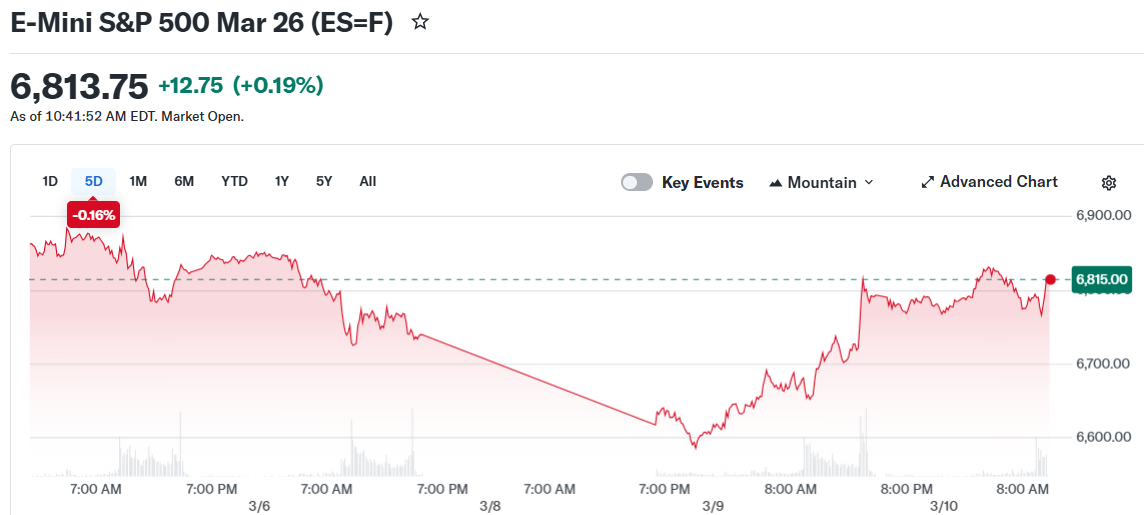
The Dow Jones Industrial Average and S&P 500 both declined approximately 0.5% during trading. The Nasdaq Composite posted losses near 0.3%. These declines followed Monday’s volatile session that ultimately closed with marginal advances.
Market sentiment deteriorated after Iranian state outlets reported a tanker incident near Abu Dhabi. The development undermined earlier optimistic commentary from President Trump, who had indicated hostilities might conclude “very soon.”
Speaking to Republican congressional members, Trump stated US forces had struck 5,000 Iranian targets, reducing the nation’s missile infrastructure to roughly one-tenth of previous capacity. He characterized military goals as “pretty well complete.”

However, Defense Secretary Pete Hegseth adopted markedly different language during Tuesday’s press briefing. He characterized ongoing operations as the “most intense” strike campaign against Iran and pledged forces would “not relent” until achieving the Islamic Republic’s defeat.
Oil Prices and Global Supply Under Pressure
Israeli Prime Minister Benjamin Netanyahu declared operations were “not done yet” and initiated additional strikes on Tehran Tuesday. Iran retaliated with drone and missile operations throughout the Middle East, impacting the UAE, Bahrain, and Kuwait.
The UAE’s largest refining complex at Ruwais suspended operations after drone strikes ignited fires in proximity to the facility. Abu Dhabi National Oil Co. continued damage assessments at the location.
Brent crude had surged toward $120 per barrel early Monday before moderating to approximately $91 following Trump’s remarks. West Texas Intermediate traded around $89. Both benchmarks remain elevated more than 50% compared to January levels.
Saudi Arabia, Iraq, the UAE, and Kuwait have collectively reduced output by as much as 6.7 million barrels daily — representing roughly 6% of worldwide supply. Saudi Aramco’s chief executive characterized the situation as “the biggest crisis the region’s oil and gas industry has faced.”
Trump announced US Navy vessels would provide tanker escorts through the Strait of Hormuz to maintain petroleum flows. He also mentioned potential waivers for certain oil sanctions to help moderate prices, though specifics were not provided.
Iran’s New Leadership and Path Forward
Iran appointed Mojtaba Khamenei as its new supreme leader Sunday. His father, Ali Khamenei, perished when US-Israeli operations commenced February 28. The successor maintains close connections with the Islamic Revolutionary Guard Corps.
Iranian President Pezeshkian indicated Iran would consider de-escalation, contingent on regional nations preventing their territories from being utilized for strikes against Iran. Iran’s foreign minister stated discussions with Washington were not “on our agenda.”
Hostilities have now extended 11 days. Casualties include over 1,300 Iranians, seven US military personnel, two Israeli soldiers, and multiple others across Gulf nations.
Two significant US inflation reports arrive this week — Wednesday’s CPI and Friday’s PCE — though neither dataset will reflect the recent petroleum price escalation.
