



Key Highlights
- PI token climbed as much as 16%, reaching a three-month peak above the $0.23 threshold
- V20.2 protocol implementation was finalized on March 7, requiring all network nodes to update before March 12
- Experimental testing demonstrated Pi Nodes’ capability to facilitate decentralized AI model training through idle computational resources
- Critical resistance remains at the $0.28 mark, where previous rallies lost momentum during Q4 2025
- March 14’s Pi Day celebration may feature major updates on validator compensation and possible Kraken exchange integration
Pi Network’s native cryptocurrency has delivered consecutive double-digit percentage increases, climbing to its strongest valuation in approximately 90 days. This upward movement coincided with two significant technological milestones within the ecosystem.
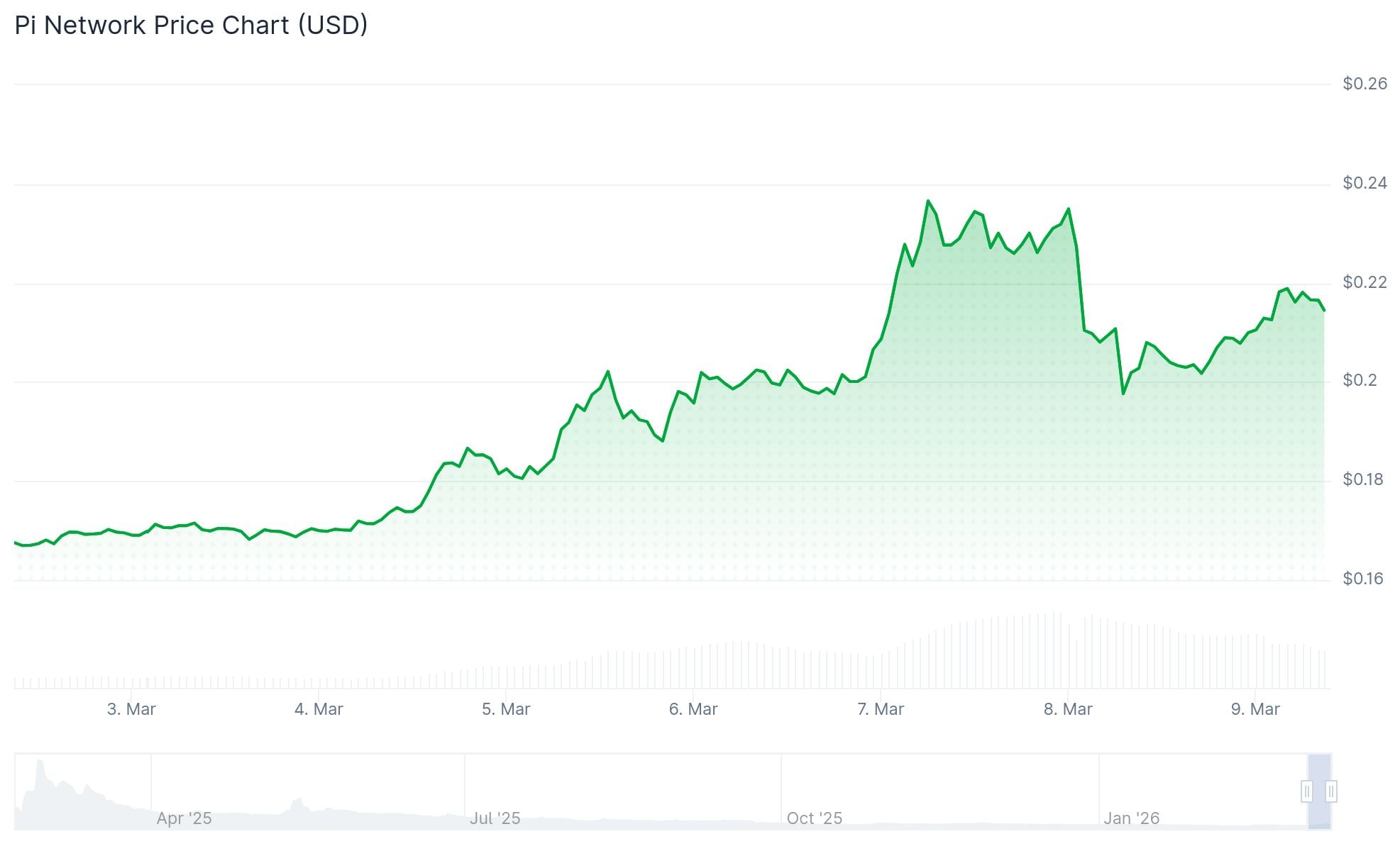
The V20.2 protocol enhancement became operational on March 7, marking a compulsory transition for every mainnet node participant. The hard deadline for completion stands at March 12. Currently, the infrastructure operates across more than 421,000 live nodes. Brief service disruptions emerged during implementation, though the system has since achieved synchronized operations.
This technical advancement represents the third milestone in Pi Network’s journey toward version 23 of the Stellar consensus mechanism, with full deployment expected 48 hours prior to the annual Pi Day celebration on March 14.
Decentralized AI Infrastructure Testing
The development team behind Pi Network released a case study during the current week that examines an innovative application for its distributed node infrastructure. Researchers evaluated whether the Pi Node ecosystem could accommodate decentralized artificial intelligence training and computational operations utilizing excess processing capacity.

The initiative involved collaboration with seven volunteer node administrators and robotics company OpenMind, which receives support from Pi Network Ventures. Testing outcomes confirmed that computational assignments were properly distributed to participating nodes, with accurate results transmitted back to external client systems.
With 421,000 operational nodes representing over one million individual CPUs, the development team highlighted this dormant computational power could serve external organizations requiring substantial computing infrastructure, offering cryptocurrency-based payments to node administrators for completed assignments.
Pi Network additionally maintains tens of millions of identity-verified users through KYC processes, positioning this user base as a potential resource for human-supervised AI model refinement.
Critical Technical Levels Under Observation
From a technical analysis perspective, PI Coin successfully breached a declining resistance trendline positioned at $0.23 that had suppressed upward movements throughout February. The Supertrend technical indicator transitioned to bullish territory for the first instance in multiple weeks, currently positioned at $0.1843.
Every exponential moving average remains positioned beneath the current trading price. The 100-period EMA located at $0.1969 represents the initial resistance barrier, while the 200-period EMA stationed at $0.2876 presents a secondary challenge.
The $0.28 price zone commands the greatest attention from market participants. During the fourth quarter of 2025, PI experienced a rally from approximately $0.19 before encountering resistance at $0.28, initiating a downward correction. A decisive breakout above this threshold would diminish the probability of historical patterns repeating.
Transaction volume demonstrates upward trends, though CryptoQuant’s spot volume metrics maintain a neutral classification, indicating speculative activity hasn’t reached elevated territories.
PI currently holds the 40th position in CoinGecko’s market capitalization rankings, commanding a valuation exceeding $2.2 billion. Nearly 21 million tokens entered circulation on March 7, with additional scheduled unlock events approaching in subsequent days.
