



Key Takeaways
- Gold is experiencing its steepest weekly decline in over six weeks, down more than 3%
- Escalating U.S.-Iran military exchanges are driving crude oil prices significantly higher
- Federal Reserve policymakers maintain rates will remain elevated, pressuring gold prices
- Brent crude is poised for approximately 12% weekly surge amid Strait of Hormuz disruptions
- Market technicians identify support near $4,000 with possible rally toward $4,500 in Q3
The precious metal saw a modest uptick Friday morning, yet remains on course for a challenging week. Spot gold advanced 0.5% to approximately $3,997 per ounce, with futures contracts edging above the $4,000 mark. However, this minor Friday recovery doesn’t offset the metal’s weekly decline exceeding 3%.
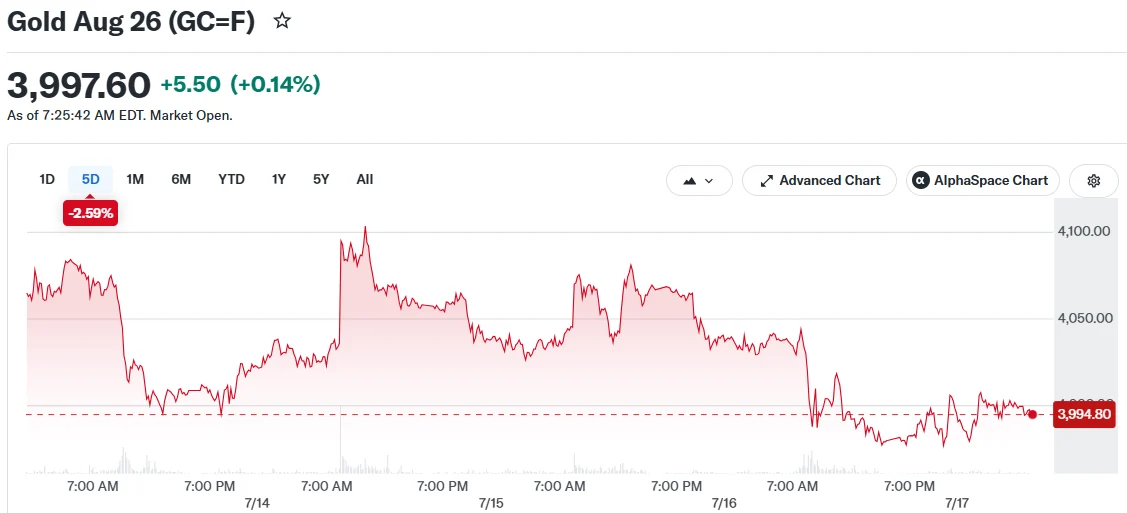
This downturn coincides with rapidly intensifying Middle Eastern hostilities. U.S. armed forces conducted their sixth straight night of operations targeting Iranian military installations. Tehran retaliated with renewed aerial assaults on American positions throughout the region.
Iranian state media outlets claim recent American airstrikes damaged civilian infrastructure, destroying five bridges and damaging a railway terminal.
Crude Prices Spike as Critical Waterway Faces Disruption
The military confrontation has reintroduced uncertainty surrounding the Strait of Hormuz. Maritime traffic through this strategic chokepoint faces renewed disruptions, dashing expectations of normalized shipping operations following a temporary ceasefire.

Brent crude futures are tracking toward a weekly advance exceeding 12% in response. Elevated energy costs amplify inflation anxieties, which subsequently influences investor sentiment regarding monetary policy.
Federal Reserve leadership has unambiguously stated their reluctance to reduce borrowing costs. Chairman Kevin Warsh, Governor Christopher Waller, and New York Fed President John Williams all cited persistent inflation as justification for maintaining current policy rates.
Central Bank Maintains Hawkish Posture, Greenback Gains Strength
Neil Welsh, Head of Metals at Britannia Global Markets, observed that despite June’s softer-than-anticipated inflation figures, hawkish Federal Reserve rhetoric indicates borrowing costs will remain elevated to combat enduring price pressures.
A strengthening U.S. dollar has additionally pressured gold downward. As the greenback appreciates, gold becomes costlier for international buyers, potentially dampening demand.
Gold generates no yield or interest income. During periods of elevated rates, investors typically gravitate toward income-producing assets.
Notwithstanding recent weakness, certain market watchers identify bullish signals. Technical analysis reveals gold maintaining support around the $4,000 threshold, potentially establishing a double bottom formation.
Positive momentum indicators suggest selling intensity may be diminishing. The RSI indicator registered higher lows during June and July despite price declines, signaling weakening bearish momentum.
One market strategist forecasts gold reaching $4,500 by third quarter’s conclusion, representing approximately 11% appreciation from present levels.
The precious metal has retreated roughly 30% from its January peak of $5,626.80. Nevertheless, analysts emphasize the long-term upward trajectory remains undisturbed, characterizing the current pullback as a healthy consolidation within a secular bull market rather than a trend reversal.
Trading volume throughout the selloff stayed comparatively subdued, indicating institutional investors haven’t aggressively driven the downturn.
